Thursday, May 03, 2007

We Have No Bananas: Joke Structure in CANDY STRIPERS (1978)

Exploding Kinetoscope : Work Safe as always!

The adult film shares a key structural element with the musical, the slasher film, and action films. These genres work toward setpieces of their particular raison d'être, respectively sex scenes, songs, murder and action sequences. Adult films as a dominant genre, like musicals and action films, are defined by the form of their content, their format free of iconography, story requirements, tone and stock characters and situations. Additionally, the genre is reception-based, and like the children's film or the women's picture, partially identifiable and bound by requirement and agreement to fulfill certain expectations of its audience; of course the family film makes implicit promise about what boundaries will not be transgressed, while the adult film requires nothing more than the presence of explicit unsimulated sexual activity. From this perspective, there are ways adult film affords a storyteller less latitude than story-identified genres like whodunnits and disaster films. This all seems self-evident, but my purpose is to consider a few of the problems and possibilities dealt to the creative personnel by this generic conundrum. On one hand, the required moments of spectacle in format defined genres make them particularly rigid: if there aren't musical numbers, it's not a musical, and if there isn't graphic sex, isn't an adult film. On the other hand, they are the genres most ripe with possibility for blending with plot-oriented or iconography-based genres. Like solid crystal vases delivered with no flowers, the format genres are not only open forms for any content, but require such bolstering for their completion. Narrative adult films are necessarily blended genre films.

And so we consider the case of Candy Stripers, directed by AVN Hall of Famer Bob Chinn, who made at least eight other features in 1978, including the loony Hot & Saucy Pizza Girls. Like Pizza Girls, Candy Stripers is a zany workplace comedy... and more specifically, a common '70s scenario about service industry businesses whose female staff ends up getting horizontal with the clientelle. This sounds pretty specific, but Candy Stripers is of a family with Hot Rackets (1979) and Taxi Girls (1979). However, while Pizza Girls goes a bit higgledy-piggledy by incorporating parodic noir and slasher elements, Candy Stripers is a model of the antiauthoritarian workplace comedy, albeit skeletal and pornographic.

Ideally, filmmakers may accept the preordained sequences of spectacle as dramatic highlights around which to build a story. That story may be clarifying justification for the threaded-together string of songs/sex scenes/car chases. Those sequences may be treated as if suspended in a rarified space, and a story must be unobtrusively shoehorned around them. The road-marker requirements of the genre may be treated as an obstacle course in which the pleasure is navigating a successful course between bright orange cones ("how can I justify the next song/orgy/explosion?"). This is not to imply a qualitative judgement of these approaches: they're all potentially valid ways to get the job of story-making done. The only Bad Choice is if the writer, director, performers, should ever feel they are slogging through the boring parts to get to the fun stuff, lest the audience feel the same way.

Behind the Janitor Closet Door: The Outrageous Beneath the Mundane

The most difficult trick is to build in these genres without rendering either those Main Attraction scenes as tangential, as interludes to the other, or narrative roadblocks. In short: it is a tougher job to make a porn movie in which the story doesn't stop for the sex. That may be common sense, but while there are no limits to the stories one can tell with a dozen sexual encounters as natural plot points, it is a dire problem for the porn comedy. A choice has to be made between stopping the jokes for several minutes, or sabotaging the audience's expected pleasure by shooting funny sex scenes. Where soft-core satirist Russ Meyer and hardcore Golden Age maestro Alex de Renzy ultimately make anti-erotica by turning their sex scenes into outrageous jokes, in Candy Stripers, Bob Chinn and screenwriter Dean Rogers instead heighten the conventions of the bawdy farce to give purpose and shape to their porn movie... and vice versa.

The central strategy for incorporating hardcore sequences into the narrative of Candy Stripers is that in the abstract the plot is identical to a mainstream sex comedy. It is the last day of work for Sharon (Nancy Hoffman, also in de Renzy'sPretty Peaches that year, and the similar Taxi Girls the next), who, with her party girl pals Pam (Amber Hunt) and Cindy (Chris Cassidy, billed as Montana), is employed as a candy striper at the local hospital. The medical facility is entirely staffed and in service of perfectly healthy young swingers, all of whom have no duties or recuperation to do besides getting hot and heavy in mix-n-match combinations. The only wet blanket is tight-ass 'Striper supervisor Sarge (Sharon Thorpe), who has a full time job just keeping her staff out of the patients' beds. The impending excitement of a farewell party for Sharon, the possibility of romance during an after-shift date between Pam and Dr. George (Joey Silvera, billed as Joey Nassivera), and the constant cat-and-mouse games with Sarge provide the thrust of the narrative; the farce premise itself, and all the major story threads are centered on sexuality to begin with, so they are natural fit.

Candy Stripers' master-joke structure is the reveal that beneath the surface of all daily-grind mundaneness bubbles a constant, irrepressible outrageous spirit. Usually that takes the form of sex but it is repeated in permutations great and small throughout. That is the promise of the premise, which turns a sterile, stultifying hospital environment into a flesh carnival. That is the fantasy of the Candy Stripers, who act like they're in a hospital room to deliver magazines, and help patients pee into specimen jars, but end up wrecking the sheets. The film's opening scene announces this pattern, as Cindy chats blithely on the phone in bed before work, even as the hideous blankets part to reveal George preoccupied with other matters.

The bulk of the sex scenes begin with various patients stuck in the doldrums of hospital life, until the Candy Stripers arrive. But the film also uses its resources for punchy cutaway sight gags which aren't atypical jokes in themselves, but can be be executed in a less coy, more outrageous manner. As in M*A*S*H the rudeness of the humor is an asset in a comedy about rebellion in a stultifying environment. So when Sarge stalks through the halls, hunting Sharon for morning role call, it's a sure bet that behind the janitor supply closet door, Sharon's on her knees in front of Dr. Bishop (Richard Pacheco). Complete with wacky music and Dutch angles, these gags are delivered like a Three's Company scene in which rather than "this is not what it looks like!", it really was what it looked like.

Running Gag Reflex: Character Development and Repeating Patterns

Nurse Allen (Lauren Black) and Nurse Reynolds (Mimi Morgan) don't seem to have any duties besides hanging out at the counter; they banter about patients and gossip about staff, until the chit-chat scene is abruptly punctured by a reveal of the source of Nurse Allen's good mood: Sharon, arguably the dumbest, inarguably the horniest of the Candy Stripers, is concealed beneath the nurse's station desk and between Nurse Allen's legs.


The gag is repeated pretty much verbatim several scenes later, but with the nurses switched. The structure is the same as the closet gag, with Sharon's eager-beavering hidden from Sarge's view behind the hospital's professional veneer; Sarge ponders where the girl could be, but declares "Sharon will do anything with anyone at any time." The audience, staff and patients all see this confirmed - mere inches under Sarge's pointy nose - but as Sarge sneers with disgust, the expression on the nurse's face makes it clear that Sharon's hospitality is a virtue, and Sarge's bedside manner is making her miserable.

Delayed Climax: Tantric Banana Humor

Pity poor Mrs. Rogers, a lonlely lady patient portrayed by effervescent Exploding Kinetoscope favorite Phaedra Grant! For she misses her absent husband, who sends naught but a fruit basket to wish her well. If we think we can see where this is headed, we are correct - except those doubters who may not think Candy Stripers will "go there". Indeed, just as Mrs. Rogers (did the screenwriter name this character after himself? Or his wife? Or mother?), lies in wait for physical gratification, her storyline is Candy Stripers's most prolonged joke of delayed payoffs. The Rogers fruit basket sits on the nurse station counter in an earlier scene, awaiting both delivery, and the opportunity to be the subject of suggestive remarks from the nurse's about how nice the bananas look... and double-entendre-oblivious banana-ogling from Sarge. At last 'Striper Cindy delivers the phallic fruit (and Cassidy nearly knocks the phone off the table in the process), while depressed Mrs. Rogers laments that it will be her only company... But from the second they appear, the bananas are the target of nothing but dirty jokes.


Eventually, after enough scenes that we may have forgotten the lure of produce, Mrs. Rogers is about to finally Peel Slowly And See... only to be disrupted by Sarge, asking if she may sample some of the fruit. Mrs. Rogers concedes, mostly to get Sarge out of her room, as she's frozen under the sheet, banana split. Sarge ignores protests not to take the last banana, and clearly has no designs on the banana but to eat it. The Sarge will not sample the forbidden fruit.


Yet more trials for the Chiquita lady, as Cindy returns to her room... to administer a sponge bath. Already driven to desperation, already the butt of Candy Stripers' delayed joke climax, Mrs. Rogers' terrified face-off with Cindy is a highlight of the film's situational comedy, while mainstream films might, oh, say, play the scene as a joke about being caught having sex with food. The shock-comedy of hardcore banana-love is the starting point for Candy Stripers' comedy, and there is ample time to recover from the image - multiple scenes worth of time - and the tender payoff, as Cindy takes pity on Mrs. Rogers, is something more than a punchline.

And for those unsold on Ms. Grant, check out her how she channels her fear and embarrassment into fake anger and indignation when Cindy wants to pull back the sheet, even though she's the one with the Cavendish cultivar between her legs.

Convergance: Come Together

Several of Candy Stripers' running gags coalesce in the moment at left. Sharon is out of sight, happily going down on Nurse Allen, as opposing-force Sarge stands center and fully visible, kvetching about her girls, even as they exercise their talent in making people happy. The fruit basket watches impassively from the countertop.


Archetype De(con)struction: Broads, Acting

Sharon confronts her nemesis in the final showdown. When Sarge storms into O.R. to break up the late night, illegal goodbye party, in big, color-bursting close up, Sharon asks her ex-boss: "Were you always such a prude?!" While Candy Stripers depicts the 'Stripers cheering up patients in before-during-and-after vignettes, their ultimate challenge has been before them the entire time. Can Sarge be saved?


It is the comic sourpuss' eternal function to either be destroyed, or kicked into reversed. Witness Grumpy in Snow White, Eddie Valient in Who Framed Roger Rabbit, Lydia Deetz in Beetlejuice, the entire town in Pollyanna; confronted with so much Eros, Thanatos can't beat 'em, and thus joins 'em. Weeping "a prude?! Is that what you all think of me?!" Sarge chugs down a glass of booze that looks suspiciously like water, tears off her glasses and lets down her hair. It may be the predictable cardboard-villain arc for any obviously pretty woman forced into ugly character glasses and hairpins, but Candy Stripers toys with this expectation as only a porn movie can: Sharon Thorpe doesn't appear nude or in sex scenes until the climactic all-cast orgy.

Elsewhere and intercut, back at Pam's pad, her hopes for a nice date with George are dashed when he strips immediately on entering the bedroom. She expresses sadness for a moment - "I expected something more romantic", she says, and he responds by dimming the lights. But she beds down with him anyhow. Pam and George's unromantic tryst is the only sex scene in Candy Stripers that involves disappointment; the pathos comes from reversal of all the patterns the comedy has been built on. On Pam and George's date, it is the Candy Striper whose needs require tending to, but there is no one there for her, and so in the search for the spirit of romance, Pam finds the serviceable but mundane.

Paying off the joke personas that define their characters, the Candy Stripers (with assist by the patients) commit the grand finale of the orgy by ravishing Sarge on the operating table; the girls' healing positive energy makes Sarge's transformation complete. Both mirroring George's emotional uselessness in Pam's bed, and confirming that the 'Stripers are the true healers of character in the piece, Dr. Bishop is reduced to a slobbering, giggling moron who sits in a wheelchair gawking at the ladies and drunkenly making out with an oxygen tank cradled in his arms. All he can do is gawk at the women, alternately laughing and crying (I do not exaggerate to make a point here!), one of the final sterile facades of Candy Stripers to crack and reveal the outrageous beneath.

In the final scene, the nurses are back at their station, the outward pretense of normalcy restored to the hospital. Sharon's replacement (played by one-timer Bron White) reports for duty, clueless and apparently straightlaced. The nurses eye the new girl skeptically as she sashays off down the corridor and drops her binder. But Candy Stripers reconfigures its primary joke premise in meaningful ways up to the end, new punchline, new girl. In the last frames, the girl in the freshly pressed uniform flips up her skirt for the simple hell of it, and the credits roll on a screen-filling freeze frame of her butt.

Wednesday, May 02, 2007

Vampira Slinks Slowly!


Here are new gigantic scans of the entire 1954 LIFE magazine photo feature on L.A.'s KABC-TV superstar, Emmy-nominated horror host and All-Time #1 Monster Kid pin-up: Vampira! Click them AT YOUR OWN DOOM-RISK!

On page 107, we get a behind-the-spleens peek at how television is made, and a glimpse of a real-live KABC-TV camera. The article text seems to capture how strange and amazing the Vampira show must have been. She provided the basic 101 Skeleton Puns template for other local television horror host characters. But I don't know of any others who traded in brazen eroticism or genuine otherworldly creepiness. In the White Zombie (1932) episode the reporter witnesses, she materializes out of a billowing mist, floats to the camera looking like a sex-demon, screams into the lens... then starts telling vaudeville Halloween jokes. This is how all people should behave.

LIFE attempts to break the spell by calling out Maila Syrjäniemi's birth name and natural blond hair color, but has to concede she is genuinely weird enough to have come up with the routine.

Irrelevant note: Vampira was 31 when the article was published, which means I am running out of time to do something with my life as cool as Vampira before turning 31.

The Sun Dial is the secret!: say what you will about mounting Cold War terror and racial tension... The 1950s was the period of most adorable typography in American advertising history! I leave in this movie-culture relevant Bell & Howell camera ad, because that woman in the upper left? Look how ecstatic she is about making her own movies. Cinemania has rendered her completely helpless!

Rollo, Don't Make Cobwebs on the Furniture!: Vampira rests her bones on a fainting couch that an enterprising furniture manufacturer should repro. Is there any reason to think it might be in a warehouse on the property of former KABC-TV lot, Prospect Studios? Is there any reason not to break into said warehouse?

Fetching as her Mona Lisa Leer is, keen as it may be to see the detail on the headstone-inspired lounger... I can't help but wonder if LIFE and cropped the top photo from a full-moon view of Vampira's corpus delicti.

* * * * *

There's an extraneous Zippo ad on page 109. It illustrates the kind of man who uses Zippos: dads, private eyes, and golfers in pleated slacks. In 1954, it cost $8.50 to get a Zippo with a picture of a leaping trout or an Irish setter on it!

* * * * *

These are the pictures designed to drive Horror-wood residents nuts! Some of my favorite passages in Rudolph Grey's required-reading Edward Wood, Jr. bio Nightmare of Ecstasy are Maila Nurmi spinning yarns about hanging out after work in late-late night Los Angeles with Criswell, eating Swedish meatballs cooked by Mae West. The neighborhood around the studio is empty, quiet and lonely at night, and must have been even more-so in the '50s, and Nurmi must have been in her, er, unnatural environment.

By the by, it's possible to take a brief and very cool Plan 9-alumni walking tour, from the old KABC-TV studios, down the road a pace past the original Monogram soundstage at Sunset and Fountain, where Bela Lugosi made nine beloved and/or lamented films, depending on who you're drinking with. At the Hollywood/Sunset intersection, Mr. Wood had his first office. The diehard will want to continue down to the Santa Monica and Wilton area, for between Gold Diggers (located at 5632 Santa Monica Blvd.), the grossest strip joint in the charted universe, and the Harvey Hotel, should one peer into the gated alley, stands the remains of Quality Picture Studios. In that hallway-sized soundstage, for $200, Vampira made her sort-of-in-character film debut; and if oral history is to be believed, the director would pop into Gold Diggers for drinks. If anyone harasses you while standing in the dark alley next to a strip club, just tell them you're a film historian.

The middle photograph A) hilariously illustrates how much old duffers at the bus stop hate Vampira, and B) is remarkably captioned. Would any contemporary celebrity be happy with a caption declaring them "HAUGHTY"?! It wasn't just the fetish fashion or the camp and cleave: Vampira's resolute confidence is inspirational.

The sharp-eyed will note that Vampira is being chauffeured past the Security Trust and Savings building, at 6381-85 Hollywood Blvd at Cahuenga (built in 1921). Here's a giant photo of the building from the L.A. Dept. of Planning.

The top photo, of Vampira tooling around the neighborhood in a rented Packard, looking either regal or irritated, is priceless. On her show, late at night, shrouded in the mist of the shabby studio set, Vampira was in her own world, a dark star in a city of blinding sunlight. This photo encapsulates the dizzy contradiction of the Night Mayor of Los Angeles.

Things We Learned!

-This article reminds us all of a pressing issue in our world, which is the lack of an acceptable DVD of Fog Island (1945). We will be petitioning Criterion's Eclipse label for a "Late PRC Thrillers" box set.

-LIFE Magazine is hard to scan!

-It is rumored that the KABC archive contains scraps of Vampira footage, probably the three-minute promo clip we will see in Vampira: The Movie. In the meantime, this clip (likely from the same source) is all that is to be had online:
[ CLIP MISSING ]

Wednesday, April 25, 2007

Know Your Movie Palaces: The Englert Theatre, Iowa City


221 East Washington Street
Iowa City, IA 52240


The Englert Theatre was built in downtown Iowa City during a 1911-1913 building boom, at a cost of approximately $60,000, on a spot formerly occupied by Foster and Graham livery stable. Opened in downtown Iowa City on September 26, 1912, The Englert was owned and operated by Etta and William H. Englert, who with his brothers Bumps and John operated the local Englert Ice Company. The downtown district has always been the social and economic heart of Iowa City, since its founding in 1839. The (old) state capitol building, completed in the 1840s, and surrounding structures provide the template for the downtown for the rest of the century, dominated by Greek Revival stone architecture, and later the high-quality output of local brick factories - including one on the spot eventually occupied by this writer's alma mater, Longfellow Elementary School. Downtown Iowa City began as a center of government and learning: The University of Iowa was founded in 1847, initially housed entirely in the Capitol Building.

The Englert Theatre was designed by the Chigago architectural firm of Rapp and Rapp. Cornelius Ward Rapp (1861-1927) and George Lesley Rapp (1878-1941) built more than a hundred movie palaces throughout the Midwest, including Chicago's Central Park Theatre and Oriental (currently Ford Center for the Performing Arts), known for brilliant practical planning, clever design, and elaborate decorative detail. C.W. worked as a draftsman in Chicago beginning in 1891, founding his first architectural office in 1900. George finished at the University of Illinois in 1899 and joined his brother. They founded Rapp and Rapp in 1906, with C.W. focusing on design and George on business and sales.

Architect Edmund R. Krause hired George in 1905 to assist with his design of the Majestic Theatre (later the Shubert Theatre, 1945-2005, currently the LaSalle Bank Theatre). Krause developed lounges designed and decorated around fantastical exotic oriental motifs. The Rapps would expand on this key idea, to encompass the design of entire theatres, drenching their later colorful movie palaces with beautiful terra cotta, intricate plasterwork, hanging gardens of lighting fixtures; their giant movie palaces are grand from their movie-set spectacle staircases to the wealth of decorative detail. Little wonder that George Rapp was consulted during the designing of Radio City Music Hall in 1932. The Rapps, though, designed theatres of all scale, from plain and functional, to the sleeker cool of Art Deco in the '30s, to those opulent Morrocan and Egyptian dream houses; all designed to work comfortably with their communities and engineered for human use.

Which, really, is the biggest problem with the mall multiplex nearest you, right now.

The Englert Theatre, with 1100 seats, was originally built entirely as a "legitimate theatre", according to local historian Irving Weber, and did not show films until ... well, "later on" is the best date I could find as per Weber. The theatre's opening was a crucial milestone in the cultural development of the city. The Englert hosted vaudeville acts in those waning years of touring variety, including Exploding Kinetoscope hero Ed Wynn, and future Hellzapoppin' clowns Olsen and Johnson. Supposed former Iowa resident Sarah Berhnardt played the theatre in 1917. Seven rooms of lodging for performers was located on the third floor; the Englert family themselves resided on the second floor.

After a few years of operation, the theatre was equipped to project three-reel films, on a screen mounted behind the stage. Though Iowa City had other dedicated storefront theatres, the Englert clearly outshone them all. And as of this writing, it continues to do so; Iowa City never had a bigger, more beautiful, more perfectly located movie house.

In 1920 (or '21?), William Englert died at 46, in a bedroom on the floor above his theatre. Etta remarried, to Iowa Fruit Co. impresario James Hanlon, and they continued to operate the theatre. The 1917 photo at right is the best image I could locate of the original Englert interior. On February 13, 1926 a fire decimated the theatre, and a large part of the downtown Washington Street block. Sadly, the Rapp & Rapp interior was destroyed by the fire, though the facade survives.

The theatre was rebuilt immediately, and the 1926 remodel was handled by Des Moines architects Vorse, Kraetsen and Kraetsch. Roadshow special attractions accompanied by 60-piece orchestras made great use of the former legitimate theatre. Management changed hands several more times, and, naturally, the theatre was modernized in later decades. The splendid marquee seen in this 1940 photograph may be no more, but inside the Englert, things got even worse...

Central States Theatre Corp. of Des Moines operated the Englert into the 1980s. Though it was the most luxurious moviegoing experience in town, the single Englert giganto-screen was competing against multiplexes only a few blocks down the downtown Pedestrian Mall, within very literal walking distance! Central States' insidious solution was, sadly, to construct a partition wall and split the Englert into two screens. This is the theatre as I knew it, with cheap gypsum and orange carpeting slathered all over the walls, like a roller rink. The "new" wall was a gigantic intrusive divider that sliced right down the middle of the auditorium. Should one enter either of these theatres, it was immediately apparent that it was once one huge room. Who builds a house that deep and a balcony for a postage-stamp-sized screen? Not Rapp & Rapp, man!

Painful renovations aside, The Englert remained the funnest place to see a movie until 1999. When there were lines around the block for big summer movies, they literally stretched around a block, backing up foot traffic on the Ped Mall, and blocking heavily used sidewalks. My fondest memories are waiting seven hours in the blazing sun for The X-Files, showing up far, far too early for the first show of Godzilla, only to find no line whatsoever and a nearly empty house, and camping overnight - and through a surprise thunderstorm - for The Phantom Menace, only to immediately fall asleep when the feature started. After the construction of the Coral Ridge Mall, adjoining glorified suburb Coralville, the city's center of commerce shifted forever. The downtown shopping district died slowly and tragically, but because it is a U of I campus hub will likely never disappear entirely. Despite its inconvenient location, the mega shopping mall's umpteen-plex screens became Iowa City's preferred way to see a movie, and in 1999 the Englert management called it quits.

The theatre was purchased by a bar owner with the intention of turning it into a nightclub. There were already a dozen-odd bars in the immediate area, catering to the binge-drinking college crowd, and a citizens group was formed to convince the City to buy the historic building and hold it in trust as they scrambled to raise funds to save the Englert permanently.

When I moved from Iowa City, the Englert had been boarded up for years, a depressing sight that I had to pass every single day. The Save The Englert letters had been sitting on the marquee for so long, I honestly didn't have any faith in the project; it seemed like all that the rescue-mission had accomplished was to gut the interior.

Iowa City has a love-hate relationship with its historic architecture, with citizens bitching and moaning whenever something beautiful is about to disappear, then failing to follow through. The Save the Englert campaign was successful, though a long, long, long five years in the making. As a condition of the City's assistance, the building could not be restored as commercial movie theatre, but was fully rebuilt as a community cultural center. Local businesses donated money and assistance in massive quantity, volunteers labored for years to renovate the interior.

The Englert reopened on December 3, 2004 as it began: a stage theatre for live performance. The second floor now houses an gallery which exhibits local artists. In July 2004, the University of Iowa agreed to pay the Englert Civic Theatres, Inc. $25,000 a year for five years, plus production and service fees, to rent the space for performances from the UI Division of Performing Arts. I still haven't been inside, but when I pass it now, and the lobby isn't full of dust and two-by-fours and the cobwebbed remains of the box-office stand... I see photos of the auditorium and it's a handsome, modern theatre, and it's presenting successful touring shows and big local theatre (see my friends Kehry Lane and Aprille Clark in Hamlet next month!)...

It's there. But it's still gone. It's been gone for a long time.

The Englert will probably never be a movie palace again.

Web resources
Most of the above data is expanded, contracted and filched from the online sources below.

The Englert official site contains a concise basic history of the theatre and the Englert family.

Town historian Irving Weber's entertaining history columns from the Iowa City Press-Citizen, including his entire early '70s columns collected in book form (!), are archived as digital scans at The University of Iowa archives, and an invaluable resource.

This report on the Dearborn Bank building by the Commission on Chicago Landmarks contains a thorough Rapp & Rapp professional biography.

Friday, April 20, 2007

This Summer's Biggest Superhero Sequel!!!

Well. I had nothing to do with this.

I wish I had, though.

The very, very patient and/or very stoned will be rewarded.

Van Helsing 2 is probably, scientifically speaking, more entertainment than Spiderman 3, Fantastic Four Meets Surfman and United 93* combined! Just as a warning, 1) Van Helsing 2 is an entire feature film, and 2) it will ruin your ability to enjoy all movies, forever.

*Please note: I did not see the first 92 United movies, so I didn't see the sequel. Therefore, this calculation may be slightly skewed.

Tuesday, April 17, 2007

Movie Science Notebook: Living Fossil on the Campus!

At left is specimen of coelacanth as depicted in the Universal International 1958 lab-coats-'n-cavemen romp Monster on the Campus. Prof. Blake (Arthur Franz) of Dunsfield University is excited to acquire his own dead coelacanth, which arrives packed in a box and bleeding freely into the shallow water which serves as its only packing. The coelacanth is able to survive the long trip from Madagascar because the it has been "treated with gamma rays." We are not told how the back of Troy Donahue's truck smelled after gallons of giant fish-goop sloshed around in all afternoon.

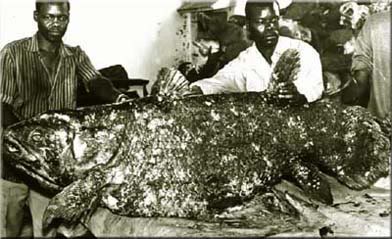
Here is a real example of Latimeria chalumnae, the coelacanth. Once believed by white people to be exctinct for 70 million years, in 1938 a live coelacanth was found off the coast of South Africa. This ancient order of the oldest lineage of jawed fishes has survived since the Middle Devonian period, some 410 million years ago. They are not quite as "untouched" by evolution as Prof. Blake would tell his friends, for they have evolved to give birth to live, adorable babies.

Overall, Monster on the Campus' coelacanth looks very much like his real African relatives. Prof. Blake is fixated on evolution, and the coelie is probably a cousin of eusthenopteron, the much-cuter fish that first crawled out of the sea! Blake tells us about Old Fourlegs' famous bone-reenforced fins, which it "uses to walk along the ocean floor". He does not address that the head is much bigger, with a longer snout, bulging eyes, prominent fangs and bigger lips, as if someone resculpted it to look like a dragon. Also it has spikes coming out of its face. If Prof. Blake's world were in color, we could see that the coelacanth is a deep, pretty blue.

The Dunsfield University coelacanth is a kind of puny specimen, as the average fish weighs nearly 180 pounds, while Prof. Blake is able to hoist his rubbery pal all over the lab without breaking a sweat. He also has no problem holding onto the fish, even though these slimy fellows goop out mucus and oil from their bodies. Perhaps this one was dried out by the gamma-ray preservation. Gamma rays are known to cause cancer in some tissues. In Monster on the Campus, it is revealed that gamma rays will mutate the blood of a coelacanth in a manner that causes complete reversal of evolution in any creature which ingests the blood. Since no one before or since has been able to make sense of this, the resultant problems are not really anybody's fault... However, if Prof. Blake had time to study his fish's anatomy before he lifted it, he would know their scales are covered with sharp spines, and might not have cut his hand, and transformed into a freaked-out caveman!

Unfortunately these startling discoveries about gamma rays, coelacanths, and Prof. Blake's previously unheard-of definition of the word "evolution" did not leave the D.U. campus that fateful semester.

Learn about it without reading a book... just like Prof. Blake!:
-PBS NOVA coelacanth site includes a clickable fish anatomy-lesson and a neat summary of Marjorie Courtenay-Latimer's 1938 discovery!
-DINOFISH.com is the coolest and scariest coelacanth site!

Thursday, April 12, 2007

"We're Gonna Do Some Stupid Shit": Finding the Light In the GRINDHOUSE


Red Band Spoiler Warning: This motion picture review contains scenes of intense spoilers, graphic cult movie references, and frank depictions of adult cinephilia.

Children who have not seen Grindhouse
should not read this motion picture review without a parent.

Coming Attractions: "Two Against the World"

The trailers for Grindhouse (2007) promise to be all things to all people ("2 1/2 hours of pure dynamite!"), and that should be your first clue: you're being duped by great hype men. A movie — or two movies — can't possibly be a send-up, an homage, a perfect recreation, and an authentic grindhouse picture at the same time. Besides, for one thing it's 2007 and there are no grindhouses. For another, Grindhouse costs $53 million dollars (or more) and the feature directors have won Oscars, and the stars aren't slumming overseas, or alcoholic wash-ups. So before we step into the theater, do look at some other reviews of Grindhouse; notice how critics respond based on what they know or do not know about exploitation cinema, more importantly what they think exploitation movies are like, what films they reference by name, what they think the frame of reference is for Grindhouse, and crucially whether they're looking for parody, homage, or recreation.

The Grindhouse trailer promises to be a goof and sincerely kick-ass because it's an exploitation movie trailer, and its job is to get your ass in a broken seat, your feet on the sticky floor, and your cash in the register. Second reason: It promises both silliness and sincerity because this because that's what exploitation movies deliver in practice. Grindhouse is a beautiful dream you have after eating a tamale you bought out of a guy's car trunk, sneaking a bottle of SoCo into the theater and falling asleep in the back row.

Don't sweat the title, Grindhouse. They could've called it Drive-In 1979. They could've called it 42nd Street Forever: The Movie. In my neighborhood, they could've called it Browsing at Jerry's Video. In your neighborhood, something else. In the Tarantino tradition of titles that lay their inspiration on the line, Grindhouse is infinitely closer to the source than Pulp Fiction or True Romance. Grindhouse is so inside you can feel the beating heart of its mother with every Scotch-tape film splice.

Maverick DIY visionary and problematic storyteller Robert Rodriguez writes, shoots, directs and cuts Planet Terror. Divisive, obnoxious pothead supergenius Quentin Tarantino writes, photographs, directs, acts in Death Proof. Wannabes Rob Zombie and Eli Roth and fine parodist Edgar Wright make pretend trailers. The filmmakers choose to recreate certain details which they sharply observe, memorialize and reinvent others, and amp up the volume on some experiences that the real grindhouse did not quite fulfill. Both features offer separate celebrations of exploitation magic, and finally trade in generic deconstruction and metafictional meditation, but go about their tasks very differently, and that's what I'm choosing to highlight in this piece. Tarantino and Rodriguez both have valid, fascinating a approaches, and if you care about trash cinema — if you care about movies — both films, vulgar and giddy by design, are also deeply moving.

Ultimately Grindhouse is not an in-joke, though it contains in-jokes (seriously, even a gross-out advert for the Acuña Boys local taco stand contains a split-second Rolling Thunder gag). Insider knowledge is not the only principle at play, so although it may provide an assist in appreciating the nuances and provide a referential compass, Grindhouse is not strictly a clubhouse affair. The film - and the films - attempts to point newbies in the right direction, and acts as a primer on the unironic pleasures of B movies. As a celebration of the least esoteric of films, nothing else would be appropriate.


I. Mexican Monster Movie: PLANET TERROR

The Sitch: Leaked biochemical weapon in the form of green mutation-gas turns the population of a small Texas town into shambling masses of bloody pustules. Can mysteriously combat-ready tow-truck driver El Wray (Freddy Rodríguez) and go-go dancer Cherry (Rose McGowan) reconcile their romantic history and blow everything up? Even if her leg gets chopped off? Can a deputy played by Tom Savini possibly survive a cannibal-monster onslaught?

Boffo action-horror that lays on the gore with a fire hose, and the comedy with a bricklayer's blunt trowel, Robert Rodriguez has trod this ground before, in From Dusk Till Dawn (1996). The gonzo aesthetic has carried through all his work. Do not mistake the tone for spoof, the leaden irony, verbal and visual puns in place of proper jokes, melting-genitalia shock humor and corny one-liners for campy put-on. This is simply the sense of humor to be found in the genuine article, just funnier, a tinge more self-conscious perhaps, but shared. When crooked scientist-baddie Abby (Naveen Andrews) falls face-down in a pile of severed testicles and for some inexplicable reason keeps his mouth open, just so the balls can go in his mouth, well, it's the kind of joke H.G. Lewis used to make in The Gore-Gore Girls (1972), then Sam Raimi used to make in The Evil Dead (1981), and now it's the kind of joke Robert Rodriguez makes. Sophisticated is not the same thing as funny. The real question is what is Rodriguez's template? What is the genuine article?

"Grindhouse movies" is almost certainly not the proper term for the major influences on Grindhouse. Historical grindhouses screened burlesque striptease films and borderline pornography before pornography was legal, and after that, the kind of nudies, ghoulie-cuties and raunchy softcore for which there is no modern analogue. There is a line of demarkation between Roger Corman, Paul Bartel and Al Adamson versus David F. Friedman, Joe Sarno and Andy Milligan; I don't propose a hierarchy of quality or talent, but intentionality, venue and audience. There would be absolutely no way or reason to spend $53 million on grindhouse product, unless you bought the theater, too. The nature of the grindhouse changed over time, and definitions are necessarily blurry and vernacular, and the film is born of a wide range of inspiration, so I do this hair-splitting to underline that Grindhouse aims for a feeling; the references are sometimes specific, but the genus of those references is not necessarily identical. There is a lot of Death Race 2000 (1975) and The Crazies (1973) in Planet Terror, and absolutely no whiff of, say Garden of the Dead (1974) or Mantis in Lace (1968), though they've got plot elements zombies and go-go dancers in common.

It's puzzling that so many critics are calling out Death Proof for failing to accurately duplicate an exploitation movie vibe. It is Death Proof which the more authentic plot, pacing, structure and ambiance. Nathan Lee at The Village Voice, for example, gets it backwards entirely. Planet Terror is a dream of a perfect beer and pizza night after hours at the '80s video store, with all the boring parts removed, leaving only hot flesh and gooey blood. Accepting that the hazy terrain of all exploitation film history is fair territory as a game-rule, Planet Terror is less "grindhouse" than a highlights reel of George Romero's zombie mayhem, John Carpenter's sort-of-ironic action movies from Assault on Precinct 13 (1976) to Big Trouble in Little China (1986) to John Carpenter's Vampires and more serious The Thing (1982), Lucio Fulci in New Gladiators (1984) mode, and a B-plot about lesbian anesthesiologist Dr. Dakota Block (Marley Shelton) trying to kill her abusive husband Dr. William Block (Josh Brolin, and yes, there's a kicky Kill Bill joke about it) that's pitched somewhere between Hospital of Terror (1978) and a multi-nested reference to From Beyond (1986). Whew!

It is more or less the approach Kerry Conran took in Sky Captain and the World of Tomorrow (2004), with forty years of pulp s.f. and serials: what if I take all this stuff I love, cram it in a movie, and portray it with special effects and more expensive actors? Planet Terror takes the raw story material and tone of these films and sculpts it into something slicker and more expensive, something they could never be while constrained by production realities of budget, time and (except in Romero's case) filmmaking proficiency. This is rather a feat in itself, since - don't believe the critical complaints or the backhanded compliments that the plot is idiot-simple - Rodriguez tells a fairly sprawling story involving a sizeable ensemble cast, and does it while hanging every scene on a thrill or gross-out setpiece. Many of the key elements of the era are difficult to capture, but Planet unashamedly reproduces unfunny "comic relief" characters, throbbing synthesizer scores, meticulously sets up almost every single throwaway line of dialogue to be repeated in new, reversed context later, and every character trait, backstory, conflict and quirk set up for triple-underlined "poetic justice" payoff that only a screenwriter could love. When Sheriff Hague orders freshly armed citizens not to shoot him, sure bet his own deputy is going to accidentally put a bullet in his boss' neck.

Romero's penchant for social commentary is given a gentle nudge in a convoluted explanation for the infections, involving the assassination of Osama Bin Ladin, the meta-joke implication being that the film would like to be a metaphor for the government’s cavalier treatment of US troops as disposable weaponry ("God bless you, and your valuable service to this country", Wray tells a totally monstered-out soldier [Bruce Willis] before shooting him in the mutated face). It is witty, and admittedly funny, but it is one of the few places Planet Terror condescends to its forefathers. Nor does Planet Terror celebrate those sequences of quiet, intense suspense in early John Carpenter. It entirely focuses on those moments designed for fanzine critics to mark with an exclamation point enclosed by parenthesis: Eyeglasses vs. bone saw (!) Weeping go-go dancer (!) Babysitters in a hot rod (!) MACHINE GUN LEG (!), maybe even (!!) Rodriguez also seems to know that too often Planet Terror's ancestors would provide these images but lack the resources or imagination to do anything with them; he comes up with more than enough for Cherry to do with her M4 pegleg, even combining it with her dancing skills in arguably the first feature's most transcendent moment, as Cherry writhes, bumps, grinds and arches her back while blasting fireballs out of her lower half.

Now you may argue, if you must, that much of the envelope-pushing that fringe cinema used to do has been co-opted by the mainstream. Planet Terror reminds us that it isn't quite so; there is forever a disreputable tinge to the interests of adolescents, bohemians, and Mexican wildmen. A crucial moment is a mother handing her preteen son a pistol, and telling him to blow off anyone's head who comes close, "just like in your videogames." Whether the scene in Planet Terror would make any parent cringe is not the point; it's an acknowledgement that rebel youth culture, and bad taste will always find a way to triumph.

80 minutes of movie with a wild hair up its ass that amounted to nothing but prolonged squib explosions, Rodriguez as a one-man back-issue index to Fangoria, would be perfectly fun. But two elements in particular make Planet Terror a more thoughtful exegesis on genre films. The first is the love story of Wray and Cherry. More formalist critics see genre characters as pawns put through their paces by story machinations, chess moves that may be beautiful in complexity on their own, but lacking the growth and development of real dramatic arc. But as Umberto Eco wrote of Casablanca, "When all the archetypes burst in shamelessly, we reach Homeric depths. Two clichés make us laugh. A hundred clichés move us. For we sense dimly that the clichés are talking among themselves, and celebrating a reunion. Just as the height of pain may encounter sensual pleasure, and the height of perversion border on mystical energy..." Well, at the height of mystical energy, we believe Wray and Cherry's love story. Partly because it is a Bullshit Movie Cliché First Rank, spanning all genre and hierarchy of classiness, that disaster scenarios are a great place for lovers to reunite, from Casablanca to Twister to infinity.

We also Believe, because the human situation is not b.s. You're going to have to run into an ex after a bad breakup. You're going to have to deal with it. It's going to hurt when you see her wearing your jacket. It's going to hurt when he criticizes your plan to be a stand-up comedian. Though the love story is all in clever pseudo-arch dialogue (that is: it's smart and funny, masked as dumb) in a horror scenario at hysterical pitch, in the end it is about the individual strength and personal validation that a good partner provides, and the confusion and loss of agency in a codependent relationship. Cherry's insecurity and sense of purposelessness, as she drifts from weird job to weird job, and self-criticizes her every skill as a "useless talent" has only been bolstered by the feeling that Wray never believed in her. Wray, too, has been stripped by Sheriff Haugue (Michael Biehn) of his greatest talents - namely kicking ass - in a vague backstory. But when the splat hits the fan, by the time Wray straps an automatic weapon to his girl's stump, neither is hesitating to put their lives in each others' hands - or legs, or whatever. "Stand and become who you were meant to be," he tells her, and one gets the sense it is Rodriguez' statement of purpose: "I was meant to do this, these are the kinds of movies I was born to make." Planet Terror is about finding your place in the universe, and the bone-deep satisfaction when you are there, ready to kick ass. For Robert Rodriguez, maybe for you too, that place is in the mad fray of movie thrills and spills.

The other element of Planet Terror that aids in the transcendence of John Carpenter pastiche - though Grindhouse is in the end about how these films don't need to be transcended - is the stylistic choice to make the image resemble a less-than-pristine, careworn, abused, faded, scratched, speckled, shot-to-holy-hell film print. When I'd heard about this choice before seeing the film, my heart fell a little, because it sounds like a gimmick, it sounds like a joke. The meta-movie experience of Grindhouse makes few pretenses to being a vintage double-feature, the films are both clearly set in the 21st century, we're seeing them first-run; so how could the prints be so damaged? Modern audiences do not have to deal with missing reels, so why... would...? Rodriguez and Tarantino could just make a snotty joke, or wallow in that peculiar collector mentality that the grungier, more banged-up and filthy a rare artifact is, it accumulates a patina of mystique and cool.

[ For example of this mindset, if you don't frequent swap meets, toy and paper fairs or trade vinyl, Pantheon's Peanuts collection, in which yellowed newspaper clippings, taped into a collector's album are photographed with fetishistic care, desperate to prove their rarity and authenticity; compare to Fantagraphics' Complete Peanuts series, restored, austure, authoritative).]

Planet Terror instead finds print damage not just a nostalgic memory of the moviegoing experience, but an integral part of the text. Adding possibility and layers of new meaning that a fresh, unblemished image cannot convey, Rodriguez uses the faux print damage of his film for pyrotechnic poetry. The idea is cousin to Bill Morrison's avant garde epic Decasia (2002), which turned deteriorating silent found footage into a symphony of loss and fear, but Rodriguez' print isn't actually dying before our eyes, so it has a metaphoric electricity Morrison's film does not. We may catch onto this frankly brilliant tactic during the first make-believe trailer, a Mannaja-meets-Johnny Firecloud revenger called Machete, as the print bounces and jitters with glee during all the exciting blade-through-skull-motorcycle-leaping-through-explosion parts. Again, it sounds trite in print, but it adds genuine kinetic energy to the action. In Planet Terror, during monster melees, the print will break into more spots and scratches than a dalmatian dogfight. It bends and warps during the worst weirdness. It looses a reel as a complex gag about missing reels, genre storytelling and audience patience. And when Wray and Cherry make love, in Grindhouse's sexiest, most emotional scene between two people, the celluloid bubbles and melts before the blazing bulb, burns up and snaps before our eyes.

That gag, by the by, is 100% Persona (1966), but Bergman's film splits with sharp pain, unable to bear the agony of existence. Robert Rodriguez's film combusts from the joy of erotic screen spectacle. There's so much love on screen the film cannot stand it.

And that is the first time I shed a tear during Grindhouse. It is not the last.

INTERMISSION
-Rob Zombie's Werewolf Women of the SS is a joke that doesn't extend much past the title, and wastes Sybil Danning and Udo Kier by giving them nothing to do. It is funny and silly, but is not cut or shot like a real Nazisploitation trailer. Zombie doesn't have much frame of reference beyond Ilsa, She Wolf of the SS (1975), which is kind of an exercise in intentional camp to start with. From Love Camp 7 (1969) to SS Experiment Love Camp (1976), not many films of this genre look anything like Zombie's fakaloo, but they are uniformly more perverse, depraved, and though they may not contain werewolves, are just-plain crazier. Zombie's worse misstep is that his pretend movie is far, far tamer than the queasy nastiness of the real deal.

-Eli Roth's Thanksgiving, while tackling the easy target of holiday-themed slasher movies, is brimming with a jocular sick-joke humor that outdoes most of its full-length bretheren. But Roth's masterstroke is that he captures Blood Freak-level cinematography and cheapo trailer editing style to a T, especially when he frames shots wrong, and re-uses footage. Grindhouse's easiest joke is one of its best-executed.

-Edgar Wright's Don't trailer is as observant as Roth's short, but uses its sharp observation to satirize the ballyhoo of Americanized Euro horror movies. A sub-Amicus/Don't Look In the Basement Brit weird-house thriller, the Don't cinematography is unmistakeably European, but cuts to inexplicable shock images with such frenzy that there's no way to guess at the plot. Which is, of course, the best way to sell any kind of foreign film in America.


II. "Hey Ladies, THAT was FUN!": DEATH PROOF

The Sitch: Four girls and one girl they don't like hang out in Austin bars. Stuntman Mike shows up, and he is Kurt Russell but with a scar-face and a scary 1971 Chevy Nova SS with Steve McQueen's license plate number from Bullit. Stuntman Mike eats some nachos, then car-murders the girls because he is crazy. Ranger McGraw (Michael Parks) from Kill Bill investigates it! Then four more girls hang out in a bar, then they test-drive a car, and one of them climbs onto the hood, and Mike tries to chase them. But the girls are Hollywood stuntwomen, and they chase Mike and beat him up. THE END!

In the passenger seat, the girl who has never even heard of Vanishing Point (1971), Abernathy (Rosario Dawson) watches as her buddy Zoë Bell (playing... Zoë Bell!) straps herself on the hood, as Kim (Tracey Thoms) stomps the gas peddle through the floormat of the borrowed spotless white 1970 Challenger. They're playing Ship's Mast on the open highway, for no good reason but that it is as cheap and primal a thrill as stuntwoman Zoë knows. CU on ABERNATHY, her face cruched with disbelief and terror. Hold. Hold, as she stares at Zoë on the hood, no CGI, just two leather belts, this is really happening. And hold on Abernathy as her rictus of fear becomes a beaming, joyous grin (it had to be Dawson, because seriously, who else has teeth that enormous and gleaming, a smile that wide?). And hold on Abernathy as she understands that the stupid, reckless, crazy, dangerous cheap thrill has become a moment of grace.

There are a dozen metaphors, visual, verbal, musical, throughout the double feature that aptly summarize Grindhouse's l'amour fou. Pick your favorite, but for me, the moment that left me with tears streaming down my face for the rest of Death Proof, was the single close up of Rosario Dawson moving from dumbfounded shock to fright to glee to something beyond.

There is the matter, troubling to many viewers, which should be addressed: the vast majority of Death Proof's running time is devoted to girl gab sessions. At a midnight screening I attended there were a half-dozen walkouts, and one dialogue-drowning cry of "BOOO! Kill some people!" Even pro critics have griped that the non-racing scenes are distinctly un-exploitation-movie. And that, ladies and Cleopatra Jones fans, is the sound of a gauntlet being thrown motherfuckin' down.

Were I less charitable, I could point out that too many critics are citing Vanishing Point, and only because it is title-dropped frequently and emphatically in Death Proof. There are some visual quotes besides just the notorious Dodge Challenger itself, (as seen at right) and they are both cool car-chase movies. But Vanishing Point barely qualifies as an exploitation film, it's not a grindhouse film by any stretch, but a sleeper hit studio movie, and is certainly not in the mode of Death Proof - a road movie, rather than a maniac killer picture - so I recommend you keep your bullshit detectors tuned to station KOW.

Rather than adopt a shove-it-if-you-don't-enjoy-it posture - which is tempting, because personally I'm happy to hear Tarantino characters yammering on about sex, drugs and Brit pop - the endless girl's night out of Death Proof serves at least four functions, all with beautiful, sleazy ancestors:

It is a pretty accurate recreation of how low budget films are padded with money-saving, seemingly endless dialogue scenes. It signals a genre shift to girl hangout movie in the vein of The Cheerleaders (1973), Tarantino's beloved Revenge of the Cheerleaders (1976) - even the attention deficit disorder affected Faster, Pussycat! Kill! Kill! (given a T-shirt shoutout) is half given over to melodrama and chitchat. It provides a plot misdirect, that we're following one band of four women, when they are abruptly slaughtered, a.k.a. The Psycho Mislead. Finally, I refer you to the stunning Avere vent'anni (1978), in which we spend an entire film getting to watch young women going about the business of young women in a sexploitation picture, only to find our feet in the air and the rug somewhere else. The chatter of Death Proof is exactly what exploitation movies do in between money shots, like it or not. Tarantino chooses to load these moments with backstory for both sets of four friends, establish intricate relationships with characters on screen and off, and set up personality traits to pay off later. This may or may not stop anyone from walking out. More than Planet Terror, Death Proof asks that you play by exploitation movie rules, or don't play at all.

For this is a film in which industry old timer Stuntman Mike laughs at young Pam (Rose McGowan), who thinks car chases should maybe involve some CGI. Pam eventually finds herself in Stuntman Mike's passenger-side crashbox, bloodied and weeping and he swerves and brakes to make dashboard paste of her skull, and she pleads: "I get it now. It's a joke. And it's really funny..." but please stop. Because these movie thrills, if you came to giggle at a send-up of So Bad It's Good, sorry for the left turn, but them's the brakes... It was never a joke, it is about reconnecting in a meaningful way with the power of these films at face value. That is the value on the face of Abernathy in Death Proof's climax: now she understands. She didn't know from Vanishing Point before, but now she's lived it. If you didn't know what rambunctious pleasures these films can hold, don't sweat it; The Grindhouse is open all night, and can educate you real fast, real cheap.

Tarantino, who invariably casts himself as a doof (or, once, Pam Grier's answering machine) plays Warren, the fictional owner of a real Austin bar, the character far and away most excited to hang out with Jungle Julia (Sydney Tamiia Poitier) and her friends. Part of Death Proof's structure is that we don't engage with the mean and domineering Julia and her catty girlfriends, Arlene (Vanessa Ferlito), and Shanna (Jordan Ladd), and drug supplier Lanna Frank (Monica Staggs), but Warren is overjoyed to see them and insists on shots of Chartreuse, all around. The bar's jukebox is Quentin Tarantino's real jukebox. A jukebox with "Miserlou" on the playlist, no less. And as much as he likes photographing women's feet, or tough guys' weathered faces, or vintage cars, the sweetest moment of naked wish-fulfillment in Death Proof is when the girls agree: Quentin Tarantino's jukebox is really cool. The converse, the sharpest self-criticism, comes in Planet Terror, where Tarantino plays a villainous soldier, who holds Cherry at gunpoint and declares "I want entertainment and that means you, baby!"; QT is so movie-mad he compares you to Ava Gardner before he tries to rape you... But the scene with Warren is critical, for it plainly tells us, as if we didn't know, that the director does not want these girls to die. But they die. Girls die in these movies, a'right?

The gender-politixploitation of Grindhouse is another essay for another time, but when the film takes a turn from stalk-and-slash-with-a-car to women's vengeance picture, Tarantino makes the Grindhouse's closing statements on exploitation movies.

Reasons We Go to Movies #1 - To Look at Pretty Girls, is confirmed again. Case study: Mary Elizabeth Winstead in a cheerleader uniform.

Winstead's character, Lee, is in a cheerleader uniform because she and her buddies Kim, Zoë and Abernathy are in Tennessee to make "a cheerleader movie". Now folks, if you haven't gotten out of the house recently, be aware: they don't make cheerleader movies anymore. After the film's funniest character comedy scene, in which Abernathy bargains with the Challenger's backwoods owner for an unsupervised test drive ("I'm gonna insinuate that Lee's gonna blow him" is the plan, which is totally how the girls in Hollywood High (1976) get their car fixed), Death Proof becomes something else, once again. From here, to the grand finale, Grindhouse, too, becomes simultaneously most visceral and most spiritual.

Stuntman Mike charmed us before, probably charmed us more than Jungle Julia and crew, only to prove to be a wolf with a Convoy hood ornament. Now he's after the women we like, yes, but it becomes a battle between genre archetypes on the open road... and on top of that, the girls are apparently exploitation filmmakers themselves. They roar and tear at each other, and the Misogynist Slasher seems to be winning, reducing the Cheerleader gang to hysterics and panic. Stuntman Mike, driven off the road, jumps from his car filled with the adrenaline of any good jump-scare or car-crash scene, and grins at the Cheerleaders, calling: "Ladies THAT was FUN!" And... and maybe it was fun. Car chases and cubist-edited DePalmaesque murder scenes, watching Kurt Russell being charismatic and scary, it's all fun.

It's fun, but a formalist criticism often overlooks how deeply we engage with fiction, and any reading of Grindhouse soley as meta-movie does not understand the genuine investment in these characters. It's important to unpack both the genre-hopping entanglements, and how we enjoy movies on their most basic level simultaneously; for Stuntman Mike wails and screams, when Kim turns the Challenger around, "I was only playing around!" It was supposed to be fun and postmodern, this Texas Chain Saw-cum-Christine, but Stuntman Mike has tangled with the wrong genre archetype, it wasn't fun for them. Y'know, on my K-Billy greatest-hits list, girl hangout movies might be cooler than slasher movies too. They're certainly a less screwed-up good time. And the Cheerleaders shall have their Revenge.

"At some point in your life, you find a use for every useless talent you have." The Village Voice chose to read this line from Planet Terror as a celebration of happy stupidity. It is not. It is an affirmation that deep devotion to the things you love, even when culturally shunned, forgotten and belittled, will serve you well.

The Cheerleaders chase down the ghosts of Mad Slashers past, Kim shouting "I'm the horniest motherfucker on the road!", ironically throwing his own sexualized violence back in his scarred face. The car plows through an abandoned rowboat, and Abernathy exclaims in breathless wonder, the neatest summation of "(!)" in all of Grindhouse: "Did you just hit a boat?!" Because that's why we go to the drive-in: to see a crab monster eat a brain and gain the voice of the man it ate, and through that learn something about death and identity. That's why we go to the back back row of the video store: to see if the mafia can win against the ninjas, even when the ninjas can turn into shrubs, and ponder their relative morality in the process. That's why we came to Grindhouse: to see a car hit a boat, and learn about being alive.

It all ends with a chase and a fight, the reason movies were invented: to show us people in motion. Wham! Bam! Thank you, ma'am... or is violence and revenge, even if it means role-reversal turnabout, still unacceptable behavior? Do we hold movie-people to the codes and standards we apply ourselves? But wait, are they real girls or Cheerleader flick metaphor-girls? Well, do you want to be preached to, or given difficult problems to sort out? So if it makes you feel weird and uncomfortable once more when the exhilarating final car race and fistfight ends abruptly with Abarnathy killing a clearly defeated man by kicking him in the face? Welcome to the grindhouse.

THE END! Now go to the bathroom, because I'm sure you've gotta take the biggest piss in the world.

Oh, okay, okay: the owners of the taco stand advertised during intermission were named after Rolling Thunder villains.

Hell of a jukebox, boys.

Thursday, April 05, 2007

"When all is most right with the world, the most unthinkable disasters decend upon us"

Bob Clark
1941 - 2007

Teen sex comedies. Cheap kiddie fantasy films. Sherlock Holmes pastiches. YA fiction adaptations. Transvestite melodrama. Jack the Ripper fiction. Vulgar star vehicle musicals. Misguided '80s concept comedies. Slapstick comedy about dogs. Babysploitation. These are a few of my favorite things, these subgenres that are not as splashy and sleazy as those that jump immediately to mind in discussions exploitation cinema, but at heart they are exploitation movies nonetheless. Bob Clark gave the world memorable entries in all of these maligned genres. In more popular, flashier junk cinema, Clark was a titan, directing key titles in those evergreen genres that define exploitation: slashers, rape-and-revenge, zombies, Bo Svenson vs. Mafia.

On a stretch of the Pacific Coast Highway, in Pacific Palisades, filmmaker Bob Clark, 67, and his son Ariel Hanrath-Clark, 22, died in a collision with a drunk driver, April 4, 2007.

I strongly suspect you will be reading a lot of memorials today that read like this one: "Bob Clark had his one great, shining moment. He directed A Christmas Story." It seems Clark's holiday film touches a lot of viewers deeply, and for them I am happy; for me, it is like watching Russ Meyer's The Seven Minutes: it is passably entertaining, it bears the stylistic stamp of its director, but it is the work of a great exploitation filmmaker trying to go legit, and avoiding what he does best. What's the funniest movie Bob Clark ever made about growing up? Oh please: see the poster at the top of this post.

A Christmas Story, coasting on someone else's empty nostalgia, smearily photographed to signify a cliched period feel, wildly uneven in its internal reality, condescendingly narrated by the smarmy Jean Shepherd... The only Bob Clark movie ever to gain respectability, the only one many audiences love, is the only one I have no time for. And I've made a lot of time for Bob Clark.

Two related, never separated, always complicated modes of art appreciation are the principle attitudes with which we watch films of limited budget, resource and class: the ironist stance and the true believer stance. The ironist may be located anywhere along the appreciation/derision spectrum, from camp appreciation to "So Bad It's Good" to "Laughing At, Not With". And the true believer, for whatever you make of it, finds satisfaction in "So Crazy, I Can't Believe It".

"So Crazy" is the more interesting, for it encompasses the artistic idiosyncrasy, the unique bad taste, antisocial attitude, and transgression, the brutal honesty about what entertains us, and absence of pretension, that are rare animals in mainstream film. The B movie, the drive-in, the grindhouse, the Wizard Video catalogue, whatever you want to say about them, they do not pretend. With more frequency than the mall multiplex, do they deliver: So Good It's Good. The exploitation true believer knows something about acquired taste, as well as the art house devotee, as well as the student of the avant garde.

And this weekend, when you're watching Grindhouse, and if you're reading reviews of Grindhouse, don't listen to any critic with a history of shitting on junk-genre movies, who suddenly pretends to be an expert on their appeal: It's bullshit. Go ahead. Read Owen Gleiberman's review. It's right here, loves the movie and is full of shit. And back to Mr. Clark, unfortunately, the vast majority of obits this weekend? Are going to be bullshit. He was by every report, an uncommonly nice man, and made one movie everyone and grandparents love, but the rest of his filmography, they hate.

So Black Christmas (1974), bloody and foul is also a taught, tense thriller, a bona fide, acknowledged classic of a slasher picture, because it does those things that slasher pictures do best, without shame or disguise. And so likewise the creepazoid Deathdream (1974) does for zombie ickiness and 'Namsploitation. And Porky's obviously struck a nerve with audiences and signals a minor paradigm shift in teen sex comedies. Why not admit it: Baby Geniuses is great at what it does, and most audiences are too cool to enjoy a totally committed, bizarre comedy about CGI-enhanced babies. At some point, you must meet the genre halfway. Baby Geniuses is, as they say, what it is, and if we can get into what it is, not what you hate it for being, it is impossible to deny the film's fevered grotesque hilarity. It's almost like no movie about super-babies was going to please you people! Likewise, The Karate Dog. It is as genuine, nutty and gooney movie about a karate dog as you could want. If you didn't want it, that's your problem. Not "kitsch", not "camp", not "making fun of" can make you enjoy it, if you aren't ready to watch a talking dog do karate.

Horror aficionados will have an easier time 'fessing up to an enthusiasm for zombie comedies. But what about "zombie comedy" is inherently more respectable or even "cooler" than "dog comedy"? A: Nothing. And Bob Clark made a a zombie comedy almost as low-budge inventive as Dead/Alive, which walks the scary-funny line in a more interesting way than Shaun of the Dead. The movie is Children Shouldn't Play With Dead Things (1972), which is not as funny as King of the Zombies (1941), but is surely an all time top-five zombie comedy.

Bob Clark was not among the most stylish technical filmmakers, nor the wild and woolliest storyteller. Clark brought instead a full, unironic investment in the genre to every movie he made, and that is what makes them so solid and fun. Murder by Decree (1979), his Holmes vs. Ripper tale, is as classy and British as he can muster, and more successful on those terms than Hollywood's stabs at the characters. His 1995 Judy Blume TV adaptation, Fudge-A-Mania, bolstered by Darren McGavin's reliable charm, is better, funnier for an adult audience than the book. As totally tacky, starstruck musicals go, Rhinestone (1984) has more charismatic performers and better songs than Dreamgirls. Given that filming Bo Svenson kick ass is an honorable cinematic goal unto itself, 1976's Breaking Point can't really go wrong (though few films can live up to its tagline: "Innocence and Fury Don't Mix... THEY EXPLODE!").

My favorite Clark film, besides Black Christmas? 1967's She-Man (DVD available from Something Weird). Why would an upstanding Army man start dressing up as a woman? Because he's being blackmailed by a cross-dressing dominatrix named Dominita, and must be her slave or she will rat him out for deserting the Korean conflict, that's why. And you know, when it comes to young exploitation directors who start their careers with black and white cross-dressing melodrama? Bob Clark's isn't the craziest, most pathological, the greatest, or the most notorious, but it's one of the most solidly entertaining and good-natured.

And in the end, all Karate Dogs go to Heaven.

Sunday, April 01, 2007

The True Meaning of Horror: THE TEXAS CHAINSAW MASSACRE THE NEXT GENERATION

The White Elephant Blog-a-Thon at Lucid Screening celebrates the act of dumping bad movies in other critics' laps and watching them squirm.
-------------------------
Aphorisms For Those Attempting to Survive The Texas Chainsaw Massacre: The Next Generation


We live in a world where an artwork titled The Texas Chain Saw Massacre is an object of adoration, and praise, powerful of influence. The 1974 film is so respected that sequels, remakes and whatever The Texas Chainsaw Massacre: The Next Generation is, may be deemed disappointments, unworthy of association, or sacrilege. The Texas Chain Saw Massacre is a standard to which film artists may aspire. Remind yourself, once in awhile, that this is the world you live in. I guarantee it will cheer you up.

* * * * *

Two automobile accidents in the same car are required to drive our hapless saw-fodder teens into the dark Texas woodlands. Do two entirely separate car crashes in five minutes signal a thematic excess of mayhem throughout the entire picture? It does not. It does signal something about the plot logic of the movie.

* * * * *

The Texas Chainsaw Massacre: The Next Generation has a fourteen-syllable title which becomes increasingly nonsensical as one reaches the end. There is no chainsaw massacre. There is not a sole chainsaw death. There are no chainsaw injuries. There is not explicitly a "next generation" of chainsaw-massacrers within the film, though it may be a remake/boot/imagine of the 1974 film for a new generation of moviegoers.

Should one be viewing the film in its original release title, Return of the Texas Chainsaw Massacre, one may ponder how a massacre can "return."

* * * * *

For as much shit as I talk about Tobe Hooper and his post Chain Saw work, defenders of the wayward auteur can always take comfort: none of this is his fault.

Kim Henkel, co-writer and producer of Chain Saw '74, certainly less beloved, must shoulder all blame, however, for writing and directing The Next Generation. It is less curious to that Halloween sequels accumulated too much complicated, needless backstory over time, and began jettisoning sequels from continuity, or, more accurately, picking and choosing which threads to continue their convoluted, silly tale. Henkel, however, free to make a direct sequel to his own first story, to integrate those elements he may have liked from the two Chain Saw sequels, or (yeah, sure) find a means by which to smooth over continuity disjunction once and for all, opts for none of the above.

He takes a stranger approach, recreating the basic scenario even while acknowledging the entire series in a title card, then through a last-act subplot implies an ongoing, eternal cycle of Chainsaw Massacre Houses, set up by the Illuminati or something, and intended as a "spiritual experience" either for the perpetrators or the victims, or as a research facility for understanding the nature of the base emotion of horror. In the last few scenes of the film, a mysterious (in relative terms) manipulator figure with an atrocious haircut and a black suit, whom the credits identify as "Rothman" (James Gale) appears, scolds the villains on their Ultimate Purpose, and exits. Literally, boundary-less conspiracy theory has motivated all the Texas Chainsaw films. Figuratively, Henkel is attempting to equate his films, and if he is generous, all horror films, with philosophical thought experiments designed, as Rothman puts it, to uncover "the true meaning of horror."

The Texas Chainsaw Massacre: The Next Generation proposes to explore The True Meaning of Horror. Do we find an answer to this grand question? Does it matter if you truly ask the question, if you name-drop the question?

* * * * *

In The Texas Chainsaw Massacre: The Next Generation, four kids are stalked through the moody Texas nightscape by a family of weirdo lunatics, including a beefy guy wearing a mask made of cut-off human faces and very excited about a chainsaw. Every time it seems they have found assistance at the outskirts of civilization, their helper turns out to be another member of the nutzo posse. One extra-screamy girl survives by running and running and running. The end.

This perfectly solid plot sketch served Henkel well in 1974, and he does not invent a new one for The Next Generation. Henkel retains the most successful setpieces and iconic images from Saw '74 -- Girl on a Meathook, Chase Thru the House and Out the Attic Window, Sawing Down the Door, Heroine in a Bag, Sick-Ass Sunday Dinner at Murder House, Leatherface Spins Around in the Road -- and slightly expands them, but does not improve or "pump up" the scenes in any way either adrenalizing or satiric. So his Next-Gen Final Girl, Jenny (Renée Zellweger. Yes, for-reals), jumps out of the attic window... and then scrambles around on the roof, up a TV antenna, and jumps up onto an overhead power line, while Old-Gen Marilyn Burns was fine just smashing to the ground. The end result is the same: Leatherface slices the line and Jenny winds up KO'd on the lawn.

Henkel has, in the 20 years since writing a TCM-Universe story, apparently forgotten all the motivation behind his plot and character choices. He fills in the blanks willy-nilly to make a new tale with the old template, and the result is semi-coherent at best, only intelligible with more effort than the film has earned, and intensive knowledge of The Texas Chain Saw Massacre, and possibly sequels. While Saw '74 follows bickering hippie teens on an already spooky trip through Southern Gothic territory to check family graves for possible desecration, Next-Gen is about four kids ditching the prom and just kind of driving around town. It's a different situation, but it's not a stronger set-up. The hillbilly creeps of Saw '74 are all types, but they are quick-sketch interesting loony types, whose sociocultural motivations we can fathom. Next-Gen offers a wide freak gallery (yes, yes, completely out of continuity), but the character dynamics are not well-designed to play off each other, which is injurious in a screenplay so heavy on scenes of their interaction. Our new Leatherface (Robert Jacks) is simpering and dull, which is far more offensive than the full female drag costuming that offended so many Fangoria readers. Bartlett's Famous-spouting ignoramus W.E. (Joe Stevens) is just a guy in a plaid shirt with a single quirk. Darla Slaughter (Tonie Perensky) is a sassy real estate lady? A real estate lady is your scary backwoods stereotype? No comment. And though often touted as the film's sole comic saving grace, as family alpha male, self-mutilator and robotic-legged Vilmer, Matthew McConaughey looks like he's having fun, but his performace is entirely ear-sandblasting shouting and popping neck veins. McConaughey is not a performer loose-limbed and imaginative to have a "top" to go "over", and the result is unmodulated and embarrassing.

The cannibal family are not cannibals in The Next Generation. They still skin people, put them in deep freezers, hang girls from meathooks, and decorate with bones. Instead, they eat pizza. This is apparently some kind of '90s pop culture joke, as opposed to, say any kind of subtext that might be found in Saw '74 with its entire backstory built upon the family history with the local slaughterhouse. The posts stand in the same spots, but the signs themselves have been erased.

* * * * *

Rothman enters the film far too late, in too cryptic a manner, and is not developed enough to register as a character, but for a brief moment as he outlines his desire to expose the Meaning of Horror, his direct orders to Vilmer and family, and detached demeanor, he becomes a stand-in for all horror filmmakers. Presumably the ancient shadow-government conspiracy is behind the deus ex machina airplane-propeller murder of Vilmer in the climax, wiping out an experiment that yielded unsatisfactory results. His chauffeured limousine is the chariot that whisks Jenny away in her final escape from Leatherface. The masked maniac alone survives, for he is the true iconic monster of the piece, and the keystone to future exercises in horror. Leatherface is an archetype of our genre-subconscious, and no plane to the skull will obliterate him, after all. But Rothman sits across from Jenny, assuring her she needn't be afraid, and that she'll be delivered to a hospital or a police station, if she likes. And Rothman expresses his deep regret that this best-laid plan has failed.

The stand-in for every horror filmmaker apologizes deeply and directly for the appalling, stupid mess of The Texas Chainsaw Massacre: The Next Generation.

* * * * *

There is one interesting, clever inversion of slasher formula that The Texas Chainsaw Massacre: The Next Generation pulls off perfectly. As Jenny fights, runs, is beaten up and terrorized through the course of the film, Renée Zellweger looks prettier, cooler and more stylish.

* * * * *

The new film seems unsure why it is repeating the old film so frequently, because it is not a traditional update of "dated" material; it openly acknowledges the first movie, and then, in a final-scene coda, makes confusing overture toward fusing both movies into a sort of Texas Chainsaw meta-mythos, intentionally repeating the first film's highlights with variation as if part of a grander metaphysical scheme. The Texas Chainsaw Massacre: The Next Generation certainly does not earn this moment with its half-assed conspiracy subplot. Had the idea been properly developed as the central plot, it might have been a small moment of glory, not just for the franchise, but the genre. To wit, Jenny is delivered bloodied and frizzle-haired to a hospital, and questioned by a policeman played by John Dugan, who portrayed the withered Grandpa in Saw '74. As Jenny realizes his promises to solve the crimes are short-sighted, she stares off after a woman wheeled past on a gurney. The orderly is Paul A. Partain, wheelchair-bound Franklin in TCSM. The woman is original Saw Survivor Marilyn Burns. And the Final Girls stare at each other in understanding and despair: this cycle continues, will always continue. We need to be repeatedly submersed in fictional horror, so we can understand horror in our lives. The Final Girls in that hospital scene recognize each other as manifestations as a genre archetype, and within their world, they feel the weight of being the girl designated to shoulder the brunt of the Meaning of Horror.

This has been The Exploding Kinetoscope's grueling entry in the Lucid Screening White Elephant Blog-a-Thon. The 'thon continues all April Fool's Day '07... and be sure to check out how I forced Ben to write about the Burt Reynold's vanity carnival The End!