Showing posts with label horror. Show all posts

Saturday, September 21, 2013

Viewing Notes: TRAUMA (Argento, 1993)

Trauma, 1993, d. Dario Argento
scr. Argento, T.E.D. Kline
with Asia Argento, Christopher Rydell, Piper Laurie

Looking at this mostly for research on a larger project about the problems, pleasures and classification of post-Opera Argento, so we'll bypass the topic for now. Here we see Argento making his first American feature (after directing half of 1990's Romero collab Two Evil Eyes), probably history's only giallo set in Minneapolis. Like Deep Red (1975; blood), Tenebrae (1982; dark), Do You Like Hitchcock? (2005; thriller history and grammar, voyeurism, Hitch cultism) and Giallo (2009; duh redux), Trauma has one of those on-the-nose titles that announces the auteur is going to investigate a pet theme to the hilt and head on. Nearly all of Argento's stories trace an exploding arc of bloody chaos backward to its origin at the scene of some damaged psyche's inciting incident: it's always about trauma. Sometimes that trauma belongs to the killer, sometimes the detective/investigator, sometimes something in-between. In Trauma it rains down on the just, unjust, and all of Minnesota alike.

Not that everyone is specifically, personally born in pain in Trauma's world, but it is a slasher with a decapitation theme as its murder gimmick and it opens with a montage of paper models depicting the French Revolution. The Reign of Terror's guillotine recurs in the 20th century midwestern US as hand-held motorized garrote always used in the rain. The wound of history is open from the start, unhealed and forever purging the current moment into existence, the heavens a-weep!

David (Christopher Rydell) and Aura (Asia Argento) meet morbid-cute when he spots her about to jump off a bridge and talks her down. He's a recovering drug addict and local TV news art director, and she's an anorexic teen daughter of Romanian psychics, who have settled in Minneapolis, as Romanian psychics do. These are our protagonists, both troubled and traumatized, with David covering the Anima-Impaired Artist-Detective duties while Aura picks up the Highly Sensitive Paranormally-Gifted Girl torch from Suzy in Suspiria and Jennifer in Phenomena. In short order, Aura is reluctantly remanded to her creepo psychiatrist (Frederic Forrest), her weirdo mom (Piper Laurie) conducts a spooky seance that goes terribly awry, and everyone starts getting decapitated. And as her parents are murdered and she screams in the rain, Aura witnesses the requisite subtle clue that is misunderstood/ignored/repressed/forgotten.

As the Killer goes about the business that the black-gloved must go about, the victims are largely medical professionals, which would seem to put the physically and mentally not-okay Aura somewhere near the center of the crosshairs. And surely David and Aura become further enmeshed, variously investigating and being further victimized, as that is how slasher/mystery business is supposed to play out. And surely the stalk-and-slash setpieces will be the primary spectacle (Brad Dourif's head severed by a necklace/elevator assault, then plummeting toward the camera in a complex quote fusing Vertigo and Deep Red), and they are excellent and lively when graded against typical American thrillers of the period, if less dazzling in the company of classic period Argento murders.

In this phase of Argento's cinema it is as if the fairy tale logic of the Three Mothers films has seeped into his gialli, which are more traditionally locked into genre strictures. Even Argento's earliest thrillers are atypical Art Gialli, but with Phenomena, Trauma, Stendhal Syndrome, this free-associative strain has fully deformed the narratives. Puzzling themes, apparently unresolved subplots, and inexplicable vignettes jut out at right angles from the main trunk of the plot. Trauma's mystery practically plays out in the background as the film is increasingly preoccupied with the afflictions of its fragile split-focus protagonists.

Protecting Aura from having her head sliced off would not seem directly linked to treating her anorexia, much as the enigma of the eponymous disorder of The Stendhal Syndrome is not readily tied to that film's primary plot about serial rape and identity disintegration. In David's determination to save her, it all gets bound up together, his life crumbles around this white knight rescue fantasy, and he relapses into drug addiction and despair. (It does happen to all rather be bound up together, actually, Bad Doctors being the epicenter of the Headhunter, the eating disorder, the drug abuse, and so on and so on.)

As the mystery works its way back to the originating trauma, a disastrous birth ending in death, the protagonists move toward death/rebirths (Phenomena's insect theme returns, focused on the butterfly/soul connection, here also constituting an Eros and Psyche motif). Along the path, the film considers Aura's anorexia from various angles. Firstly, there is Aura herself: hostile and tormented, defensive and closed off, placed in the abyss between broken mirrors. Her capacity for trust demolished, she pushes back when offered any assistance, and with good reason: her damaged existence has been sculpted largely by the authority figures (mother, doctors) claiming to help her in the first place. Every helper is corrupt, every savior is suspect, including David.

As David's concern for Aura grows, a coworker provides a clinical Freudian psychological profile, claiming that subjects supposedly all experience the same recurring incest dream: a horror/wish/memory in which the father looms, about to close in for a kiss. Even if it were accurate, the one-size-fits-all description of a personality type does not address origins of the disorder, practical medical issues or treatment, and is presented as a prurient pop psych diagnosis (and this information, apparently, is all from daytime talk shows).

After this crash course, David wanders Minneapolis and sees every street haunted by the specters of anorexic girls, the dead, dying and unreachable. This mournful passage moves from the abstract diagnosis of a Problem in Modern Society into a deeply felt sadness, as David begins registering the helplessness of caring about someone who you are not equipped to aid. Still later, after Aura has disappeared again, David is broken and strung out, and stands before a store window displaying John Everett Millais' painting Ophelia. As the designated artist figure of the film, he draws the connections between the drowning young woman driven to madness, the troubled teenager he loved, and himself. The image is of Ophelia at the last moments of melodious lay, it depicts a scene that is described but unstaged, and gives it back to Ophelia. Drowning but not drowned, floating away but afloat. At this, his lowest point, drowning in self-pity, David reaches an empathetic epiphany, and reflected in the window glass, he catches a glimpse of a clue that will lead him back to Aura.

Trauma's closing shot pans right across the final crime scene, past cops sneering at the embracing protagonists, moves down the suburban street and up to a second-story balcony. A reggae ensemble is playing up there, crooning a variation on David and Aura's final dialogue, that nothing can now go wrong, that someone will be loved. And a tall, terribly thin woman we have not seen before dances as the band plays, and she is Anna Ceroli, Asia Argento's two-years-older sister (born to Daria Nicolodi and sculptor Mario Ceroli). And as the credits roll over this mysterious, somehow reassuring image, the upbeat Caribbean dance music crossfades into Pino Donaggio's aching Julee-Cruisesque ballad "Ruby Rain" (The title evokes blood and precipitation, and those lyrics?: "I miss you/ so badly… tears are nothing in the rain/ jewels of pain…"). The camera pushes in on Anna, suddenly bathed in a blown-out golden flare, hair billowing in a wind that has risen from nowhere, just Anna swaying and twisting and dancing in the inexplicable light, in the loveliest, most lyrical of all Argento's closing shots.

The closing credits fail to announce it, but, you have, of course, been watching Trauma.

Viewed on: 9/21/13 — DVD (Anchor Bay; Region 1)

Wednesday, September 22, 2010

Weekly Deprogramming Schedule — #3


Masters of Horror: John McNaughton — "Haeckel's Tale" (2006, John McNaughton)

Originally earmarked for direction by Roger Corman, passed at some point to George Romero, the MoH first season finale ended up in the hands of John McNaughton. While I greatly enjoy the maniacal Wild Things, no disrespect intended, but McNaughton is not Corman or Romero. When "Haeckel's Tale" was broadcast it had been twenty years since McNaughton directed his only nominal horror film, Henry: Portrait of a Serial Killer. This is my sneaky way of suggesting that some of the "Masters" of Horror are not masters, or maybe not even specialists in horror, which may account for the general lack of mastery on display. This is my kind way of saying that this promising premise resulted in a generally junky program.

Point in case, "Haeckel's Tale" is based on Clive Barker material, which ought to prime an audience for hideous transgressive visions, bizarre plot inventions or at least some weird gross-out shit. What transpires is an absurdly padded out buildup to a laugh-riot punchline that maybe is/probably isn't supposed to be funny, which is that a 19th century country lady has a sex orgy with zombies. Everything is wrong here: go-nowhere reference to historical figure Ernst Haeckel, telegraphed twists, pointless sidetracks exploring God's Domain vs. science vs. Frankensteins vs. necromancy, circular conversations repeated over and over, and poor Jon Polito wearing a long gray wig. The self-negating frame story, for instance, sees an old lady telling a cautionary tale about why not to raise the dead, when the twist reveals that she gets it on with revenants all the time. In one of those special moments where nails are struck squarely on the head, a zombie dog pops out of a trunk and wriggles around in sub-par special effect fashion but our skeptical protagonist scoffs "it's some kind of crude puppetry!"

On a more important note, "Haeckel's Tale" was scored by avant-garde music heroes The Residents, whose work was then rejected and replaced. This previously unreleased material is currently available for a pittance at the group's newly mounted download store. As the Rez say, Buy or Die!

* * * * *

Masters of Horror: Tobe Hooper — "The Damned Thing" (2006, Tobe Hooper)

What this amiable mess seems to have borrowed from Ambrose Bierce is a title and the image of a man killed by an invisible creature. Basically the deal here is that an unseen horror of some kind stalks Cloverdale, Texas, but is mainly after poor Sheriff Reddle, whose family was wiped out in an attack 25 years prior. "The Damned Thing" tries out and swipes a dozen different ideas, and may be amusing or effective in the moment but the whole thing just doesn't track. It's got a small community devolving into a mob of crazies (like The Crazies, sure, or "The Monsters are Due on Maple Street"), a small town in denial until its sins come to roost in supernatural form (like Stephen King in It, 'Salem's Lot, Cujo, etc.-forever mode), nuclear family meltdown as psycho dads hunt the wife and kids (an extended Shining swipe), a horror passed through generations of the same family (like, er, Jaws the Revenge, maybe), and a sub-Smog Monster not-quite-environmental-parable about tampering with the mysteries of nature (SPOILER it's a giant oil monster that wants to eat the Reddle family because they built an oil rig). Sometimes the monster is invisible, sometimes not, sometimes its presence drives people to aggressive violence, sometimes not, and the story sorta makes sense but really does not.

As an addition to the Hooper legacy "The Damned Thing" is obviously minor work, less ambitious but less botched than "Dance of the Dead", and not as much fun as The Mangler. The episode's most effective sequence in terms of plain, wincing horror and oh-goddamn! surprise is of a man attacking himself in the face with a claw hammer. Clearly this Tobe Hooper has a talent for horror about the misuse of hand-held woodworking tools, and that skill ought to be channelled into something of more consequence than "The Damned Thing".

* * * * *

The Garbage Pail Kids Movie (1987, Rod Amateau)

Every time one sits through this treasure trove of appalling images, something new will bother the edges of the mind and haunt the viewer well into slumber. Perhaps it will be gutter punk fashionista Tangerine spreading her pantyhose'd crotch in order to entice 14-year-old Dodger into allowing her to exploit his home-sewn garments (don't worry, she's fifteen, herself... or maybe do worry). Perhaps it will be the never-again-referenced title sequence that may or may not imply the Garbage Pail Kids are extraterrestrial beings. If you haven't seen The GPK Movie — or, rather, Experienced it —, it is the dingiest-looking, most unpleasant children's movie ever made and is about how the a bunch of toddling dwarfs in walleyed rubber baby masks puke, snot, fart and piss all over and help a little boy try to score with a gang leader's girlfriend by using their magical sewing skills.

Like I said, something new every time. This go-round it was a little girl sneering "Go suck a rope!" at the men from the State Home for the Ugly who have caught her in a butterfly net. The image of the pummeled Dodger doused with raw sewage by bullies is enhanced when one remembers he is covered with open wounds. A newly discovered puzzling detail: a painting from fellow fucked-up family classic Troll (1986) is prominently featured on the stairs to the antique shop basement where the GPKs are held captive. The overlapping staff between productions does not seem to include the art directors or property masters, but the films do share the same special effects crew and Charles Band's favorite thespian, Mr. Phil Fondacaro. Perhaps the Troll painting resides in the Fondacaro archives, or maybe like the Garbage Pail Kids driving off into the night on ATVs, some mysteries are like the wind.

Credit also to the lady of the house for noticing that among the cluttered set dressing a nude Cabbage Patch doll hanging by its neck in a rusty bird cage.

* * * * *

The Informers (2009, Gregor Jordan)

The Informers is set:
a) in Los Angeles, 1983.
b) in a world of people who can afford to sit around watching MTV on Eames furniture in their underwear, with some sidetracks to a fanciful vision of how not-rich people live (selling abducted children to rich people).
c) deep inside Bret Easton Ellis' stalled-out brain.
d) who cares? It's over. It doesn't matter. Like... it doesn't matter.

The fourth screen adaptation of Bret Easton Ellis is apparently the writer's least favorite — he's even gotten soft on Less Than Zero — because it "doesn't work," as he told Movieline and more helpfully lodged the complaint that "it’s not supposed to be played like an Australian soap opera" and that his own vision for the project was funnier. Not being versed in Australian soap opera, I can only say that the tone is perfectly appropriate for an Ellis adaptation, that being suitably zoned out portraits of wastoids punctuated by hysterical potboiler speeches, fights and meltdowns, and shrill moralizing throughout. To be fair, Ellis can sometimes be actually funny — my favorite moments are Patrick Bateman hallucinating a television interview with a Cheerio in American Psycho, and a possessed Furby emerging from a dog's butt in the bonkers Lunar Park. He usually settles for Warholian jokes funnier to talk about than to experience, such as endless lists of characters' designer consumables, celebrity names, sex acts and drugs.

All four Ellis adaptations offer valid, committed takes on the material, all emphasize and capture different aspects, but all are sincerely Ellis-ian. The Informers specifically nails Ellis' cold, sheeny prose, affectless characters, leaden, portentous symbolism in every prop, backdrop and air-sucking line of choked dialogue. Gregor Jordan's film is mostly shot in that too-bright gray of overcast L.A. and his chilly liquid camera moves like it's been resting in an ice bath. Lots of shots of people staring off and thinking/not thinking.

The Informers retains the book's interconnected short story structure but cuts between story threads, in the tapestry narrative tradition of Nashville and Short Cuts, rather than the anthology tradition of Fantasia or Dr. Terror's House of Horrors. Also unlike any of those movies, the hoard of characters are all creepy disaffected idiots and nothing particularly happens in any of their stories. For example the rock singer for the titular band, The Informers, sits around a hotel, ingests substances, cuts his hand, sexes underage groupies, doesn't sign a movie deal, makes a phone call and finally punches a groupie. While magnolia is built of a dozen small stories packed with incident, intricate overlap and convergence, and Crash (2004) has a certain thematic unity and its interwoven sprawl is part of its purpose, The Informers is glued together with persistent drone, its characters largely linked because everyone is passing around the HIV virus, and its theme that everyone is an amoral shitbag trapped in stasis. I'm gonna go ahead and say I think it is surprising and questionable that a gay man who lived through the era would write a satire about the early '80s in which one of the blackly comic jokes is that the whole cast is spreading AIDS to each other, then complain that he wanted the movie to be more "light-hearted." Or it would be surprising if the same guy hadn't written a book with a severed head on a boner, then complained that critics missed the satire.

The magnetic cast gives all kinds of alienated, glassy-eyed and ridiculous, and there are some killer scenes built around very fun performances. Mickey Rourke abducts a child in broad daylight by scooping the boy up and chucking him in a van, and it looks like documentary footage of what Mickey Rourke happened to be doing on his way to set. Billy Bob Thornton as a sociopathic movie studio head corners his mistress, Winona Ryder, in the Spago ladies room. She keeps trying to break up with him and he just smiles calmly and doesn't listen, and she bugs her eyes out, sputters and just can't fuckin' believe his gall. Another diverting Ryder scene sees the nicotine-fitting news anchor harassed by a sniggering rock band during lunch at Canter's deli; it's a sharp and specific confrontation as privileged L.A. square culture and snotty hipsterdom look each other up and down. Stealing the whole mess is Chris Isaak, looking very much like Kurt Russell and playing a terminally dorky dad trying to bond with his bratty, resentful son on a Hawaiian vacation. Again, nothing really happens in any of these stories and that's sort of the point, so in a way these amusing performances are working against the spirit of the material.

If you have read the novel, be warned that all the vampire parts have been removed which makes the film less silly and entertaining. If you have not read the novel, unlike the movie, it has vampires in it, which makes the book stupider but less vague about why kidnapping victims are being sold to Hollywood creepos. Jury is out on whether it is weirder to adapt a vampire book and cut out the vampires, or that vampires could be inserted or removed from a story with no appreciable damage.

* * * * *

Project Runway — "A Rough Day on the Runway" (Season 8, Episode 8; Lifetime)

Jacqueline Kennedy Onassis was many things, but "fashion risk taker" is not one of them. A style icon, sure, but in my humble, wearing Dior is not risky. And that's fine, because fashion inspirations from Audrey Hepburn to Tim Gunn may be timeless and memorable without any particular edge. But contestants, advisors and judges alike seem confused by exactly what Jackie's style consisted of, what it meant, and the idea of this week's nebulously-worded challenge. See, T-Gunn stands in front of a big collage of Jackie snapshots and tells the kids that he is "honored" to be in the presence of... 40 year old photographs? Yes. Then explains that Jackie is to be their muse for this challenge.

There are lots of ways to interpret this, but I would have/did assume it meant something like "draw inspiration from and update a classic Jackie look of your choice." The designers largely seem to think this means "what would Jackie wear in 2010?" But, er, no, because she'd be 81, people. She would have Casanova make her clothes. The real point of all this is that they want the designers to make American sportswear with some kind — any kind — of '60s inspiration. To reinforce this, January Jones of the Adventures of the Mad Men teleprogramme is in attendance as a charisma-free Stylish Actress guest judge. See, slight retro-styling and mid-century references are the rage right now due partly to that very AMC show, which is why there are posters about it in Banana Republic windows as we speak. ANYWAY, nobody picks up the hints except Mondo and Michael Drummond. In the end one is de vinna uf dis challench and one is gone, daddy, gone.

I'm gonna go out on a limb here and say that Mondo Guerra knows his 20th Century fashion miscellanea rather well, as when asked why he is wearing eyeliner, suspenders with tiny shorts and knee socks he says his look was "inspired by The Cotton Club." Which, 1) holy shit, dude, and 2) oh, right on. Point is, young master Guerra's major reference points already seem to be '80s Trapper Keeper covers and '60s sportswear fashion, and he knows how Jackie Kennedy dressed. When the judges coo that he was somehow able maintain his own design identity in the winning ensemble, well, uh, no doy. He'd seen Jackie wear bold colored suits and houndstooth (presidential campaign, check the books!), and seen her casual and in striped tees post-Camelot, split the difference and tossed on Jackie O sunglasses like a goddamn maraschino cherry.

Every other designer just didn't listen or didn't get it or sucks, maybe? No hats, no bold, bright colors, no A-frame dresses, no long gloves, no immaculate styling. And maybe fine, there's not time to make a Kennedy-style suit, but there's time to properly sew an Onassis-style yachting outfit.

Gretchen is not called out on obsessively making the same camel colored Jedi robes that sank her team in the group challenge, but there are more important matters to attend to. Namely, Andy South not only doesn't listen to the "Jackie Kennedy Onassis" part but ignores the "sportswear" tip and disregards "properly tailoring any and every piece." Popular sport-making aside, these are not proper harem pants, but... eh, close enough that with the sorry little vest, Mr. South's model appeared to be costumed as Toad from Super Mario Bros. The judges laugh openly at this clothing which has been custom made for colorful derisive metaphor, but the most tragical, sad thing is that Andy was essentially dressing his model like himself.

Now, whatever else one wants to say about Michael Drummond's lazy-ass bag top and skirt consisting of nothing but pleats, it ought to be pointed out that he made a perfect little wool jacket that was the very picture of vintage Jackie Kennedy. He is made to be Out, possibly because of all the deep V neck T-shirt wearers, his are the deepest and, therefore, grossest. Goodbye, Mike D. You are still my second favorite Beastie Boy!

Thursday, June 24, 2010

Two Zero Zero X: Favorite Films of the Decade Pt. 6 — 2005


Previous installments: 2000, 2001, 2002, 2003, 2004...

The Exploding Kinetoscope — 10 Favorite Films of 2005


10. Star Wars: Episode III — Revenge of the Sith (dir., scr. George Lucas)

A far-too-gushing write-up from 2005 can be found here, republished for the Star Wars Blogathon.

With an element of gross misstep and a boggling triumph in every scene, this age's designated popcult touchstone epic marches and meanders to its in/evitable conclusion, and Star Wars ends. The end is the beginning is the end, as unspooling contradictions writhe beneath the surface of George Lucas' primal and personal glossy space opera. A full-frontal merchandising assault is mounted on the same stage as a politicized Greek tragedy about how genocidal dictators are born. Bleeding-edge tech is harnessed to create photorealistic Amazing Stories covers. Every major beat of the story is etched in marble, but destiny's grim march is constantly interrupted by noodling asides. The unreined imaginations of a hundred creature, costume, environment and spaceship designers are funneled through a director with no filter for kitsch, cliché, or dorkiness, and a stadium full of lightsabers cannot slice through the resultant clutter. The downward-sloping arc of doomed protagonist Anakin Skywalker is designed to take him from slave boy to slave cyborg, and focused on the moment when he will murder his pregnant wife, but when that defining moment arrives the cause of death is something like lack of will to live. The biochemical mechanics of the Force are explained, but in such a way as to explain nothing. Moldering Yellow Peril caricature villains are merged with amphibians in papal hats and named after Republican politicians.

The nominally straightforward plot is confused, baffled, and rerouted through twisting blind-corner mountain roads. Nothing so agonizingly prevized on every level from galactic to midi-chlorial has ever been so sloppy and strange.

We have here a series of children's films with images of decapitated and dismembered fathers as a major visual motif. There is something going on in the Star Wars prequels at direct odds with certain conventional wisdom that they are vapid, soulless, lazy, cynical cash-grabs: Bad in some conventional, grinding, anonymous fashion. They are many things, but normal they are not. They are profoundly weird and more than a little bonkers.

This shadowed half is intended to balance the bright-hearted Episodes IV-VI. Within the six-movement film cycle, the Episode I-III trilogy climaxes and resolves with a fall from grace, leaves the universe charred and smoldering and thus primed for new hope. In an infamous, much scoffed-about preproduction documentary clip, Lucas tells his team that the films are "like poetry." A peculiarly formal poetry they are, carefully metered, rhymed and assonated, highly allusive and steeped in mystic esoterica. E.g., General Senator Binks may not be funny, but his real role in the mythos is of the Holy Fool, and his place in the poetics is to rhyme with the sidekick life-debt of Chewbacca. Where the story does not work, the schematic is rich. Trash, perhaps, but singular, epic trash.

Revenge of the Sith specifically finds its director in purposeful, less spastic form, confident in the forward thrust of the film and not just isolated sequences. A sleek black helmet is lowered over the burnt skull of a little boy who once insisted that he is a person and his name is Anakin, and the weight of six films bears down and presses the mask to his face.


9. Sin City (dir. Robert Rodriguez, Frank Miller, Quentin Tarantino, scr. Miller)

Set in a cherry-picked L.A.-New York-Vegas-Chicago-Detroit of the troubled imagination, Sin City is a film on a shopping spree to fill a cart with its favorite elements of noir, hard-boiled detective, cop thriller, and vigilante stories — essentially all of crime pulp — and is very probably bad for you. For cartoonist Frank Miller, the exciting parts of those genres are flappy trench coats, sensitive but impossibly tough guys, absurdly large guns, Madonna/whore complexes, serial killers with grotesque M.O.'s, tar-black irrationally placed shadows and glowing rim lighting, and a pervasive air of moral, mental and physical rot. Those looking for complex detective plots, sophisticated, dimensional femmes fatales and human-scale violence with realistic repercussions need not apply. Apart from the caricatured chiaroscuro, the reference point for Sin City is less Late Show Bogart movie than the sort of lurid crime magazines with a brand of hyperbolic violence Stephen King once charitably described as "gushy." Adapting Miller's comics for the screen, Robert Rodriguez takes the difficult road and assumes that while Frank Miller's psyche looks like a difficult place to live, it is a pretty hilarious, entertaining place to visit.


8. The Proposition (dir. John Hillcoat, scr. Nick Cave)

Hard, mean land, it seems, has made hard, mean men of its residents. Or perhaps they were drawn to this, their ideal landscape, as Hell was built for demons and the damned. If the classic genre theory reduction says that Westerns are About Civilization versus Wilderness, Law versus Freedom, Order versus Chaos, White Hat versus Black Hat, etc, to The Proposition this may as well be Mad Dog versus Mad Dog, or meaningless as Late Breakfast versus Brunch.

Bull-man Captain Stanley enlists captured outlaw Charlie Burns to put down his rampaging criminal brother, Arthur, somewhere in the hellscape of 1880's Australia. The collateral is to be younger Burns brother, Mikey, scheduled to walk or hang on Christmas Day, pending Charlie's success. As Charlie wanders, drinks, and laments, Stanley finds himself forced to protect Mikey from the wrath of the community. And everyone is compromised, every hand is bloodied, and man clings to the lie he needs to get through the long, boiling days.

Nick Cave's score is in wistful, hypnotic mode, and his screenplay is in brutal poetic mode that casts every human as killer, victim or ethereal outside observer. This is the shortlist of options as the characters trudge through the sun-pounded outback, looking for their place in the universe. Stanley aims to civilize the land, but in familiar, eternal, sickly comic Kubrickian tradition, has tragic ideas of what that means, how to do it, and insurmountable circumstances working against him. The cycle of history turns the wrong way. Stanley's brand of civilization cannot abide the criminals, cannot survive the rough justice the townspeople would like, and cannot truly coexist with the native population, and so the contradictions will be written in blood, gunpower and pain.


7. The Call of Cthulhu (dir. Andrew Leman, scr. Sean Branney)

The geeky, obsessed cabal of the H.P. Lovecraft Historical Society focus their efforts to create the Lovecraft adaptation of the highest fidelity to the source material in all of film history, and display sizeable cinematic prowess and good taste throughout. The simple and clever conceit that makes The Call of Cthulhu soar is to pastiche the fantasy film style of 1928, when the story was published, as if Lovecraft were being adapted in his own era.

Though some of the accuracy of the attempt at silent Expressionist style is dubious, on the whole it smoothes over the rough patches of semi-pro production. Arch performances, unrealistic sets and handmade special effects become strong artistic choices in a creaky / wildly stylized aesthetic, rather than flaws to conceal. Lovecraft's globe-jumping, disjointed, epistolary plot structure remains intact, and his antiquated, lugubrious purple prose is ingeniously transformed into irrationally-lit, oneiric images.

The way the story is built is more about pace and increasing scale than plotting. Notes left by a deceased academic relate tales of increased activity among demonic cultists around the world, and eerie, otherworldly clues point toward the awakening of a transdimensional alien god. Cthulhu is too twisted and feverish to be flattened into three acts, disinterested in character drama, but is full of vivid imagery and snowballs to a thrilling, monstrous and cosmic climax on a sea voyage to an uncharted, newly risen island.

Part of Lovecraft's enduring power is in the dread sense that the stories themselves are unstuck in time and space. That there is something Wrong with them, or maybe with the writer. That maybe he is slightly mad, or a visionary, or both. That the stories are doing something to you. Though he casts a long shadow over all mediums of fantasy art, these are the Lovecraftian qualities never captured in screen adaptation. Simultaneously hokey and august, the feverish Call of Cthulhu strays closer to those mad mountains than any motion picture dream-quester before it.


6. Manderlay (dir., scr. Lars von Trier)

For the fancy-schmanciest art movie on this list, I’m going to drop the pretty talk for a minute. Lars von Trier makes fairly accessible art films, full of ideas, discussion points for later, and crazy formal experiments. They also have strong stories that are communicated in a relatively normal way and movie stars from all over the world. So von Trier is a good starting place for understanding how normal, unfancy, untrained never-took-a-film-class people can get a lot out of art cinema, and with a little work even find it fun and exciting.

I dunno if the gods love a good provocateur, but I know I do. It is good for audiences of the arts, casual and serious alike, to be challenged and affronted. People don’t like to be fucked with. That is understandable in real life, but art is a great place where we can be provoked and irritated without actually being personally injured. It’s okay to be bored during an Andy Warhol film, because he really is trying to bore you, get you to a place where you think about why you’re bored, what about the movie is boring you, and what it means to be bored. Maybe it even makes you mad. Maybe the guy is fucking with you. Did you really leave the house and pay money to watch a guy sleeping? You did, and Warhol is certainly fucking with you. Maybe that’s a scam and you could make a movie like that, too. You could, but you didn’t. But you win in the end because you just had a meaningful sit-down with some challenging art, and that experience went beyond “liking” or “not liking” a movie.

Lars von Trier is also certainly fucking with you. In his case, the stories are emotionally direct and brutal and he’s honestly working out issues that are personally troubling and painful to him. But they’re also a joke. Not a trick or a prank on you for having feelings about the put-upon protagonists that von Trier abuses. The joke is about how extraordinarily cruel the universe seems to be. The nature of drama is conflict, so melodrama piles on as much misery as possible, and it’s funny, interesting and beautiful that we still respond to this, even when as absurd and excessive as in a von Trier plot, even when as minimally presented as Dogville and its sequel, Manderlay. It seems impossible to forget the artifice when the sets are a giant black box with white lines on the floor and the buildings have no walls, but it is possible, too, because we kind of do forget. This isn’t necessarily a difficult, distancing way to tell a story that we have to work at to figure out or how to look past. It is potentially a stripped-down, simple way to tell a story without unnecessary stage dressing, like telling ghost stories around a campfire.

Anecdotal evidence says that some people (Wikipedia would put a tag here that says “[Who?]” and the answer is “some Americans I read on the Internet”) don’t like that von Trier frames Dogville and Manderlay as films about America. This is apparently because the writer-director isn’t American and has never been here. Now maybe some of Those People are spouting off, haven’t seen the movies, and just don’t like the idea of the rest of the world having opinions about America. That’s weird for a lot of reasons, but if I may characterize the nation (this is what blogs are for!), the country is pretty much a big showoff and wants the other countries to talk about it at parties, so here you go, this is what one troubled, weirdo filmmaker from Denmark thinks. I know you can handle that, America. But giving Those People the benefit of the doubt, it’s great that they take issue with von Trier’s Land of Opportunity movies. It means that they’re engaging with the films and interpreting them.

Interpretation is necessary, because von Trier doesn’t actually make definitive statements. He doesn’t put forth an articulated thesis that he perfectly illustrates, but worries through complicated problems at length, and doesn’t resolve them entirely or come to definitive conclusions. Dogville is about things like the pitfalls of charity, kindness, capitalism, the work ethic, and the unbridgeable gap between ideals and their application. Manderlay is about those things plus American race relations, slavery, power dynamics, the meaning of freedom, democracy, and historical trauma. When we talk about those things in Real Life, we usually take a position, have an opinion that we cling to, and shout a lot. Von Trier gives individual characters strong opinions, puts them in conflict, and usually has something awful happen to everyone. His own position is not necessarily in the mouth of anyone onscreen or even easy to suss out. When the stage is cleared at the end of Dogville, all that is left is a God’s eye view of the void and a furious, snapping dog. I’d guess that’s as close to a mission statement as von Trier gives.

In Dogville's case, maybe von Trier uses the town of Dogville to stand for America the Real Place, or to represent the national character, or as stand-in for any capitalist nation, or the entire sphere of human society, or all of those, but it’s also just the isolated, specific, imaginary mountain town of Dogville. Now, in Manderlay, our old pal Grace is leaving in the car with her gangster dad, and she transforms from Nicole Kidman into the more starry-eyed and sincere Bryce Dallas Howard, and happens upon an Alabama plantation where the resident slaves aren’t aware that they have been legally emancipated for seventy years. So, being Grace, with her superiority complex, good intentions and deep sense of social justice, she sets about forcing the slaves to be free. This being von Trier, that plan will go about as well as expected, which is to say not well at all.

If your Manderlay discussion club needs some prompting, bounce over to the Rotten Tomatoes patch and see how the Fresh (32% of Top Critics!) and Rotten alike mostly agree that this is some kind of indictment of some aspect of something. Some critics find a scathing statement on President Bush’s Iraq war in the way Grace pushes freedom upon the Manderlay slaves — using machine guns if necessary — but doesn’t have a solid plan in place for the clean-up phase. Some critics find a condemnation of well-meaning liberal tendency to rush in, meddle and foist assistance on others without understanding the situation or helping people to help themselves. Some critics say both those things without noting the confusion of targets. But wait, does von Trier even know the particulars of contemporary American conservatism and liberalism? This seems doubtful.... Iraq war, sure. But also Vietnam. Also every time anyone ever forced anyone to do anything for their own good. Manderlay is more like a frustrated, angry satire of no-win situations, especially those shitty circumstances you’ve inherited, must take action upon, want to set right, but there’s no clean, correct way to do it.

What belief systems do we get to impose on others? How does America move past its historical atrocities? Specifically, how do white people feel about and deal with the legacy of slavery? Broader: how does anyone in the world deal with these kinds of traumas? How do they haunt us, how do we remember them and move forward, and what do we do when confronted with their residue? Have we truly dismantled and discarded our racist stereotypes? Which ones are gone, which persist, which could reoccur? Why do we continue perceiving truth, allure or usefulness in stereotypes that we know are hateful and untrue? When do you help people who don’t want help? How hard should you try to help? When have you accidentally imprisoned someone with your ideology? How complicit are minorities and the oppressed in their own subjugation? Sorry, I got lingo-y there on you. Point being that some of these topics are painful to consider in private, infuriating to discuss in public, but all necessary to confront.

Now maybe Lars von Trier is fucking with you, and maybe that’s a good thing. What separates the great provocateur from the chortling wiseass? How do we tell a challenging, serious artist from a naughty attention-mongering huckster? Well, that's part of the fun, isn't it?


5. Serenity (dir., scr. Joss Whedon)

In which Joss Whedon does the impossible, or at least attempts it, and succeeds to an implausible degree, and completes the birthing of the rumpliest and philosophically humane science fiction for the screen in decades. The impossible task of Serenity is to act as second (er, third) pilot episode of Firefly, season finale (should the film have performed better), and probable series finale for a failed-culted-resurrected television show. It has to do this without the broad cultural awareness of Star Trek, which would otherwise be a logical comparison. It attempts to function as a self-contained feature film, a continuation, a conclusion, reiteration and encapsulation. As a film that, in all reality, exists thanks to the support of a network of vocal fans, it wisely attempts to satisfy those supporters and thus mustn't bore them with repetition but needs to introduce a nine-crew member ensemble cast and the precepts of its SF universe.

The central mystery tease of the series is played out, namely What is Up with Wise-in-Her-Madness Teen Waif Stowaway River Tam? This being Joss Whedon's playground, the answer is obviously that she got kung-fu powers after patriarchal powers tampered with her personality. The stories can't all meet their tidy, intended endings. That option was lost years ago. So some of the Serenity's crew of bandits and fugitives are get the short shrift, but the single most important story arcs out beautifully: fourteen episodes of Captain Mal Reynolds accepting the part of outcast, outlaw, lost cause, unloved cynic pays off as he resolves his bad faith, stands unshackled and free. Roaming the frontier space after fighting for the losing side of the Unification War and resigning himself to a life of scavenging, running and smuggling, what we have here is a man trapped — like Howard the Duck — in a world he never made, restless, frustrated, and chasing an undefined Something.

Whether he could use some faith, purpose or just some inner serenity, Mal certainly needs to free himself from bad faith. And he does, in shining Existentialist hero fashion, release himself from that moral death-grip, realizes his inherent, unstrippable freedom in the universe. The Alliance isn't Inherently Evil Empire Par Excellence, but ideologically stifling; as Mal is being smothered more than most, he's in the best position in the 'Verse to notice and do something about it. And that's how Serenity pays off the character arc properly.

Mal's circumstances "force" him into outlaw role, but he wills himself into semi-cooperative inertia through all of Firefly, and he tells himself: I'm a bad man, I'm on the run, I'm struggling to survive, human relationships are barely tenable, and I have no choice in the matter. It is not that he plays victim, but Mal sees his unsatisfactory life inhibited by circumstance, blind to the myriad courses available to him. He's not "free" because he doesn't acknowledge himself to be free. Were Firefly-Mal singing the theme song, the refrain "you can't take the sky from me" is wistful and ironic, but by the end of Serenity it is a true, defiant statement of purpose.

In less fancy terms, Mal needs to stop feeling sorry for himself, and gets inspired to action because he finds something to stick up for, namely the right to feel sorry for himself.

This is the extraordinary par for a Whedon-engineered course. All three of his lead TV protagonists have been plagued bad faith, constrained by roles and external belief systems. Buffy Summers doesn't need to just grow up and accept that she's the Slayer: she needs to locate a viable moral space in which to live, give herself permission to have problems, accept that she is grown up but not Solved, and that circumstance may suck, but you're never out of options (and ultimately says the hell with being The Chosen One). Angel doesn't need to Fight For Redemption! Not when there's (probably?) no God, everyone who matters to him has forgiven him, and he's going to "hell" anyway: he needs to reconfigure his sense of purpose, moral system and definition of "redemption," moment to moment, for all his un-life (and ultimately says the hell with any further reward).

And Mal, too, chooses what kind of man to be. He's not redeemed. But he's something like free.


4. A History of Violence (dir. David Cronenberg, scr. Josh Olson, from the comic by John Wagner and Vince Locke)

Here’s the problem for diner owner Tom Stall, who lives an idyllic, calm life in small-town Indiana: gangsters show up and say he’s mob deserter Joey Cusack and his nature is to murder people. Tom denies this for a good while, and Viggo Mortensen plays the affable straight arrow family man with all his bodily cells except a couple muscles somewhere in his jaw and some that calibrate pupil dilation. Something is wrong, or was wrong, or is about to be wrong.

What does it mean for a film to be truly Cronenbergian? It must take more than inventive grotesque biological mutations. That’s a signature plot trope, not a quality, not a style. A video-playing chest-vagina is an example, not a theme in full flower. Cronenberg infuses his unpredictable, uncompromising take on genre pictures with a profound human sadness, a wintery melancholy that pervades whether his bent lens is trained on the sex thriller, the tragic monster saga, the psychic assassin yarn, pervy transgressive horror, adaptation of modern lit classic, or crime drama. The inner turmoil of protagonists explodes all over their physical reality in spectacularly gooey, messy or at least violent and traumatic form, and the mysterious transmutations of perception and reality, identity and form get blurrier, blurrier, meltier, meltier. So tooth-shooting guns made out of gristly flesh are in short supply, and A History of Violence sounds like somebody's term paper subtitled "Evolutionary Stasis and Sociological Satire in the Films of Stanley Kubrick," but the picture is inescapably Cronenbergian.

They used to make terse, starkly poetic, dolorous and doomed crime pictures approximate six per week back in the 1940s (coincidentally circa when Cronenberg was born), when everyone had problems with their souls due to the trauma of the war. Nobody is exactly sure what David Croenberg's trauma is, if any, but it causes him to make purposeful, confident cinema that glides along scene to scene like a mean animal that knows where it's going.


3. King Kong (dir. Peter Jackson, scr. Jackson, Fran Walsh, Philippa Boyens, story Merian C. Cooper, Edgar Wallace)
Also available here are lumpen extended thoughts about Kong '05, the first film written about at length on ExKin.

The rarest of unnecessary remakes is one that not only assumes thorough familiarity with the original, but wants its audience to hold that original forever in their hearts with religious awe. King Kong '33 is an Ur-film, a primal, godlike thing that lives in human consciousness like the Old West, the Christ story, and the Oedipal complex. Kong has no company but The Wizard of Oz up in that stratosphere. Chaplain does not live there, not Casablanca, nor Citizen Kane. Just Kong and Dorothy.

It is, then, not possible to really remake King Kong any more than one could rebuild the Great Sphinx of Giza or raise a baby to be Muhammad Ali. Peter Jackson would not replace, revise or improve upon King Kong '33 even if he could, so King Kong '05 is what exactly? A meditative deconstruction and expansion? An extended film appreciation essay? A public display of affection? Sure, sure, and sure, and Jackson's King Kong is a dream journal. The accumulated flotsam in one man's brain from a lifetime of dreaming about King Kong. The result is sentimental and strange, juvenile one moment and sophisticated the next, and all things considered (including peeks at ill-conceived, long-ago screenplay drafts), possibly the most naked and honest approach the filmmaker could have taken.

Every thought that Peter Jackson has had about King Kong and could possibly weave into his film is crammed into the loom, including those dangling in contradiction and unresolved (e.g.- it is an adventure at heart or maybe it is not an adventure). But key among those threads is a theme in Kong '05 wherein each man kills the thing he loves. Obsessive, bottomless passion proves throughout to crush the fragile dream. It comes to bear most spectacularly for Carl Denham and Kong himself, but behind the curtain we sense Peter Jackson pacing in worry, knowing that the act of creating this film is not so different from hauling the giant gorilla across the sea and placing it on stage in Radio City Music Hall. And will that crazy scheme work? Can Peter Jackson ever be done with King Kong? Can any of us? Will it kill the beast, or will the ape unleashed kill the showman? Don't worry, folks. Those chains are made of chrome steel.


2. Grizzly Man (dir. Werner Herzog)

It is Man versus Nature as environmentalist Timothy Treadwell attempts to live among Alaskan grizzlies. It is Man versus Society as the National Park Service tries to prevent Treadwell from breaking the law. It is Man versus Self as Treadwell struggles with the the personal issues that cause him to shun life among humans and delude himself about how beneficial his presence is for his beloved bears. It is Man versus Destiny as Treadwell is inevitably killed and eaten by a bear.

And Grizzly Man is ultimately Man versus Man, in an ideological war between the self-designated protector of the bears and filmmaker Werner Herzog, who assembles Treadwell's own documentary footage and freely editorializes. It is impossible not to do so, as the fascinating, outlandish star blathers and rages and shoves his hands into fresh bear dung, pesters and taunts massive animals while insisting to his camera that the creatures love him, and gathers approximately zero useful data about bears. Treadwell's footage is bracingly beautiful, and absurdly hilarious in its own disconcerting, tragic way. In one of the movie year's most indelible scenes, Treadwell has his hat stolen by a wild Fox, who he has named Ghost and tries to treat as a pet. Ghost the Fox scampers off to his den with the cap, and Treadwell wails about the theft, the violation of his trust by the naughty animal, and never gets his hat back. Whether one sympathizes with Treadwell or agrees with Herzog that nature is a brutal, inhospitable, impassive force, one has to admit in the face of the evidence that a fox will steal your hat and just not give a shit. Nature is like that.


1. Sympathy for Lady Vengeance (dir. Park Chan-wook, scr. Park, Jeong Seo-kyeong)

Mashing up the chain-reaction kidnapping plot of Sympathy for Mr. Vengeance and the extensively-premeditated revenge tale of Oldboy, Lady Vengeance concerns the elaborate score settling between convicted child murderer Lee Geum-ja and the man who actually did the deed. And between Geum-ja and her daughter Jenny, long lost to adopted parents. And with the families of several other murder victims. And between Our Lady of Vengeance and God.

The emphasis is on themes of identity and art, prep work and improvisation, and the hair-fine lines between sacrifice and degradation, grace and wrath, atonement and —wait for it — vengeance. As she examines a specialty firearm crucial to her painstaking scheme, Geum-ja is warned that ornamented gun is entirely impractical. She does not care, and murmurs only that it is beautiful, and every piece of her scheme must be beautiful. The death angel's day job at a bakery sees her excel at the decoration of tasteful, fancy cakes. As her life has been wrecked, her world shattered, Geum-ja reinvents herself with a purpose, and that plan is an elegant confection. Revenge is all she has, so it must be beautiful.

Central to that plan is complete full-body transformation, several times over. Before imprisonment she was a schoolgirl in over her head. The publicity circus around the crime recasts her as an angel-faced monster, and here begins the long, treacherous snaking of The Plan. As far as news media and prison personnel can see, in the arms of the penal system, Geum-ja becomes a repentant saint-in-training; so the Kind-Hearted Geum-ja facilitates her own release. Meanwhile, she wins the gratitude of fellow inmates by donating organs and murdering bullies; so the sisterly bonds forged and debts are incurred that may be paid off outside prison walls. And once outside, Geum-ja's decorations shift once more. Like a superhero suiting up, she paints on red eyeshadow, dons the coolest high-collared leather coat available, and chops off her finger in penance. If it is not artful, it is not worth doing.

Byzantine and intricate as Geum-ja's plan is, the film’s chronology is rewired into flashbacks and temporal cutaways. Information appears when and if the audience needs it, and not before, surprise reveals of causes after effects, as if the plot has gotten ahead of itself or Geum-ja’s scheme has outwitted the storyteller. The heroine undergoes (undertakes?) such radical behavioral shifts, transforming herself as required to achieve her next goal, that like Kill Bill, Lady Vengeance becomes a revenge quest as journey of identity. Where The Bride is winnowed down and built back up, Geum-ja is in a constant state of becoming.

Park Chan-wook lands his camera on unexpected views, literalizes metaphors without warning, frames to communicate dramatic relationship as much as compositional aesthetic and hops between scenes with flashy transitional devices. So the beatific Geum-ja prays and is crowned with the glowing aureola of a religious icon, or we glide between rooms on intercom cables to reveal one scene listening in on another, or a subtitle is rattled onto the screen by an overhead shot of tabletop coitus. Each scene has a little formal surprise in store. In one remarkable sequence the captive villain about to feel the wrath of Lady Vengeance is forced to translate from Korean to English and back again as Geum-ja communicates with Jenny. Blocked as a line of linked subjects with the translator in the middle, a gun pointed at his brain, split screen effects and simple editing gradually blur the geographical staging. The translator is gradually forgotten, disappears from the screen, though his voice continues. Halfway through the conversation the mother will stand with her back to the child, but Park continues cutting their close ups as if they are facing each other. In these moments, as Geum-ja makes her confession (through the mouth of a man also being forced into confession by repeating her words), states aloud her intention to kill, articulates as best she can her understanding of sin and atonement, she uses the act of her revenge as a statement. She literally makes her victim speak for her.

So what we have here is an exploration of the value of ritual, the role of the symbolic act in the invention of identity. Upon her release from prison at the beginning of the film, Geum-ja rejects a symbolic brick of tofu presented by her Christian comrades. It isn't a coded object with a secret meaning to unlock: its meaning is explained, and explicit. Shucking off the Kind-Hearted persona, Geum-ja requires more than a costume swap, and with high heels, red eyeshadow and burning cigarette in hand seduces the teenage bakery assistant. She has to transgress the boundaries of the Kind-Hearted to transform herself. And so she progresses, marking each step of the way with ritual and symbol, imbuing her quest with meaning beyond personal revenge.

"Atonement" is at the center of Geum-ja's Great Work, but for the film it is more a question than a purpose. That violence begets violence is a given in Park's Vengeance Trilogy, and here the Lady aims to atone by killing her guiltier partner in crime. And this outlaw justice, as outlaw justice is sometimes wont to do, actually may "solve" something — namely uncovering and halting a serial killer — but that is not the same as atonement. The damage to Geum-ja's original victim and his family is already done, and for this she can apologize, revenge, repent, and even affect positive change, but cannot undo. The pattern of destruction has encompassed more murder victims, but none can be saved. There is, however, another child and another parent wounded but struggling for air: there is still a chance for Geum-ja and Jenny. If Lady Vengeance wants something like redemption, wants to atone, wants her world set right, she'll have to forge the tools herself.

Lady Vengeance may famously fade to black and white in its director’s preferred version, but there is no black, white, or grey in the world of the Vengeance Trilogy. There are actions and consequences, impossible choices, and a cast of characters backed up against the wall. Everyone here is a victim of circumstance. Blackness swirls around them, but before they are enveloped, they will try, as Lady Vengeance says, to “live white.” All we can do is try.

Tuesday, January 05, 2010

Two Zero Zero X: Favorite Films of the Decade Pt. 4 — 2003


The Exploding Kinetoscope — 10 Favorite Films of 2003

10. Final Destination 2 (dir. David R. Ellis, scr. J. Mackye Gruber, Eric Bress)

Hysterical-pitch odium fati sustained over the film's entire running time, Final Destination 2 believes that between death and taxes, you can often dodge your taxes. The adjective — if not meaningful examination of the concept — "nihilistic" is bandied about in pop film criticism, and applied to such inappropriate, diverse guy-movie films as Fight Club, The Dark Knight, the work of Quentin Tarantino and Joel and Ethan Coen. But this practice is not usually coupled with explanation of how and why these films are nihilistic, frequently merely acts as an indicator that the film metes out much destruction and violence, and comes with the unspoken assumption that nihilism is evil, everyone knows this, and everyone agrees. But the Final Destination films, in which "evil" simply does not compute, present a true nihilistic vision, and it is jolly, sadistic and liberating.

In theoretical abstract, the slasher film genre template treats characters as hash marks on a machete handle, a series of deaths standing in line, waiting for their turn to step up to the camera and bite the dust: there shall be six girls for the killer, and when they are used up, the contract is filled. In practice, most slashers are also mystery, suspense or survival stories, and play games with assumptions, toss out red herrings and turnabouts, and make film-long sport of the killer winnowing the herd until a worthy adversary remains. While slasher films are slightly more complex than a checklist of Teens to Kill Today, they still add up to parables about Death Ever Vigilant. Final Destination 2 is not terribly more complex than that checklist. It pushes checklisting to the limit, relishes the slow drag of every downward stroke, completes each mark with triumphant flourish, and, cackling, moves on to the next empty box.

When we take a step back from our lives, loves, problems and relationships, a shape emerges. The pattern: everything dies. Once in awhile, fine, compassionless art comes along that dares to find the whole thing just too goddamned funny.


9. Freddy vs. Jason (dir. Ronny Yu, scr. Damian Shannon, Mark Swift)

It took nearly two decades for the Destroy All Slashers! picture of Fangoria subscribers' dreams to materialize. The prolonged gestation and distance from the films that inspired it serve Freddy vs. Jason well. Maybe it is the waning cultural relevance to audiences and decreasing financial reliance on these ex-titans of idiot terror that facilitates this goony-assed monster cakewalk. Maybe it is the opposite, the canonization of the beasts by a generation who knows the demons by reputation only and by nostalgic old-schoolers — those who recall the humorless, hulking and dumb Friday the 13th films as brutal and compact blunt instruments and the convoluted, dreary Nightmare on Elm Street pictures as witty, and colorful dreamscapes.

Whatever stars had to align for the project to occur, the screenplay is approximately as reverent as a kid wearing a Halloween mask shoving cotton candy through the sweaty, stifling mouthhole. Director Ronny Yu sustains a tone of knowing inanity and fevered all-hero-shots imagery (unforgettable: Jason as a fiery scarecrow cutting a swath through a cornfield party — Jason has it better here than in every Friday the 13th film combined). The raison d'être fight scenes are cleanly, kinetically staged, gag-packed and loaded with lovingly detailed gore. The first, funniest and constant joke of this utterly, happily unnecessary high-concept comedy is that there is a movie called Freddy vs. Jason, because a lot of people wanted to see a movie where Freddy fought Jason.


8. Pirates of the Caribbean: The Curse of the Black Pearl (dir. Gore Verbinski, scr. Ted Elliott, Terry Rossio)

If Disney animator and attraction designer Marc Davis once noted that theme park rides are not suited to storytelling (and said with inside authority that “Walt agreed”), then Disney park enthusiasts the world over have been arguing that idea's validity and meaning ever since. Because the most famous rides do tell stories, they are just vague, impressionistic and broad. Or perhaps they don’t tell stories, but utilize a vast grabbag of storytelling technique to give form and lend the impression of narrative to non-narrative experiences. The company as a corporate entity and the creative personnel in its employ have been in continual artistic dialogue about issue since the planning stages of Disneyland, and it is not limited to the treatment and perpetual revision of the parks, but spread across Disney’s media output. Recall, for starters, that the Disneyland television program was born of a partnership with ABC to secure funds for the park’s construction: Disney film and TV and the parks have always been speaking to each other.

The 2000s saw Disney adapting several theme park attractions into feature films, beginning with Mission to Mars (see our 2000 Faves List), and The Country Bears (2002... don’t bother checking the Faves List), and 2003 brought the trend to a climax of sorts with the dumb but fascinating dud The Haunted Mansion and the launch of a series of smart, too-rowdy, wildly popular Pirates films, Pirates of the Caribbean: The Curse of the Black Pearl. Several dark rides, classic and otherwise, play off the Disney movie canon in interesting ways because familiarity with the films implies or causes a narrative throughline. i.e., Snow White’s Scary Adventure, particularly in earliest incarnations, is impossible to “follow” without knowledge of the film. It requires further argument, but some dark rides cherry pick the stories of their parent films, some compress, some allude, some reinvent, but all are in dialogue with another medium.

Film is not necessarily a narrative medium, but it goes without saying that is its most popular application and the vocation of the Disney feature film department. The ‘00s attraction adaptation films then are faced with the task of fleshing out the ride narratives (such as they are), or at the very least inventing personalities and characters to drive those stories (exception?: The Country Bears). The Haunted Mansion, for whatever reasons, is the most steeped in Disneyland lore and chooses a story that approximates the experience of riding the ride, to the point that it visually indicates the path one takes to arrive in New Orleans Square, passing the Enchanted Tiki Room on the way, and turns Eddie Murphy's character and family into surrogate parkgoers trapped in fate's Omnimover. Black Pearl instead takes the simple-but-effective plot of Pirates of the Caribbean — here are the spoils of sin, both earthly treasure and death, and here are the antics that created these skeletons — and runs it forwards, backwards, inside-out. The film crams every nook, cranny, cove and cannon full of Story, elaborating backstory for a zillion evocative but vague details from or coulda-been-from the ride. As the multiple visions of Pirates of the Caribbean talk to each other across the theatre, the movie sweats and strives, expending much effort on those things the ride cannot do. That is: baroquely detailed narrative, the flyaway charm of human performances (Geoffrey Rush and Johnny Depp as dueling opposite-number freakshow captains, one dead, glowering and purposeful, one too-alive, foppish and chaotic, both insane) and — that thing the movies do very best of all — the (erotic) pleasures of moving photographs of pretty girls (Keira Knightly and Orlando Bloom). But the mystery and immersive marvel of the ride elude the movie for the same reasons, resist capture the more the tale is fleshed out, until breathless and exhausting, The Black Pearl tosses one back ashore, drenched, dreamy, and addled.


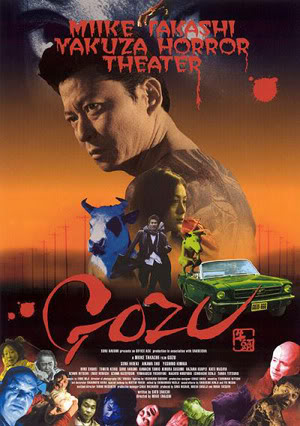
7. Gozu (dir. Takashi Miike, scr. Sakichi Satô)

Like Happiness of the Katakuris and Dead or Alive 2: Birds, Gozu is one of the projects on which Takashi Miike's scatterbrained any/everything-goes inspirations align to form a coherent whole. Gozu rides on the shoulder of gangster Minami, as he is assigned to assassinate his criminal mentor, Ozaki, whose mounting madness is concerning the bosses. Beginning as curveball yakuza thriller and landing somewhere far outside the stadium, the film becomes rapidly infected with Ozaki's madness as it winds deeper through Minami's grey-matter maze.

Other bad-boy/weird-boy artists may share Miike’s delight in gross-out body horror, the love of a dirty joke about sex and/or violence gone too far. But truly no holds are barred here, as homosocial bonding explodes into homosexual panic, the knight’s quest sets down in a labyrinth of sexual confusion, and gods old and new assert their terrifying alien presence. Takashi Miike thirsts for transgression, strives for perversity, cannot resist jerking any string he sees tied to an audience. This keeps his films bubbling and alive, and he knows that in a morass of horror the greatest shock tactic of all are moments of clear, quiet beauty. Miike is fearless.


6. Cowards Bend the Knee (dir. Guy Maddin, scr. Maddin, Adam Gierasch)

Guy Maddin's multipart not-serial "Hands of Dr. Orlac" riff was originally presented in 10 chapter loops, viewed privately through kinetoscopesque peepholes. What an experience that must have been, staring into a tunnel that bends back into your brain, or maybe Guy Maddin's brain. One wonders if Los Angeles is at all envious toward Winnipeg, as it pours hundreds of millions of dollars into productions without a fraction of the inventive results Maddin achieves with a $10 cheque from the National Film Board in pocket.

The armies of screenwriters tasked to invent ludicrous stakes-raising plot points every 20 pages cannot produce events as numerous or outrageous as Maddin jams into sixty seconds, as he hurtles through exposition with terse, exclamatory intertitles. Those all up on Charlie Kaufman's jock for fracturing his commercial impulses into an imagined awful twin brother might die of astonishment as Cowards Bend the Knee follows one "Guy Maddin," hockey star turned hairdresser, who ditches his preggo girlfriend in the middle of an unsanitary abortion, and embarks on a murder quest that his new squeeze will let him touch her boobs, if only with her dead father's transplanted hands. While drenched in/fixated on the techniques of early cinema (and in love with the ironic, mysterious, poetic effect of decay upon the physical materials of formerly-ultra-modern films as much as how cool women's make up was in the '20s), Maddin cuts more times per minute than Michael Bay. Only one of them, however, uses the Moviola's Veg-O-Matic attachment to 1) convey "images" containing "information" and in "a meaningful way", and/or 2) harness the powers of Eisensteinian montage to portray the moral conundrum of fisting your girlfriend's mother to avenge a dead hockey player.

Perhaps direct comparisons are meaningless, but combining apple and orange peels may make nice potpourris.


5. Memories of Murder (dir. Bong Joon-ho, scr. Bong, Kim Kwang-rim, Shim Sung-bo)

From even the first ant-covered corpse found in a drainage pipe, the rain drenched crime scenes are saturated with clues — killings timed to weather patterns, clear and consistent modus operandi, footprints in mud, and a surplus of forensic biological evidence. But alas, it is 1986, in a nation with no labs for DNA testing and no precedent for serial murder. And lo, Detectives Park (Song Kang-ho, more in a moment) and Cho (Kim Roe-ha, obsessed with kicking people) are a bit lazy, a bit sadistic, sloppy of method and utterly unprepared. And so the bumbling, undisciplined rural police force matches wits with South Korea’s first documented serial killer, but the cops are only half-armed. Brooding Detective Seo is sent in from Seoul to assist, and actor Kim Sang-kyung plays him with cool dude quiet, supercompetant with haunted brain always abuzz, and the threatened Park and Cho act as unhelpful Watsons to his stymied Holmes, attempting to show up the better investigator. But Seo is a man unstuck in time, the state of ‘80s forensic science in South Korea can’t keep up. He responds by becoming more haunted.

Memories of Murder, like director Bong’s The Host, approaches its story as if it could belong to a dozen possible genres, allowing blind, unpredictable left-hand turns, sometimes straight into the headlights of oncoming traffic. The strategy illuminates everything in turn. A police procedural about the flouting and botching of procedure, a comedy of errors as nitwits scurry against the tide of horror, a study in masculine one-upmanship and bonding, a crime thriller about ethical slippage as men of nebulous goodness quest to capture an evil made of smoke, a period piece about the way the present leaves scars on the future as history washes away.

In the film’s final moments, Park has long retired from the force, moved on to sunnier pastures, but pays a visit to that ditch from long ago. A passing child indicates that the murderer may have recently stopped by to peer into the tunnel. Song Kang-ho stares into the camera in the greatest close-up of the young millennium. Just his face, straight ahead, expressionless but brimming, as his memory floods: all that has happened, all those intersecting paths, who he’s been, how the case transformed him multiple times over, how these crimes and horrors destroyed him and improved him. A killer walks, a detective looks at a ditch, the afternoon is lovely, the clouds roll insensately on.

One performer’s resume highlights over ten years: Joint Security Area, Sympathy for Mr. Vengeance, The Host, The Show Must Go On, The Good, The Bad and the Weird, Thirst, and more bit part work for Park Chan-wook. Certainly a cool job list, but also of vast range and depth of character. His performance in Memories of Murder alone might have placed him in consideration.

Song Kang-ho is the actor of the decade.


4. Oldboy (dir. Park Chan-wook, scr. Park, Hwang Jo-yun, Lim Chun-hyeong, Lim Joon-hyung, Garon Tsuchiya, based on the comic by Garon Tsuchiya and Nobuaki Minegishi)

Wonder why Oh Dae-su is locked up in that room for 15 years! Wonder why he is released! Wonder what the title means! Oldboy teases with well-measured mysteries and patient reveals. What would you do if you were locked in a room for 15 years? If released? If... And from set-up to final moments, Oldboy offers those great hooky What If?s that fold back to reveal relevant moral questions both less fantastical and more difficult. Live octopus consumption, giant ant hallucination, (and, yes) one-man, one-hammer vs a hallway long goon platoon fight. Oldboy traffics in indelible never-seen-it-before images and heightened situation vitality that is the reason for pulp art.

Oldboy offers among its freaked-out images and wild ideas the most dramatic (multiple senses) transformation (multiple senses) of a leading man of the decade. Choi Mun-sik's soulful and scary performance begins in bloated, drunken aimlessness, melts into shaggy, impotent rage, hardens into dour, inky single-mindedness, shatters into sensitive snowflakes and disappears on the wind.


3. The Lord of the Rings: The Return of the King (dir. Peter Jackson, scr. Jackson, Fran Walsh, Philippa Boyens, based on the novel by J.R.R. Tolkein)

The panoply of geeks and tableaux of mean-anything "yeah, man" symbolism of Jackson's Weta-fied take on Lord of the Rings finally accumulates into an 11-hour version of the 7-minute traffic jam dolly from Week-End across the gatefold art for Eat a Peach. An acid-burned money shot of cave-Lugosi Gollum in ecstasy as he splats into the hot sauce (dude, the camera goes through the Ring) punctuates a climax that boils down to three midgets drawn by destiny into a cartoon volcano to fight over evil jewelry, and well, let us not forget to note that is a very strange way to end a very expensive event movie.

Return of the King is not over after that, and like the Ring, resists dissolving in the heat. How ever exciting or violent or scary Rings was along the way, in any given moment Papa tells us that yes, the fairy tale has a happy ending. And it does. And then tides lap those mythic shores and it just keeps ending. And it just keeps getting sadder. Or... not sad. Wistful. Perhaps Mr. Frodo Baggins does not suffer the torments of poor John Rambo, but like Herman Blume of Rushmore, part of him will forever sigh "Yeah. I was 'in the shit.'" We don't need to look to movie warriors to understand this, or to warriors at all. After you've gone through a life-changing trauma, the thing is, you are changed and traumatized. And that is another way to end a very expensive event movie.


2. The Matrix Reloaded / The Matrix Revolutions (dir., scr. Larry and Andy Wachowski)

"One thing I've learned in all my years, is that nothing ever works out just the way you want it to." —The Oracle, The Matrix Revolutions

By the time The Matrix was released on DVD (and moved 3 million units), it was readily apparent worldwide sensation would be granted a sequel. And while its conclusion is open-ended enough to warrant further installments — in a way, on reflection seems to demand them — the film is actually cannily constructed to stand alone, should the $63 million dollar experiment have failed.

The Matrix Reloaded and The Matrix Revolutions, however, written concurrently, produced back-to-back, released months apart, are the work of storytellers who have been guaranteed a forum. Three chapters, that is the length and breadth of the window. At the conclusion of The Matrix, Thomas Anderson fulfilled messianic prophecy, was resurrected from death to combat the apparent devil of Agent Smith, and flew away as a rabble-rousing Marxist Superman Christ, and it appeared that the Wachowski brothers had gorged heartily on DC comics, anime, Hong Kong action movies and non-medicinal marijuana before stumbling into their Intro to World Philosophy class; The Matrix is psych-pop riot on scale with Jack Kirby's Forth World comics or The Dark Tower. And these things are going on, to be sure, but if The Matrix made it apparent that the Brothers had read Joseph Campbell on the Monomyth, Reloaded implies that the enemy Machines had read Campbell, too.

It is a frequent complaint but not really true that since action scenes in the Matrix itself are the conflicts of avatars in a computer program, those fisticuffs, chases and gun battles are rendered dramatically weightless by the same masterstroke (I know it is frequent, because I've checked Rotten Tomatoes). Certainly by the story's explicit rules, if you die in the Matrix, you die in your chair on the hovercraft thing. Something else is going on with the digital dreamworld though, and it always hinged on the idea that what happens in the Matrix is just as immediate and vital as events in the physical world: there is no spoon, but you have to deal with the idea of the spoon anyway. The Matrix, as literal a reality for the film viewer as Zion, Machine City, the Construct, the Train Station, or any movie you've ever seen, provides, if not complete Brechtian distance, a certain metaphorical brain-padding.

The Matrix Reloaded, point by point, loosens the screws on everything The Matrix seemed to be saying, vis-à-vis Christ figures, Chosen Ones and designated hero-saviors, then in final spectacular blow-out kicks them over. The Matrix does trace Neo's walk down a well-trod path, even if in comparison to Establishment-approved heroes, his route is richer, more subversive, disobedient and slightly bonkers. Those who find the story satisfactory as the Übermensch ascends and the credits roll may gaze upon Reloaded and mutter, as does poor Morpheus, "I have dreamed a dream and now that dream is gone from me."

Maybe we hate to see this happen to Morpheus, who we once met as particularly charismatic kung-fu Ben Kenobi, but there was always a problem with his worldview. Morpheus began his exposition on the Matrix not by emphasizing the horror of bodily imprisonment or painting the human/Machine paradigm as host/parasite, but in terms of ideological oppression. He says the Matrix is a prison for the mind, and frames it in sociopolitical terms, telling Neo that you are enslaved by economic systems, government, media... and religion. He spends Reloaded taking contrary position to rational, pragmatic pessimist Commander Lock. He places faith in prophecy and believes the Oracle to have supernatural powers. He's dogmatic. He is great at criticizing other people's dogma, but blind to his own. For a man who sees providence everywhere, he's somehow never examined the question that begs: providence in service of what?

And Neo breaks it to him, that the very concept of The One, the seductive story of a supernatural savior was another level of control. Neo is dejected too, though it should have always occurred to this man who does not like the feeling that he does not control his life. Well. Nothing ever works out just the way you want it to.

Confidence, vision and purpose bind the Wachowski's filmmaking. Every action sequence is a little carnival of invention, telescoping in scale, packing in oddball poetic detail, always expressed in crystallized, striking images of comics panel clarity, always concerned about — always about — movement in time and space. As every moment is meticulously designed and crammed to the hilt with Meaning and Cool, one is hard pressed to choose a favorite. But if this is about choice, consider this contender, as dark messiah defector Agent Smith steps onto a green-tinted, abandoned urban playground, a viral Loki in black Secret Service suit, a flock of crows dispersing in honey-thick slow motion. Perceptive time snaps back to normal, and Smith gives Mr. Anderson a rousing, ominous speech about his doomsday perspective on "purpose": "We're not here because we're free, we're here because we're not free." And Agent Smith, it turns out, is in no way "wrong." There is a visual motif in the trilogy, of halls full of pillars, which are pummeled by gunfire, chipped away by kicking and punching, used as shields and cover for ambush. The pillars are blasted, but not to be taken for granted.

As the second film variously negates, inverts, complicates and deconstructs the first, so the third reconfigures, reprograms and reinserts the code. The thing about Christ figures is that they don't kick people to death, and must understand perfect sacrifice. The Matrix Trilogy completed is larger than a headtrip cyberpunk messiah myth; it is an exegesis and meditation on the purpose, use, abuse, and meaning of the Monomyth in our lives. Everything that has an end also has a beginning, and this story was never complete until the God From the Machine murmurs, "it is done." Each step of the way, the Matrix films grow increasingly wise, profound and/or profoundly bananas. If all the Wachowskis will reveal is that The Matrix is "about robots vs. kung fu", by the end they are also about mecha vs. tentacle monsters, samurai vs. ghosts, and a giant talking baby head vs. a blind wizard. The final fistfight is as much about Hegelian dialectics as dueling imbalanced Christs, Vishnu avatars amok, the will to power and the strength to sacrifice, control and receptivity, as it is about every slacker's battle with his boss. It's truly the Dude vs. The Man. It's purpose that binds them.

Some things in this world change, some never change, and nothing ever works out just the way you want it to. Maybe that's for the best. The Wachowskis make strong, sometimes difficult, often weird choices with the Matrix trilogy. Now you have to understand why they made them.


1. Kill Bill (Vol.1) (dir., scr. Quentin Tarantino)

A’right, here’s a thing we should get out of the way right up front, you and I. I'm going to say this part in English so you know how serious I am. Kill Bill is one movie. It was written as one movie, and shot as one movie, and treated up to a point in the editing process as one movie. It is one long movie delivered in two parts, just exactly like Children of Paradise. And just-exactly-like-Children-of-Paradise, it is acceptable to spread a viewing across two evenings, but the story isn’t over until the credits roll on Vol. 2.

And now we have that out of the way. So the reason the break between Vol.s is ingenious is that it ought to help underline the complex structure of Kill Bill. The plot worms and winds through the Bride’s list of Things To Do Today: Kill Everyone, but the narrative folds on itself. Not chronologically as in Pulp Fiction's loop-the-loop, but it thematically doubles, a technique Tarantino would explore in the persistent halving of Death Proof and the caduceusian build of Inglourious Basterds, twin snakes winding around a central pole. It is not perfectly accurate that Vol. 1 is all action, ass-kick and adrenaline, Vol. 2 all talk, heartbreak and tears. There is, after all, a lot of jump kicks and a lot of talking in both halves.

If Hamlet is about a protracted case of deciding to do some revenging, exacerbated by a too-smart/crazy-for-his-own-good hero, aware of the impending complications of others' agendas and moral skew, Kill Bill Vol. 1 is about the difficult task of orchestrating and focusing on a hearty revenge even once that choice is made. Also, oops, there are complications. Conventional wisdom has it that Kill Bill is painted broad-stroke bold, a story so primal and simple that it dares to put the ending in the title. Reality is that revenge is never a straight line, and this thing is pitching screwballs before it gets to the mound. Rococo characterization of every supervillain badass, every brutal, balletic action sequence paced and beat-out with a storyteller's instinct, every scene lovingly hand-injected with endorphins, liquefied condensed film stock and bubbling fizzy love. Every prop is a personalized emblem (quickcheck the lioness motif through the films) starting with The Bride's sword, though not every object is gifted with half an hour of elaborated backstory, one has been imagined, from the Pussy Wagon's keychain to Sheriff McGraw's collection of aviator sunglasses, from GoGo Yubari's beaded knife sheath to The Bride's yellow ASICs with FUCK U embossed on the soles. In a world of Red Apples and Fruit Brute, every watch is The Gold Watch to somebody.

And everybody broke somebody's heart, and, revenge being a forest, everyone's trees are blocking someone's sun. They all came from somewhere, are going somewhere, and meet a crisis point in that forest. So here is the Deadly Viper Assassination Squad (even our spelling bee flunkout auteur must know this does not acronymize into "DiVAS"), once bound as teammates, bound in a Massacre at Two Pines, now bound on a List. To varying degrees we see (or will see) where they've been, how they grew, how they changed by choice or circumstance, learn their designated Tragic Flaws and understand their sins. They'll get to change one more time, and then they'll get chopped up, but everyone will have their say. The enigma among these vipers is the silly Caucasian girl who likes to play with samurai swords, the one we've been calling The Bride, 'cause of the dress. The others, it seems, have been schooled and tested, risen and fallen, and have discovered what kind of people they are and will be. The Bride, though, has a long way to go on this mission of self-discovery. Poor girl thinks she's on a revenge mission. We'll see how long that lasts. Silly rabbit, doesn't she know Trix are for kids?

Who knows what kind of life experiences outside "the video store" that Top Critics agree Mr. Tarantino has not had, wish he would experience and bring to bear on his storytelling. From here, it looks like he's lived as much life as any of us.