Showing posts with label Mary Harron. Show all posts

Wednesday, March 16, 2011

Two Zero Zero X: Favorite Films of the Decade Pt. 7 — 2006

Previously: 2000, 2001, 2002, 2003, 2004, 2005...

Two quick notes, skippable for the disinterested. The Decade Review Revue continues because I always meant for it to take a long time, spread well past when your list-collating people are collating lists of such things. Not because we are now properly in a new decade — as a man once said, "Nobody likes a math nerd, Scully" — but because I enjoy this project and can take my time. See, reviewers and columnist types — those with niceties like editors, paychecks and readers — have to do constant pulse-taking and odometer-checking as they jog their beat. So right about now they're, what?, supposed to be writing about awards and/or festivals and/or generating think-pieces about, like, what celebrities wear to court. Daaamn, that's a harsh gig, but I ain't judgin', I'm just sayin'. Surely this is a stubborn exercise in what my sixth grade teacher politely called “divergent thinking” but the post-mortem on The 2000s is not done till we’ve weighed all the organs and sewn it back up.

One of the reasons the "Two Zero Zero X" lists take so long to write is that I make a point to investigate a lot of films from each year that I hadn't caught up with and rewatch anything I have not seen in awhile. So, logically, the more recent the year of inquiry, the less time I've had to see everything I'm interested in. But I'm finding that it doesn’t really matter. Gaze, for instance, at this original Best of 2006 round-up, and note that it doesn't look much different from a mash-up of the list below plus a couple of foreign film holdouts from 2005 and a couple of items that would show up on this 2007 list. We're entering territory largely already covered, since this journal's inception in 2005. So dread the upcoming day when I have to discover if I really have more to say about Grindhouse (2007!), but in the meantime, welcome to 2006, which isn't so different from last time we visited 2006...

The Exploding Kinetoscope — 10 Favorite Films of 2006

10. V for Vendetta (dir. James McTeigue, scr. Larry Wachowski, Andy Wachowski, from the comic by Alan Moore and David Lloyd)

Well, you can draw this stuff, but that doesn't mean you can film it. The V for Vendetta comic that Alan Moore wrote between 1982 and 1985 extrapolates a political dystopia out of '80s Thatcherism and sets against it a sort of man-against-the-system freedom fighter missing link between archcriminal terrorist Fantômas and the proto-superheroics of The Shadow. It is an almost-direct-engagement of contemporary political situations by way of enlargement. The polemics on-page are located at the inflamed ends of a spectrum, which is the position from which, gods bless him, Moore always makes sociopolitical argument, which is to say that the comic is about Fascism v. Anarchy. The older and wiser Moore gets, the more he boils human power struggle down to these terms, which makes for compelling art and zero tolerance for, say, American and Australian filmmakers futzing around with his book. Multipurpose metaphor, of course, is how one builds things to last.

Of the transition from agitprop comic to the McTeigue/Wachowskis/Silver poli-sci-fi film, Moore offered the astute criticism that the metaphor has been remolded to a sort of contemporary American liberal response to neo-conservativism. This is, of course, meant as a complaint, but might as well be a compliment, because, Jesus, ain't that something? Joel Silver surely has his own peculiar voice as a producer, and the verdict may be iffy on the voice of Mr. McTiegue, but part of the Wachowski project thus far has been to dance a highly subversive ballet on the stage of the monolithic studio system without allowing the sundry associated pressures to interfere with their choreography. The decade's preferred commercial spectacle genres were superhero action and nerd fantasy literature adaptation, and, 2006 being Life During Wartime and a Dark Time for the Nation and Post-9-11 and all, V for Vendetta is rather a break in continuity in this pop art dialectic. It sprays graffiti on the broad, oppressive walls of Batman Begins, and, because it wears a mask, can walk right up and do its business in broad daylight.


9. Black Book (dir. Paul Verhoeven, scr. Verhoeven, Gerard Soeteman)

There is something of the same work being done in Black Book as in decade fellows The Pianist and Inglourious Basterds, in that cine-serious authors with hearty, ironic senses of humor have made deep-probe adventures set in non-battlefront corners of World War II, and largely in reaction to how the war is depicted and discussed at the movies. In their particular ways, Polanski, Tarantino and Verhoeven find their tendencies to puckish perversity roused by an interesting unresolvable tension: war, this war in particular, provides a marvelous toy chest with which to build stories, and is at the same time the most disgusting thing of which human beings are capable.

Black Book is then a sort of Raiders of the Lost Ark with the ark popped open at the beginning, and the whole adventure story scorched by punishing fire. Verhoeven and actress Carice van Houten go on an epic marathon run with heroine Rachel Stein as she tries to outrun the razing of the European landscape, hopping and dodging through story-modes and transforming from refugee to resistance fighter to girl spy to revenger. If John Rambo grunted that to survive war, you have to become war, here are a dozen variations on what he might have meant, and they all boil down to the constant, increasing moral compromise. Whatever you do to survive in the moment, you pay for later. Whoever is on top after the battle needs a scapegoat. If a principle is exhibited in this formula it is the conservation of mass: all that shit is going to end up dumped on somebody, over and over, forever and ever. If there are tips provided on how to survive the ordeal of existence, they are that once in awhile chocolate can save your life, and never climb into a coffin before it is your time. This is Man's Inhumanity to Man as action-adventure spectacle, and a Thrilling Survival Tale of the Enduring Human Spirit in which history is chronicled in one endlessly long black book.


8. Gumby Dharma (dir. Robina Marchesi)

Shucks, back in 2009 I had hoped Gumby Dharma, the epic-in-miniature biographical documentary about Art Clokey, would find a good distribution channel and lead to sudden widespread interest in Clokey's animation, and there would be a bunch of exciting articles about Gumby for me to read. None of this happened, and, worst of all, Art Clokey stopped motion on this plane of existence early last year, passing away on January 8, 2010 at the age of 88. The bulk of his work remains poorly represented on modern home video formats and Gumby Dharma has shown on the Sundance Channel and was finally released on video in March, 2010.

Documentaries about filmmakers and their work are in no short supply, and in sundry form litter the Special Features menus of a thousand DVDs. Gumby Dharma is automatically interesting for those who value Clokey’s work, but it also builds a case for its subject as a filmmaker worthy of study beyond just the recognizability of Gumby bendy toys. This work begins by telling Art Clokey's story without flinching, which means personal and professional triumphs are not inflated beyond their context, and death, drugs, disease, loss, abuse and bad behavior — those examples inflicted by Clokey or upon him — are met head-on. If that is not extraordinary for a 21st century documentary, please, please do not forget that we are still talking about Gumby cartoons, and that this is a story that has never been told with such depth and honesty. This is not to paint Gumby Dharma as some sort of scandalous exposé of Art Clokey; it is, rather, a complicated, naked, and ultimately joyous portrait of a man, an artist, an animator, a filmmaker.

Last time around, my notes focused on the film's excellent formal choices and valuable research and historical testimonies, and delicately rendered profile of Clokey. I do not want to lose sight of what I feel is Gumby Dharma's overriding thesis, which is that the animator possessed a unique vision of the world and was able to channel that into undulating, speaking, dancing clay. All that passion and pain, curiosity and fear, weirdness and love pulse through Gumby; Gumby skates and plays along the path, and he is the path, the ball of clay, the heart, the part, the enterable book, the blade of grass, the you.


7. A Scanner Darkly (dir. Richard Linklater, scr. Linklater from the novel by Philip K. Dick)

These things cannot be defined in tidy syllogisms or anything, and this isn't about, like, rules, man. But to help sort things out, we might say that: Obviously not all films about drugs are proper head movies. And at the risk of offending, what I'm talking about with this classification does not include a vast majority of stoner comedies, nor the sort of SFX-heavy audio-visual spectacles one might use as an in-home Laser Floyd show. A great head movie A) is about and/or is an investigation into consciousness expansion and/or warping, and/or B) examines, encapsulates, and/or explains the human experience with an eye that is part anthropological, part philosophical, part spiritual. Hints that the film might open up with a chemical key are optional. Whew!

A Scanner Darkly has those qualities, so by my count Richard Linklater has two fine head movies under his belt, and a handful of interesting experiments (the Before Sunrise/Set diptych and Waking Life, which are earnest almost-theres, Slacker, which plays better straight or very caffeinated, etc.) Where the beautiful and fuzzy-hearted Dazed and Confused wafts by on a Circle of Life/Family of Man buzz, A Scanner Darkly is paranoid, doomed, tragic, cottonmouthed. Fueled on dread, it is set entirely during that bad moment you are coming down, notice your fingernails are way too dirty, there is a stack of unwashed dishes in the sink, and maybe you're not coming down after all. So get this: undercover agent Bob Arctor goes so deep under that he ends up investigating himself, and watching with a detective's fascination as the twin serpents of Id and Superego begin uncoiling from their cosmic hula around the center pole. Do try this at home, but maybe not in public.

When last we saw Keanu Reeves on this journey, the effect was opposite: Neo staring back at the threshold of perception, seeing the code beneath the skin, and finally learning to sense the gold that unites it all — no glass, no scanner. If Robert Zemeckis' mo-cap freakout Beowulf accidentally captures the acid-vision nightmare that humans are weird-eyed puppet husks being jerked awkwardly around too-vivid sets, reenacting some kind of mythological parody, the computer rotoscoping of A Scanner Darkly serves a not dissimilar function. Here the stage is made vague or simplified with outlines and color planes, while the surface of the players players crawl and squirm; the whole world is covered with a thin metaphorical hide, a construct, a mask, a cartoon envelope that can't quite be peeled back but isn't quite telling the truth.


6. Pirates of the Caribbean: Dead Man’s Chest (dir. Gore Verbinski, prd. Jerry Bruckheimer, scr. Ted Elliot, Terry Rossio)

Curse of the Black Pearl reformed the theme park ride’s impressionistic story of skeletal pirates, hoarded gold and the wages of sin into particularly buoyant four-quad fantasy action adventure. With the scant narrative materials of the theme park source material used up, Dead Man's Chest scrapes up the unused themed visuals (fireflies), settings (bayou), and ambiance, then goes about the business of transforming the Pirates of the Caribbean series from a potential string of cast-connected sequels into a trilogy proper, and that is an exponentially more difficult exercise. That is, Dead Man's Chest has to connect forwards and backwards to make three scheduled films into a one massive three-chapter story. To illustrate the difficulty and ambition of that task, consider that while remembered as "trilogies," The Godfather is not built like this, Star Wars is not built like this, and so forth. Pirates is outsized, long-form original storytelling, whether it is "branded" as a concern of a major corporation or not. On the business end, where all films are merchandise, someone in a suit seems to have remembered that the merchandise is still art, that despite all their cruise lines and shopping mall emporiums, The Company is still in the business of stories and characters.

This is all simply to say that despite the increasingly pre-drinking-age milieu of the Summer Movie Game, the Pirates films are unusually committed to and serious about that game. They are crafted with the belief that an audience is invested in the tale and the world, so every nook, cranny, and cannon is crammed to the brim. Completely, seam-burstingly overstuffed, to be sure, but this middle chapter in particular is a Valu-Pak film; it's so much movie. There is faith here that this story should be dense and all subplots should intertwine and motivate each other, that sets should be rich with detail, every single character should grow or change or be tested — that each of them is someone's favorite player and so should have a hero's entrance, a crowning moment of cool, and a dramatic exit — and that half the spectacle is of actors acting. That makes it noisy and exhausting, but heartening next to most of its glib, insincere competition — say, Universal's Mummy movies.

Pirates is blessed with a glinting edge of perversity— an eye for grotesque design, admiration for mischief, a hard-on for the masochistic dimension of heroic sacrifice, and not a little bit of out-of-the-blue weirdness. It is far more sexed-up than Lord of the Rings, and more tripped-out than Harry Potter, breezier than both by several factors. If the comparison to fantasy-lit classics of their kind seems unfair (or unfounded), consider that Pirates is aiming exactly that high, and that ambition alone is pretty damn cool. With this installment, it becomes clearer that in its overstimulated noggin and wistful heart, this story is about mortality, about the death of imagination and adventure at the hands of global business expansion, cultural imperialism, colonization — about fun withering in the brutal sun of finance. In this light, that the Pirates of the Caribbean movie overlay onto Disneyland's Pirates of the Caribbean ride does a tragic disservice to both the park and the films can only be bitterly fascinating.


5. The Host (dir. Bong Joon-ho, scr. Bong, Baek Chul-hyun)

The monster is big, but could probably fit in your living room if you have high ceilings. We traditionally read human-size monsters as a warped Us or a feared Other, and the bigguns as metaphors for some pressing sociopolitical terror, both are favorite subjects for extensive probing with psychoanalytic theory, and fair enough to all that. The best of the best, from King Kong to Mothra Vs. Godzilla, Q — The Winged Serpent to Jurassic Park, find some magical way to make the ground-level, people-sized story as compelling as the beast rampage and about something besides mere survival. That is no mean feat.

The Host injects intense big monster mayhem into a droll dysfunctional family comedy, warping it into a search-and-rescue abduction suspenser as the Park family looks for their youngest member who has been swiped by the creature, and frames it all in Brazil-style paranoid government thriller. Somewhere near the center of this is another superlative performance by Song Kang-ho as Gang-du, the monster-napped child's scruffy nitwit slacker father. Song plays Gang-du something like Shaggy in mourning having lost Scooby, beginning with literal pratfalls and emotional slapstick, until the lovable cartoon dope is hardened and seasoned with hellfire, and somehow coming out on the other side as a lop-sided, smushy-hearted hero.

So we have here a daikaiju black comedy sprouting agitprop polyps and one can't really predict where it's going, what will happen next. This is not to say that The Host plays as a crazy quilt mash-up, or is as nuts as, say, #3 below, or dreams of being something other or "better" than a giant monster picture. Instead it dreams bigger, striving to be the best giant monster picture it can be.


4. The Notorious Bettie Page (dir. Mary Harron, scr. Harron, Guinevere Turner)

You don't get to be notorious all by your lonesome. "Notorious" is a reputation, and that requires observers to cast an opinion. It goes without saying that pinup models are the locus of much fantasy projection — that's pretty much what they're for. Besides the obvious, consider the imagination fuel of even innocuous swimsuit cheesecake photo. We might imagine the scenario suggested by the photo, or the circumstances of the photoshoot itself, the unseen photographer and the photographic apparatus. We imagine those body parts not on display, hidden by wardrobe or pose, imagine the dimensions not captured in 2D. We imagine the model in movement, imagine her voice, and imagine a personality onto the mute, frozen figure. When we look at Bettie Page, we project an imagined Bettie onto her.

Harron and screenwriting partner Turner begin The Notorious Bettie Page with a basic map of the strategy that will branch out through the film. Adult bookstore customers inquire about the selection of under-the-counter specialty photos ("unusual footwear" stuff, if that means anything to you), but in short order the shop is raided by cops: one trenchcoat crowd replaces another, and Bettie Page finds herself summoned before Senator Estes Kefauver's Senate subcommittee hearings on pornography and juvenile delinquency. So there we have it, two audiences hunting for the same photos but imagining their own Betties for their own reasons and to their own ends, and the flesh-blood-and-bangs Bettie the cause of it all, or tied up in the middle of it, or maybe just there and being Bettie.

Now any old model, real or invented, could potentially serve as subject here. Harron, Turner and Gretchen Mol — their flat-out sparkling, bubbling, fully-carbonated Bettie — never indicate for a moment that they've distilled the ultimate secret true story of their subject. Rather, the film suggests that any biography by its very existence imposes a narrative on the raw data of a life and creates a character in the process. To tell the story of Bettie Page is to make Bettie Page into a story. This, Notorious indicates, has its potential virtues and pitfalls, but is the process by which identity and legend are built.

It has to be Bettie, or at least she is a perfect subject. Page's latter-day immortality as cult pin-up is the reason this biopic exists, and that interest was stoked by the apparent mystery of What Became of Bettie Page? By the mid-'50s she'd become the most photographed model in the world. She worked in nearly every form of non-explicit adult photography, from Playboy centerfolds to 8mm catfight films to underground bondage photo clubs to burlesque revue movies. That's a lot of audience, a lot of imagined Betties. What Bettie Page meant in the middle of the 20th century is not what Bettie Page meant by the end of the century, by which time she'd become America's retro sex icon of choice, plastered on comics shop walls, motorbike gas tanks, and photobooks destined for the coffee tables of the très hip across the nation. That's a lot more audience, and more Betties. The interim is legend, speculation, rumors, stories. And where was Bettie? Unaware that this was happening, that anyone cared about antique nudie pictures, that so many ghost-Betties had come to life.

What The Notorious Bettie Page does that is so intelligent and kind — charitable, really — is suggest that all of our fantasies of Bettie Page — those sexual and political, those that would make her victim or legend, those that would see her in bondage or in angel wings — are legitimate and integral parts of her biography, and her extensive body of modeling work continues to fascinate and inspire, which is the legacy of that work. The photos and films, you can have. The story, whichever you prefer, you can have that too. But only Bettie Page lived the life, and that is not something to solve and explain. That, you don't get to have.

As she once said in Striporama (1953), her only speaking role on film, "I'm illusion!" "You mean you're not real?," gasp the baggypants comedians who would possess her. Replies Illusion Bettie: "Of course I'm real."


3. Brand Upon the Brain! (dir. Guy Maddin, scr. Maddin, George Toles, Louis Negin)

Guy Maddin — the character in Brand Upon the Brain! and director of Brand Upon the Brain! — puts a fresh coat of whitewash on the island lighthouse where he grew up, and feverishly reminisces about his childhood loves, traumas and love-traumas, dramatized as careening melodrama/mad scientist/teen detective/wild child/evil mother/incest romance/zombie horror/steampunk melodrama and made in the style of, um, a Soviet montage/German expressionist/Hollywood silent comedy/abstract cheesecake peepshow. That's all literal as it is metaphorical, and though this is poetic interior autobiography and rumination on the nature of Memory and Self, nothing could be more accessible: it's sex-fixated and silly, the plot never stops moving for five seconds and it's a knee-slapper front to back. No doctors or lit majors need to assist with the decoding, as the plum-syrup narration will do it for you, and it's impossible to be inscrutable when everything is on the table.

Maddin's lighthouse is famously stocked with out-of-fashion early cinema, pulp fiction and avant-garde clutter, but fret not, all you have to do is experience the sight of how that stuff branded his brain, and learn in short order what is so special about all that moldy old stuff. Maddin is, in these blatant ways forever fetishistically gazing at a silver-emulsioned past, a memory eating itself up like nitrocellulose decomposition, but is also forward-thinking, evolutionary. Everybody and their mom knows how to psychoanalyze a filmmaker based on how he frames a shot, can pick out Major Themes from table setting mis-en-scène, and knows which props are phallic and which ones criticize American foreign policy. So what if, asks Guy Maddin, we start with the assumption that this work is already done, and set archetypes and personal symbols on a romp through a story-space that purports to dive straight into the psychosexual miasma of the artist's head? The result is a wholly original breed of comedy, an exciting new kind of storytelling, and cliché-decimating entertainment built entirely out of clichés so disused you've never seen them before.


2. The Black Dahlia (dir. Brian De Palma, scr. Josh Friedman from the novel by James Ellroy)

Certain crimes — big, terrifying, era-defining crimes, mainly — speak to us with layered voices, at first seeming to be manifestations of some core societal fear, but ultimately telling us more about what we are afraid of than actually confirming those dangers, prejudices and myths. e.g., in the moment it can appear, through spin or sincere interpretation, that the Manson Family crime spree confirmed dark fears about hippie culture, drugs, rock music, California. Certainly those events and those figures spoke to a significant portion of the population in exactly that way. But those crimes were so singular, Manson himself so exceptional, the scene so one-of-a-kind that, really, it doesn’t say such a thing at all. In that case, we’re left with a tragedy about this particular nutjob con man, his brainwash victims and their subsequent non-symbolic coincidental murder victims. This is not a cozy thought, but in the ensuing hysteria and excitement Charles Manson is given a constant public forum, and the families of victims are forever caught in this ugly saga. That Family of victims extends on out along this fractal arm, from Roman Polanski in the micro to the entire Love Generation in the macro. When this feedback loop is turned up loud enough, somewhere in the mix Manson’s code-speak bilious rants end up being made true: you wanted a Devil, he’ll be your Devil.

After the tawdry facts of a crime, and beyond the personal aftermath for survivors, the further tragedy is in the myth-making. If we’re adept at keeping our eye on the birdie, the underlying theme tends to be how good the media is at finding an angle to sell a story. Even if we’re dealing with the Kennedy assassinations, 9/11/01 or Jeffery Dahmer, data points are not a story: you need a narrative hook. The big ones leave us all scarred, even if that mark is only across the imagination. So:

Meanwhile, over in the vacant lot on Norton Avenue, Elizabeth Short is transfigured in death into The Black Dahlia. And that particular body, with those particular memory-searing, picturesque mutilations, might have captured public imagination for a few weeks, but that’s not The Story. The Legend of the Black Dahlia is that this poor Massachusetts girl wanted to be in pictures, and ended up in pieces. That seems to say something; about this untamed town that wants to be a desert; about this Boulevard of Dreams littered with the shards of broken would-be starlets; about a Dream Factory that is really a high stakes business running on the blood of pretty young things; about a Tinsel Town adorned with razor wire.

That would be the legend, of course, and it’s a good one — so good that its whirlpool sucks down L.A. “supercop” and local celebrity pugilist Lee Blanchard (Aaron Eckhart, doing impotent moron in meltdown like a champ). Poor sap only lasts, what? A week?, so caught up is he in dead white girl mania and troubling, circling questions that are not beside the point, but not conducive to solving the crime. What is this strange system by which starry-eyed women offer themselves up to men with money and cameras? Is this germane to the question that James Ellroy says is at the heart of this mystery, which is: why do men kill women? We note here, that this is the kind of thing that Short's murder makes one think about. Blanchard can't reconcile the black alchemy that discards the bodies and leaves the immortal part on a screen and made of light. He can't make it add up, and as is the hotheaded flatfoot's fate, ends up pursuing the Dahlia into Hell — that is, his throat slit and body fed into the furnace by his mob-connected informant. Blowing out of this world as a spectacular, blinding, horrifying supernova is no substitute for the dream of being a star.

After all is said, done and revealed, Blanchard was scrambling through life to protect an image. His fancy home is funded with stolen money, his career accomplishments puffed up, his promotions earned for their P.R. value, his fame-making boxing win a rigged fight, his live-in girlfriend poses well on his arm but he isn't sleeping with her. In his main squeeze, Kay Lake (Scarlett Johansson who, you know, poses well and adequately fills out an angora sweater), Blanchard has built a perfect rescue narrative; she's an ex-prostitute-gone-gold-hearted, and he helped her go straight. His motivations are not just covering up his culpability, living a lie or faking it till he makes it. He protects the ones with a good Story.

This is the guy who is "supposed to be the hero," as per the real protagonist, Bucky Bleichert (Josh Hartnett wearing a hat), who holds an ice pack to his aching skull as his partner's corpse is fed into the inferno. Mr. Fire and Mr. Ice, then, promotional nicknames invented by the LAPD, which ostensibly describe their boxing styles, more or less indicate their personalities ("I can't move! I never move!" wails glacial Bucky), and indeed one rages and one is slow to thaw. But it's bullshit, too. "You're a political animal!," the Deputy D.A. chastises the broken-down Blanchard. So are they all, and for the Bucky and Lee it means they're pawns, moved to Homicide and put on the Short case because they're the Supercops. Don't you read the papers? They're characters in someone else's story.

If Bucky is tortured by Beth Short at first, it is because the media ruckus over the dead white woman — whose link to The Industry is not even a whisper of a dream, whose movie-derived nickname is entirely posthumous and newspaper-invented — is drawing him away from important cases he could be closing. And maybe, he tells Lee, this Beth Short wasn't such a nice girl. i.e., the crime needs solving, certainly, but maybe it needn't be glorified, made legend. As Charles Manson often points out, he wasn't shit until you put all those TV cameras on him. But.... there stands Kay in her underwear, and sliced into her back are the initials B.D. As it happens, that stands for "Bobby DeWitt," her old pimp. It stands, symbolically, naturally for Black Dahlia. That doesn't go away when you blink. "Who are these men who carve themselves into other people's lives?" the V.O. ponders, and as serendipity would have it, B.D. are the initials of a renowned director of thrillers, horror pictures and neo-noirs who happens to be directing the scene.

The tale connects Paul Leni's Expressionist melodrama The Man Who Laughs (1928) — a horror film for all intents and purposes — with a (fictional) stag reel starring Short. In direct connection, both are shot on the same set (a frankly insane conceit), the former inspiring the later, a beautiful link in the film's chain of mouth trauma that begins with Bucky's symbolic castration when he loses his choppers in the boxing ring. It is a chart of cinematic lineage, as well, in which German avant-garde technique moves overseas and mingles with hardboiled detective fiction, and the resultant new genre baby eventually grows up and Brian De Palma falls in love with it and has to make The Black Dahlia. In these and sundry other ways, De Palma implicates and investigates himself among those who mythologize this crime specifically, but more generally cleave bodies on screen and burn images onto imaginations.

Bucky solves this one, insofar as he learns the details of Elizabeth Short's death. He follows the money, of course. And all are implicated — De Palma and Mack Sennett and the men with the cameras, media and politicians, institutions and underlings, gardeners and carpenters. By the end, Bucky finds the housing development under the Hollywoodland sign was built of rotten wood and hides a film set with a murder shed out back. The very city itself is a façade constructed of corrupt materials. He might've guessed earlier, when the unstable town vibrates in an earthquake. When we leave Bucky, he's still hearing the crows, still seeing that body on every empty lawn. The facts and the legend are both etched on him now. The big ones leave us all scarred.

The citizens of this Los-Angeles-as-black-hole play at being human beings, covering their faces with flimsy masks to indicate profession, social strata, gender, identity and character (arche-?stereo-?)type. The faster they put on their costumes, the faster they are ripped away by the howling void swirling at the center of The Black Dahlia. It is blacker than black in there, so black we need the French to name it. We call it noir.

More on Bucky in Noir-land, symbol-chains and metafic here.


1. INLAND EMPIRE (dir., scr. David Lynch)

David Lynch's shot on video horror movie tops the very short shortlist of that lowly genre's unabashed masterpieces. It is not as bizarre spectacle as Boardinghouse nor as depraved and feverish as Splatter Farm, but it has many fine qualities and is scarier. INLAND EMPIRE was received, ignored, and criticized in a manner that means mounting a defense, writing a simple appreciation and beginning a cursory exploration all amount to the same thing. Insofar as INLAND EMPIRE is a difficult work, three roadblocks typically greet those having difficulty, and rather than demerits, they are simply its qualities. 1) INLAND EMPIRE is a piece unabashedly shot on digital video, and arriving in theaters with the announcement that Lynch has no future plans to shoot on film. 2) INLAND EMPIRE announces itself as a narrative feature and contains abundant plot information but is firmly rooted in modes of avant-garde cinema that include the non-narrative and entirely abstract. 3) The narrative of INLAND EMPIRE is consistently oblique, but explicitly links itself to mystery stories. It seems to offer thousands of clues and few conclusions. At its most explicit it seems to suggest that it might be solved, at its most opaque it seems to suggest that something crucial and meaningful is being missed.

Speaking of solutions, these problems are all, naturally, intertwined. If there is any help to be found below, I would suggest instead that perhaps if you are sitting in front of INLAND EMPIRE with your eyes pointed at the screen, then you do understand INLAND EMPIRE. Unless your eyes are closed.

Lynch often foregrounds the materials used in the creation of his art — like a Jackson Pollack drip painting, the fabric and construction is the subject. Even his figural paintings are dollopped with paint and scribbled on, flat-planed and collaged. Think of the puppet robin meant as real in Blue Velvet or his film-loop-on-sculpture "Six Men Getting Sick" or the incandescent "Premonitions of an Evil Deed", a stunt film of poetry and prowess shot on a Lumière camera. INLAND EMPIRE is boldly, proudly a video project, exploiting and exploring those things only video can do. The result is Lynch's most abstract feature since The Straight Story (1999) and most experimental since Industrial Symphony No. 1 (1990). That is, a true experiment of the let's-see-what-happens variety, this one exploring the visual qualities and editorial rhythms of consumer grade digital video, and in shooting hours and hours of scenes with no master blueprint for assembly.

How to Watch INLAND EMPIRE may be, as Roger Ebert once opined of Dune, to let it wash over you like a dream. This is, in this case: don't fight it. It is the same advice Lynch gave critic Martha Nochimson when they looked at a Pollack together: you do understand it, he told her, I saw your eyes moving across the painting. To engage that dream any more analytically will find one scrambling for purchase, just as in a dream or maybe as when trying to explain one. Some things that happen, you're at a loss to articulate, some are intuitively understood. Anyhow we're squarely (well, asymmetrically) on the shoulders of Laura Dern as actress Susan Blue, who is warned off making the film On High in Blue Tomorrows, and then walking alongside Susan playing Nikki Grace, who is perhaps her own person or several people. An issue that frequently arises when discussing Lynch's film is that the filmmaker finds increasingly sophisticated ways to preserve what he loves about Mysteries, and that love is not in the solving but of luxuriating in Mystery itself. As Sandy asks Jeffrey in Blue Velvet, "you like mysteries that much?" And Jeffrey answers: yes. So analytical language will be wrongheaded at worst, coy-sounding at best. It is not that Lynch films can't be written about, but the task is like tracing letters in smoke or drawing diagrams on wet paper with a fountain pen filled with perfume. And yet, here we are.

This free-associative ebb and flow creative process births a work about a film struggling to be born — or perhaps resisting its creation — and documents the challenge put forth to Laura Dern. Never positive during shooting where her character had been, or where she was going, Dern is ultimately playing an actress grappling with a role. This is a film of linking and connection, disparate geographies, identities, chronologies that peer at one another through torn membranes, down dark hallways, through burn holes in fabric, ruptures in spacetime. Passageways are important in Lynch's work, and all of the films contain a signature movement/image in which the camera descends/dives/probes/is-sucked-into a mysterious black hole: moving deeper into Another Place. In Lost Highway, Fred Madison wanders into a dark corner of his windowless home and emerges somewhere in his own echo chamber head. Blue Velvet famously tilts down from the sky, dives underground, enters a severed ear, reemerges from a reconnected ear and gazes back to the heavens. INLAND EMPIRE is a series of tunnels sliding into one another, connecting back on themselves.

Susan Blue's task is to fully understand Nikki Grace, and to do so she ventures all the way inside and inside out — for Susan to understand and become Nikki, she'll have to plumb the mystery of herself. Along the journey she finds and embodies a replicating chain of Lost Women, ventures all the way to the heart of the universe to find the most lost of souls, and in the end perhaps she does not fix everyone, but finds them. Susan gathers the lost to her and they rejoice.

And these are the keys to INLAND EMPIRE, but there are so, so many keyholes to be tested. Like Mulholland Dr. on back to Eraserhead, INLAND EMPIRE begs to be played with, have its pieces shifted, riddles catalogued and links tested. The puzzle-solver is not on a fool's errand, but is engaging INLAND EMPIRE as designed: playing an infinite game.

Sunday, November 15, 2009

Two Zero Zero X: Favorite Films of the Decade Pt. 1 — 2000


Preamble

The end of a decade comes but once every ten years! Arbitrary and traditional as Top Ten lists are, the division of history’s ebb and flow into ten-year cycles is even more pervasive and less meaningful. What we collectively imagine as The Sixties or The Eighties are no such thing. History does not wait for round numbers. Nonetheless, here we are. 2000 through 2009.

Historians form a master narrative through an ideological lens. The most persistent shape for film history narratives is a teleological model explaining how film art and film culture has arrived at its present state. When Roger Ebert laments of Transformers 2 that it marks the “end of an era,” he envisions film history piling up to the circumstances where Transformers 2 is possible, a series of manipulations and accidents that add up in backward view to explain how we got to this moment. First the highway is built, then the cars are set in motion, somebody doesn’t brake fast enough, and the dominoes topple until the ambulances arrive. This construction is intended to locate root causes and pivotal events, and also cooks up an aroma of inevitability. Most of us build casual causal arguments about film culture in this fashion, even if we know it involves cynicism or naïveté, simplification and received wisdom.

Consider a familiar case: the present-day event picture. They do exist, and without even bothering with a specific title, imagine a summer release action-fantasy, calibrated for maximum width of appeal and depth of box office receipts, and oiled up with cutting edge technology. One or two of these pictures, though extraordinarily expensive, prop up a studio’s entire fiscal year. Consider how frequently one is presented with the idea that this is the legacy of Star Wars, that lavish effects extravaganzas, shopworn goodie/baddie conflict and juvenile exuberance makes the most money. If we are expressing a bellyache, this is framed as: this is Star Wars' fault. Shade that outline, detail it, change the resolution, whatever. Maybe we want to say it was the one-two punch of Jaws (1975) and Star Wars (1977) that dumbed down studio product into a stream of mass-appeal blockbusters. Maybe we want to make it a flurry of increasingly powerful jabs with The Godfather (1972), The Exorcist (1975), Jaws and Star Wars, the Coppola film additionally accounting for the contemporary model of awards-bait prestige title epics, the Friedkin for the sure-bet adaptation of any national bestseller, no matter how trashy. Maybe we want to point out that the Movie Brats once celebrated as artistic insurgents during the death throes of the studio system proper ended up establishing the template for the modern blockbuster-as-genre. Maybe we want to complain that things used to be better or different... or that they are roughly the same, that Gone With the Wind was 1939, and The Sound of Music was 1965, or that the meaningful difference is the breaking of block booking and studio production... the pivotal event being the outcome of the Paramount antitrust case in 1948.

Maybe we want to fawn over Casablanca (1942) as the finest example of the studio system’s ability to produce magically slick, universally beloved entertainment. Maybe we want to remember that our greatest film critic, Mr. Manny Farber, thought it was a corny junkyard of spare parts that worked better in other movies. Could be that the demise of RKO is ultimately as responsible for Revenge of the Fallen as anything else.

Each citizen in a world of moviegoers builds a little history of film for themselves, complete with private pantheons, household classics, the unjustly dismissed, overpraised or overlooked. These histories are influenced by our selective blind spots, parents and gurus, taste economies, social engineering and pure dumb chance. List-making is an act of criticism all by itself. It winnows and excludes, reveals and conceals, and for the list-maker causes at least cursory examination of critical values and assumptions.

It is not the most insightful critical practice. List-making is also rife with problems and begs a lot of questions, particularly of the apple/orange variety, and can easily slip into attempt to stratify and quantify the unquantifiable. As much as an awards show, the building of lists can transform art appreciation into a sporting event. When it comes to matters of “Greatest” and “Best,” what we’re really talking about is “Favorites” perfumed with false objectivity. We don’t cotton to objectivity at Exploding Kinetoscope. An objective observation on a movie would read something like “the film was projected onto a screen at a rate of 24 frames per second.” Farber also said in interview that the last thing that matters is whether a writer “liked” the movie or not. Point taken to heart, but it is also the inevitable starting point for all that follows, all critical arguments and observations proceed from preference.

In a series of ten lists of ten, Exploding Kinetoscope will present my ten favorite films from each year of the decade, 2000 through 2009, with a brief appreciation of each of the 100 (or so) films. The brave and bold may wish to read “favorite” as “the best,” but I make no concessions but that they are favorites. Were the project to identify the 100 most influential films of the decade, or most revolutionary, zeitgeist-capturing, popular — “important” in some way — films, the titles would be different. A list-maker might even be forced to include Transformers 2.

The only qualities I am making conscious effort to project are honesty and a degree of eclecticism. The lists were not built with an eye to looking smart, sophisticated, worldly, populist or contrarian. If they end up that way, so be it.

The project begins two months before the end of the year because I take forever to write pieces. This will allow the year to actually end before the 2009 list is unveiled to thunderous silence and boredom. I take forever to write pieces because I am lazy.


HOW THIS WORKS: Practical Matters (AKA – Boring. Skip.)

Like any responsible blogger, I normally contribute an annual favorite films list at the end of each calendar year. The films considered for inclusion in those lists are any new releases first available for viewing in my geographical area during the year in question. As I am located in Los Angeles, this allows inclusion of limited releases — generally for small films, dumped films, and those special December films funneled in for awards season consideration before wide release. It also includes pictures from exotic foreign lands on their first American release.

When I make lists for years gone by, foreign films slip back into proper alignment by their release date in country of origin. If this sounds arbitrary, it sort of is. The reasoning is that year-end lists are built with the intention of pointing readers to recent releases and celebrating personal viewing experience of that year; the purpose of retrospective lists is to weigh recent history after some cooling-off time. So, for example, Sympathy for Lady Vengeance appeared on my original 2006 Favorites list, but now has to contend with 2005 releases — which actually improves its ranking. As to whether festival screenings, non-US limited releases, etc. influence the determination of year of release, I confess the entire system is built on whim and fancy. I have tried to iron out major defects with cursory Internet-based “research,” but feel free to notify the manager of any errors.

Speaking of cooling off, heating up, the dispassionate eye and the seduction of novelty... well, that’s why I am doing this. Things look different in the long view, and I’m more confident in the lists from 2000 to around 2006 than recent years, simply because I’ve had time to see more of 2000’s films than 2008’s, and more time to think about them.

Documentaries, experimental film, art video and genres not yet named all compete for space with narrative features. Features are defined by Academy rules — 40 minutes minimum — and do not vie for position against short subjects... except in one(?) rare (arbitrary) case below, in which a short was just too goddamned good.

Do keep in mind that the completed set of ten lists would not necessarily represent a set of top 100 favorites of the decade. One year’s unranked #13 could be better than another year’s #1. For the bean counters, at the end the individual lists will be shuffled into a weigh-distributed master list of 50 titles.


Favorites of the Two Zero Zeroes, Pt. I — 2000

10. Final Destination (dir. James Wong, scr. Wong, Glen Morgan, Jeffrey Reddick)

Jeffrey Reddick’s repurposed X-Files spec script (that’s fine, it wouldn’t have jibed with what we see in “Tithonus”) was repurposed and rewritten into a feature by Files first stringers Glen Morgan and James Wong. The hook is irresistibly silly, a slasher movie with no slasher, and in a stroke of bold, unapologetic redundancy, “death” itself is the killer. Boring teenager Alex (the boring Devon Sawa) has an unexplained precognitive vision and convinces a handful of passengers not to board a doomed 747. Thus thrown off-track, Death is forced to work overtime to burn, decapitate and smush all escapees. Imagined as an implacable force of nature and visualized as shit falling over and blowing up, Final Destination’s vision of mortality is the most fatalistic in all pop horror cinema. The first great horror franchise of the brink of the new century, the Destinations are loud, rude, pitiless black comedies with one single-minded two-fisted joke to tell.

Director James Wong moves through the hollow space between death setpieces at an acceptable clip. The characters are bound to be little but Reaper-feed, but the first installment doesn’t even bother to sketch its people as types or caricatures (however, everyone is distractingly, pointlessly named after historical horror film figures). Sequels would reach grander heights of invention, comedy and ludicrosity, but Final Destination is the first wicked hammer drop in death’s Rube Goldberg machine. The joke is on everything with a beating heart.

9. Memento (dir. Christopher Nolan, scr. C. Nolan from short story by Jonathan Nolan)

Pity poor Leonard (Guy Pearce, looking like a battered, blown-out half-developed Polaroid) who cannot form new memories since his injury, whose brain self-purges approximately every ten minutes and whose body constantly snaps awake while in perilous situations. Pity the audience of all sloppily written and edited pop cinema product, for we possess attention spans, allowing us to track plot holes, oversights and fudge-ups, recognize clichés and retain information without being condescended to. Presupposing capable viewership, Memento runs backwards, requiring that its revenge thriller clockwork not only be tooled with precision but fully reversible. The film’s thrumming ontological malaise and show-off structure tend to overshadow its pleasures as a terse and chewy crime picture, but these concerns are bound up together. As metafiction on the art of narrative filmmaking, Memento reconfigures the steady, regulated information leak of storytelling, applying its full smarts to suspense and mystery genres in which the shielding of the dealer’s cards matters the most.

If Memento says nothing more profound than that reality is simply the state in which we find ourselves second to second, that is enough. Leonard has lost the illusion that he is the sum total of experience, that a life lived provides anything but consequence and circumstance, that history conspired to make him the man he is today. He loses that when his head smashed into a mirror: self-perception shattered, slate wiped, scars permanent. Those who charge forth with confidence that we know who we are, know where we’re going, know where we’ve been labor under a very practical delusion. Those who wonder in anguish over who they are may be asking a question that does not make sense: you are the man looking in the mirror and asking who you are. Memento makes over Camus’ The Stranger as sunbleached California noir, in which perception is slippery, but it is all we have. The pictures lie. You must remember this.


8. O Brother, Where Art Thou? (dir., scr. Joel and Ethan Coen)

A rangy, meandering tall tale of the Depression era Deep South, Joel and Ethan Coen’s sole musical is also an amiably stoned ramble through screwball comedy, self-serious social issue films, and cornepone rural comedy. After 15 years of Coen films, the temptation is strong as ever to create run-on lists of every genre and text being pastiched, lampooned and paid homage, then marvel that the resultant film does not really resemble any of that parentage.

A swiped Preston Sturges title is applied to the sort of goofy crowd-pleaser that it was meant to stand in contrast to in Sullivan's Travels, and recalls some contradictions that Sturges shares with the Coens. These are, namely, ambivalence about characters, swinging between affection and distain, and incontrovertible authorial smarts playing push-pull with the desire to be taken Seriously. As Sullivan alludes in the broadest ways to Gulliver's Travels, O Brother purports to adapt Homer’s Odyssey. And it does, with cute, unceremonious parallels and offhand references, but the important thing is its purpose and spirit. O Brother is a period piece set not in a real historical era but in the accumulated imagined American past, populated by icons and legends, historical whitewashing and spooky folktales. Like the Odyssey, it is the historical epic romance of a nation as it wants to see itself. In the case of America, that is with much contradiction, truth and wishful thinking. O Brother presents the American hero as scrappy but upright, resourceful but hardscrabble, charming and clever but not too clever, rugged and handsome, wise-ass and silly, wandering but family-obsessed, lazy and hard-working. Above all, the very shape and subject of this comic myth celebrates and satirizes in the American character an incompatible desire to be an impossibly lucky winner and still possess hard-luck simple-value “Authenticity.” Witness, as Ulysses Everett McGill, proud and indignant that he is Bona Fide, makes a big success by recording that timeless ode to American shit luck, “Man of Constant Sorrow”. Adopting the Greek Pantheon sure makes it a lot easier to reconcile that that some days your manifest destiny is to roam, and some days it’s nothing but depression.


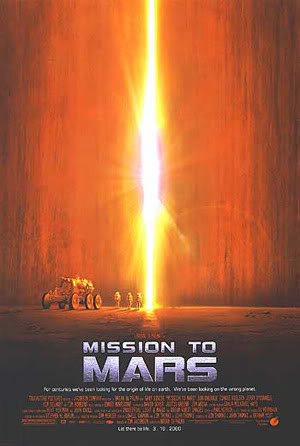
7. Mission to Mars (dir. Brian De Palma, scr. Jim Thomas, John Thomas, Graham Yost)

“Drifting through eternity will ruin your whole day.” So goes some wisdom from Brian De Palma’s marvelous spaceman thriller. Mission to Mars is practically a humanist retort to 2001: A Space Odyssey, its climactic moments dedicated to a pretty and inspiring filmstrip on biological evolution on Earth. Containing something to bewilder or sour nearly ever viewer, even the film’s final statement of wonder is marred by one badly designed transitional era CG alien effect. But all De Palma films have a little of this wonder, and no small amount of dread, as starry-eyed humans are ricocheted around a cosmic pool table along networks too daft to make sense of, dragged by forces they cannot see. Mission does, in its finale, marvel at nature, but until then it is variously spooked and awe-struck.

The climax of physical action occurs in the black void, of course, stranded between heaven and earth (well... between spaceship and Mars), safe home and unknown adventure, chilly womb and blazing death. The suspense device is of properly calibrating jet pack thrusters and conserving limited fuel supplies; the moral questions are of the same stuff: applied force, inertia, impossible choice and aiming carefully while navigating through space.

One zero G setpiece alone sees the director pushing the cinematic apparatus’ ability to organize space and time to a new plane: it is a De Palma Future. As the ship is about to enter orbit around Mars, a micrometeorite barrage perforates the hull, one space suit helmet, and one astronaut’s hand: bam, bam, bam, these are the crises in poetic simplicity, tiny rocks hurtling through infinity just to fuck up four heroes. The ensuing repair effort is a suspense scene of elaborate construction without parallel... except in the De Palma canon. Beginning with the image of atomized blood globules swirling lazily about the pristine ship, the sequence expands and flows into airless abstract 3D museum diorama. As four crewmembers undertake separate tasks in different locations and the atmosphere rapidly suctions out of the craft, their work unites the action, a seamless vignette about punctured seams. The source of the first leak is detected via the floating blood droplets, the second by a serendipitous packet of Dr. Pepper. The pieces and particles flocking in one direction to create a whole, the scene snakes through space, inside and outside, perfectly oriented in a place where up and down do not apply and time is the crucial dimension. Linked in purpose, discrete no longer, like the chromosomes sent to a blue planet from a red one, like the astronaut’s DNA model built of M&M’s, like the Dr. Pepper and the blood, like the clouds of Martian dust. Like pictures threaded in sequence, moving in time together to tell a story.


6. Dancer in the Dark (dir., scr. Lars von Trier, songs by Björk)

Old-time women’s picture hokum, nothing in Lars von Trier’s musical extravaganza holds any water or makes any sense, except that melodrama tells its own sort of truth. When the indignities and cruelties upon the innocent are piled high enough, any weeper turns into a dark comedy; tell a horror joke from the inside out, and with enough sincerity and it becomes a tragedy.

This joke is about a girl who gave and gave and a world that took and took, until she had nothing left. Von Trier has told this one before, would tell it again, and the challenge this time around must have been to test the limits of weepy excess while purging every semblance of reality: how far can either fundamental component of the film be pushed before it undoes the other? The martyr heroine is not only impoverished, abused, wrongfully persecuted and slowly going blind, but apparently suffering some intellectual disability, her every interaction and behavior exactly the kind of thing no one would do. Björk plays Selma as a walking Sacred Heart, a lived-in, humanity-stinking performance, a matted waif that one might feel compelled to slap for her own good, if she were not constantly being slapped already. The music is exuberant, aching and achey, and bitterly ironic in context. Björk’s own records thrive on a similar tension, as dance music that cannot be danced to, soaring pop as intimate and uncomfortable as crawling through the singer’s throat. As a victim/collaborator in Von Trier’s campaign, Björk adds another layer of contradiction and mystique to both the film and the art project of her public persona. For in Von Trierland, it is possible to become confused as to what is sincere or put-on, sophisticated or juvenile. Dancer in the Dark is both, of course. The kind of emotional rawness and thoughtful technique on display are simply too much work to muster up for a derisive chuckle. Dancer in the Dark is Passion play as escapist Mamoulian musical, and vice versa.


5. American Psycho (dir. Mary Harron, scr. Harron, Guinevere Turner)

Brett Easton Ellis’s gasbag novel is punctured, drained and distilled into an elegantly mean and hilarious feminist tract by director Mary Harron and her co-screenwriter Guinevere Turner. While Ellis’s method of literary satire is to stand in one place, bare-knuckled, and punch the same spot over and over and over, Harron and Turner feint and bind, slice and dice with a thin, exacting blade. The subject is manly competition and conspicuous consumption in the world of late-1980s Wall Street investment banking, the case study one Patrick Bateman and the crimes engendered by boundless privilege and ridiculous amounts of money: disconnect from humanity, ennui, failure of taste and serial murder. As a period piece takedown of extreme yuppiedom, American Psycho picks an easy target, but courtesy of Ellis there exists a graceless, hammering take on the same material, proof that this is not as easy as it looks. Whether one finds the ‘80s stage dressing deft and funny or irrelevant nearly a decade after the fact, the thesis is tied to no one time and place, a hysterical burlesque of late period capitalism careening into a barbaric dead-end, the human body made ultimate disposable luxury commodity.

The excesses of Ellis’ novel are the point, but it is more excruciating than funny or horrifying, ideas more interesting to discuss than to read. Harron and Turner’s choice to clean up the grue, besides making the book filmable, eliminate Ellis’ habit of rubbing an audience’s nose in the material. The only lamentable cuts are of Bateman’s most far-out hallucinations — being pursued by a park bench, and witnessing a Cheerio being interviewed on television — that might have strained credulity even with this most unreliable narrator. The psycho himself is alternately locked in a human skin sarcophagus, and on berserk nude chainsaw rampage. While the film is largely lodged inside Bateman’s head, crucial space is made for the voices of the women of American Psycho. Turner is tellingly cast as the only woman who laughs in the protagonist’s face. In a moment like a clear, mournful bell amidst the cacophony, Bateman’s secretary, Jean (Chloë Sevigny, earnest and breakable, good as gold), steals a peek at the boss’ diary, and finds only primitive childish doodles of mutilated women. The film still closes with Ellis’ bleak jabber (and portentous inscription: THIS IS NOT AN EXIT), Bateman’s final embrace of nihilistic abandon, brain-snapped and sweat-drenched. But the summary of Harron’s Psycho is in the eloquent, beautifully composed scene of Jean alone, confronted with the swarming, dehumanizing rage of Bateman’s notebook. Whether the crimes of the book are “real” or not, the disease behind the symptoms is the same, and lost, confused, and hurt, Jean weeps.

Bonus points for a credits sequence that prefigures Dexter's opening by 6 years.


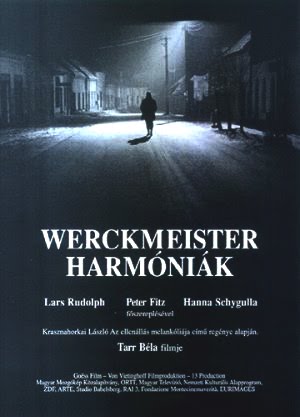
4. Werkmeister Harmonies (dir. Bela Tarr, scr. Tarr, László Krasznahorkai, from the novel The Melancholy of Resistance by Krasznahorkai)


3. In the Mood for Love (dir., scr. Wong Kar-wai)


This is a film about extraordinarily beautiful people smoking cigarettes, which make extraordinarily beautiful smoke, and looking moody, sexy and tragic while they do it.

The story of Chow Mo-wan (Tony Leung) and Su Li-zhen (Maggie Cheung) lovers-never-to-be, neighbors united because their own spouses are cheating on them with each other, is both emotionally complicated, poetically pared-down. It is speaks to many things inside those prone to heartsickness, romantic longing and indolence. Like a series of lugubrious interlocking etudes, In the Mood for Love is vague and elliptical enough, repeats variants on its own themes with such seductive rhythm as to encompass itself in forward and reverse. It is a story about how a mutual case of blue balls prolonged over the better part of a decade, combined with a propensity for melancholy, can cause the afflicted to inflate intimacy and longing into having mistimed meeting one’s one and only Soulmate. In more sympathetic light, the opposite spin: love and connection flit through our lives, prolonging defining moments with an aching sustain, and sex just has nothing to do with romance. Chow and Su torture themselves into increasingly lovely emotional and-or sexual starvation, their stated motives may be to maintain the moral rectitude and dignity that their spouses could not. Of course, this just makes their anguish more perverse, their behavior creepier and more damaged.

Should you remove the mud, and let the whispered secrets float out like scribbled plumes of cigarette smoke, there is every chance that the voice of a broken heart has nothing to say but “Oh my God, oh my God. I should have fucked her.”

In the Mood for Love is truly and deeply about how gorgeous movie stars can look while smoking cigarettes in the rain.


2. “The Heart of the World” (scr., dir. Guy Maddin)
“Heart of the World” IS:
-Six minutes and some few seconds long.
-An erotic montage-edited frenzy about the erotic frenzy of montage editing.
-A romantic evocation of the spasmic lovemaking of silent Soviet sci-fi, Fleischer brothers shorts, experimental Marxist documentary and many other sorts of popular entertainments currently in vogue with audiences the world over.
-A loving, meticulous recreation of German Expressionism and Soviet montage that looks precisely like no Expressionism or montage that ever existed.
-Absurdist redemptive melodrama about the redemption of melodrama!
-A full history of passion, love, death, resurrection, erection, economics, religion, science, sacrifice and birth conveyed in such bold, decisive strokes that it takes place entirely in hyperspace!
-KINO KINO KINO KINO!


1. Battle Royale (dir. Kinji Fukasaku, scr. Kenta Fukasaku, from the novel by Koushun Takami)

Directed by the 70-year-old Fukasku, the last great film of the millennium closes with an imperative to the young: RUN.

Japan of the undefined near future finds its economy collapsed, unemployment rates soaring and youth in rebellion. The implied fascist government instates the Battle Royale program: each year, a ninth grade class is abducted, shipped to a small island, and made to participate by slaughtering each other until one child remains standing. From this high concept, equal parts compelling and appalling, proceeds Battle Royale. The giggly, angry, black satire plot reads, on paper anyway, like a premise John Waters might have imagined, had he been born some thirty years later. Its barely-science-fiction kill-or-be-killed tale meditates on universalist themes common to Lord of the Flies, The Most Dangerous Game, and Stephen King from Roadwork to Under the Dome: the scary speed with which the body’s survival instinct kicks in when under duress, the fascinating and varied ways in which civility disintegrates and societies break down.

Battle Royale is bitterly funny to be sure; its political bite sinks deep into the luxury culture, unhealed generation gap and entertainment tastes of postwar Japan, teeth scraping bone. The premise alone is enough, an overstated, ferocious lampoon of conservative social politics, and their bad ends for the defenseless and innocent. The BR program is ostensibly created to quell the rising tide of youth discontent, but is motivated by adult failure, fear, and anger scapegoated onto the nation’s teens.

But Battle Royale does not play out as a bad taste splatterpunk comedy, a sadistic action movie or, really, in any way expected at all. The film’s main modes inside its pointed, complicated satire are rich, novelistic storytelling and quiet, sensitive poetry. The strong backbone allows Fukasku to check in with the 42 students in various combinations all over the island, and on their mysterious teacher Kitano (Takeshi Kitano, also malevolent and weary), in quick sketch intertwining vignettes. Comically blunt intertitles punctuate the deaths, but the survival game is not the heart of this story, and the rest unfolds in the oblique, haunted tone of flipping through a high school yearbook with a headfull of psilocybin.

In careful, spare strokes, the film marks out miniature portraits of its dozens of 15-year-olds. The emotionally intense reality of adolescence is so vivid that Battle Royale seems willed into existence by the resentments, heartache and irrational impulses of the ninth grade class. Still, somehow the film stands at a contemplative distance from this hormonal miasma, those love stories that are really crush stories, bullying that is really dismemberment. The abject nastiness, adorable naïveté and poignancy of teenage social interaction is observed with empathy — respect, even— and on their own terms.

In the greatest movie scene of 2000, fierce and beautiful class track star Chigusa (Chiaki Kuriyama, blood type: A) is dying. Her friend Hiroki (Sousuke Takaoka) finds her, and though freaked out, picks up the dying girl and sits with her as dusk falls. And what can she want in those final moments? What is important right then? She asks Hiroki if he is in love. And yes, he is. She asks: but not with me, right? And no, not her. Hiroki can barely stand to look. But he will stay with her. Still nervous, even with nothing to lose, Chigusa musters everything she has and... tells Hiroki that he looks cool. Hiroki gives his friend the most beautiful last moment possible, as her heart simultaneously breaks and slows and stops. He tells her: “You’re the coolest girl in the world.”

What does it mean, then, to tell a generation to “RUN”? Contemporary as its other concerns may be, Battle Royale is not an anthropological exposé on the slang, savagery and mating habits of modern Japanese youth. It is about what it is always like to be 15, what it has always been like to be 15, and what 15-years-old means to a 70-year-old man. There is nothing sweeter than catching the extremely jaded in a moment of wistful reverie.

Thursday, January 04, 2007

My 10 Favorite Films of 2006... But NOT YOURS

The Rules of the Game

-Skip this introduction, if you have no problem with year-end film lists.

-We make lists because lists are fun. Even more fun, I've illustrated with The Hot Movie Babes of 2006!

-According to my "2006 Comprehensive Viewing Diary", I saw 129 films in 2006. Knowing I failed to record a few, that can probably be pumped up to 150. This is "pathetic" and I resolve to see more in 2007... however, I did manage to read more books in '06 than '05, or ever before, and frankly, I'm not willing to cut into that figure, no matter how much I like movies.

-If the movie was released in 2005, but there was no way to see it in the U.S. until 2006, it is a 2006 release for this list. While it may not be "fair" to include 2005 festival-and-foreign openers like Manderlay, The Proposition or Sympathy for Lady Vengeance, I feel it's a greater disservice to never give them an opportunity for listhood.

-If I see a commonality between the films below, it is that they are not making many year-end round-ups, and that on their release, I was generally frustrated or confused about how they were being discussed or ignored. I tend to be drawn to genre films because they engage, trouble and move us in a more seductive manner than Important Message Movies. Below are: a biopic that leaps the pitfalls of the genre by being about something larger than the subject herself. Two crime thrillers crafted by master hands but in which no one cared to look for what they might be "about". A comic book adaptation with more to say about fascism, imagination and the revolutionary spirit than Pan's Labyrinth and Children of Men combined. A political documentary so grand it should make Michael Moore buy a gun and shoot himself in the head for crimes against humanity, but which isn't even eligible for Academy Awards. Gory Korean weirdness, smudgy digital mindscapes, and cartoon headtrips whose strange forms distracted writers from engaging their beauty. One hilarious, obnoxious foreigner goofing on Americans, making the nation pout in response... but not the one you think. A goony summer kiddie blockbuster so universally despised, no critic could be bothered to explain its success, unless to say it must be that audiences are stupid. Er... right.

I didn't gerrymander my list to favor underdogs, it just came out that way.

If you find these films unworthy, dare I suggest you did not think about them hard enough? I suppose I do.

-The disclaimer is unnecessary for Exploding Kinetoscope, because I'm happy to title it a "favorites" list. Those questioning the validity of "Ten Best" or the vague "Top Ten" lists might find peace by replacing a critic's "Best" with "Favorite".

If critics aren't qualified to make lists unless they've seen every film that year, then neither are they qualified to write about film unless they've seen every film in history. Neither are you qualified to have a best friend until you have tried out every person who ever lived. You do not have a favorite food, a favorite sweater, or favorite Beatles song. Are favorites inherently interesting? Must we undergo this semantic torture and soul-searching for a game that, for a rare occasion, allows critics to write only about films they enjoyed?

Look, I'll read your list, if you read mine. It's fun, and maybe we can convince each other to watch ten movies through each others' eyes. As Mr. Presley said, the Halls of Darkness have Doors That Open. Peek ye, through mine door!:

10. Wacky Races: Manderlay


Manderlay takes on the specific problem of America's foundation in slavery and the ultimate failure of the marginal improvements in race relations in the aftermath of abolition. Those are things Lars Von Trier thinks the nation does not like to talk about honestly, and bleak conclusions we rarely reach. An unfair generalization, perhaps, but this is hardly about being "fair". Manderlay is the more difficult film than Dogville. It's the meaner, funnier satire, too.

As Mr. Morrissey said, "I have spent my whole life in ruin, because of people who are nice." And so Manderlay and Dogville's terrible truths are ideas no one wants to hear, not ever. Are there possible problems with, gulp, democracy? No, no please, it cannot be that the very notion of kindness, charity and goodwill can be problematized in practice. As relevant and necessary as it will always be to take stock of race relations, Manderlay is, beneath that, a satire not of American racism, but a cultural tendency to simplify unfathomably complex issues. Beneath that, a parodic look at how and why social progressives do their good works in general. Manderlay is, beneath that, a puckish pantomime of human nature, as we struggle with moral dilemmas we've brought on ourselves, strive to do good for all the wrong reasons, and hurt each other in the name of salvation. Nice try, human beings!

Oh, and for my money, David Thomson can keep his Nicole Kidman fetish. I'm happy to develop one revolving around Bryce Dallas Howard. Reasons We Go to the Movies #1: To look at pretty girls.

9. I Outta V Ain't Bad: V for Vendetta


The only Alan Moore adaptation of which the Old Magician should be proud is the one that made him recoil the hardest? Ah well, a crazy genius is still crazy. The Wachowski Bros. and James McTeague may or may not realize how their minor story tinkering rejiggers the politics of Moore's novel to become an unambiguous call to active revolution, rather than a meditation on the process by which the power of the political symbol to makes its meaning manifest. The comic remains superior (superior to anything on this list?), but I'm unconvinced a madder Hollywood big-budgey could've been made from the material. McTeague makes a smashing debut... and no one would have made this movie but the Wachowskis.

8. Fertile Crescent City: When the Levees Broke: A Requiem in Four Acts


This movie is not about hot babes.

Here comes the story of the hurricane. The media whipped itself into a frenzy with tales of organized terror-squads of rapists and hospital snipers, implying without saying that perhaps the flooding of New Orleans was a modern cleansing of Sodom and Gomorrah. The implication is that no matter how much suffering CNN was happy to show you, not to go down to Louisiana and try to help. So never again should you let anyone tell you Spike Lee is irresponsible, too angry, or an upstart.

When the Levees Broke does its most important work as Lee documents and explains in level-headed terms exactly How It Went Down. Did you know how a levee works in engineering terms? The various construction options and cost of upkeep? The issues involved in building port cities? Exactly where to point the finger for what happened in the New Orleans flood and why? You will learn these things.

Spike Lee's Requiem, though structured as a Jazz Funeral, does not quite propose that we have entirely lost one of the greatest American cities. It proposes that something died inside the national character that summer, not because of a natural disaster, but the unnatural actions of a government toward its people. Because of laziness, ignorance, greed and lies, and oops! Those are all human failings. If you hadn't reason enough before, the Hurricane Katrina debacle should tell you: someone seriously does not care about your safety and well being. Not my president!

Levees is also about celebrating and remembering to value our national treasures of art and culture. There are sequences that Reel Film called "completely unrelated and downright pointless tangents (i.e. the history of jazz within the city)." It's a dead-wrong evaluation. In such a vast document, other critics have been most moved with political outrage; some needed Levees to truly understand the unfathomable damage to lives of survivors. The human loss would be atrocious in any situation; that it took place in a city whose primary contributions are to arts and culture make it easier to ignore for some, and harder to bear for others. Levees documents the most important Mardi Gras of all time. It's not a party: The Carnival, Mikhail Bakhtin explains, is a playing field for working out all issues, socioeconomic, political, communal, of death and renewal. And New Orleans certainly has a lot they deserve to work out.

7. Believeth All Things: A Scanner Darkly


Like a beam of pink light from Philip K. Dick's brain, comes Scanner, adapted by the most sympathetic sloppy philosopher on the contemporary movie scene. Linklatter is a Problem Author, a man whose body of work is half films I Do Not Get. I don't get why he wants to make School of Rock when he has Slacker and Waking Life rattling around his brain. Guru or crackpot, it is not mine to say, but Scanner Darkly's full-service breakfast-in-bed of hashish brownies and bong water provides more food for thought than any previous PKD adaptation. No other filmmaker has been philosophically nimbleminded enough to tackle the material. Ridley Scott, Spielberg, Verhoeven never stood a chance.

The rotoscoped animation augments the performances of those gorgeous icebergs Winona Ryder and Keanu Reeves, but obscures frenetic freaks Woody Harrelson and Robert Downey, Jr. It does afford an imaginary look at Ryder's breasts (truly, the movies are the stuff of which dreams are made!), but as any fan who's seen Autumn in New York can tell you, they don't look like that. Ryder's is the performance for which I couldn't wait, this year. As in her best work, Ryder constructs a character out of emotional building blocks that rub disconcertingly against her real life. Sympathetic and nervous, we watch her Donna attempt to drown her fears and personal disappointments in a pond of Slack, only to fall in, sink over her head, and nearly lose herself in nervous breakdown. To be sure, it is uncomfortable to watch, as Donna melts down while trying to force her coke-rushing brain to slow down so she can explain the intertwining reasons she's doing so many drugs, can't get closer to her boyfriend, and completely needs him. So uncomfortable that a fainthearted actor wouldn't have taken us there, let alone herself.

Reeves' monologue, in which he explores his filthy house like an anthropologist of the Self, investigating himself in both senses of the word, is my favorite male performance of the year. In his stoned terror, Reeves' Bob Arctor wonders if he has inadvertently undone the Gordian knot of his existence, been doomed, having unravelled his own spiritual DNA. "What does a scanner see?," he asks. "Into the head? Down into the heart? Does it see into me? Into us? Clearly or darkly? I hope it sees clearly because I can't any longer see into myself. I see only murk." Arctor gropes for the reasons we turn to the fantastic for stories to explain the mysteries of existence. The Biblical reference is important, for what is the Holy Bible but a fantasy novel investigation of the soul? The power of fantastic fiction is in metaphor so incisive as to cut through the muddle of perception, and scan for the truth. It is a moment of clarity.

6. All That Killin and Fuckin, and No Sons: The Departed


At this point in the list, and until we reach #1, the ranking means little to me. The Departed... man, I'm pretty rave-prone, you know? But in The Departed, Martin Scorsese builds within his exciting little cops-and-robbers story, a complex web of visual motifs to match William Monahan's meticulous infernal machine of a screenplay. Doubled and reversed characters abound: at the story's core, DiCaprio's Bill Costigan a good man duty-bound to act like a criminal, and Damon's Colin Sullivan a bad man honor-sworn to act like a do-gooder. They vye to please two stand-in fathers, one dark (Nicholson's nutzo crime boss Frank Costigan), one light (Sheen's Capt. Queenan). The men chase each other without realizing it, through endless corridors of ironic payoffs, mirrored situations, loaded dialogue. "I'm a detective, I'll find you!" Colin flirts with a woman, a pickup line from a man who can't find himself. "One does tend to follow the other," goes a line late in the picture I wouldn't spoil for you, but it's in reference to anything but the cat-and-rat games Bill and Colin are playing. Visual riffs on Psycho, Vertigo, The Wild Bunch, The Third Man and Kill, Baby... Kill play witty cinephile sports, even as they expand the real issues of identity and personal responsibility addressed by the cracking crime story.

Even The Departed's admirers seemed to agree it is not obviously "about" something, unlike the self-announcing weight of Raging Bull or Last Temptation of Christ. I smell a rat. The Departed is about personal identity in crisis. It examines how the ambiguities implicit in acting or performance may corrode self-reliance, loyalty and family responsibility. The Departed sees the exhausting, chaotic blur as we are forced to shift between domestic, public, private, and work identities. In short, it's a story about the fractious stress of getting ahead in America: don't stop till you're numb.

5. Into the White: Sympathy for Lady Vengeance


This movie is totally about hot babes.

Like his spiritual brother-in-arms Quentin Tarantino, Park Chan-Wook makes sick joke exploitation movies staged as handsome arthouse films, and bursting with delirious style. As with Tarantino, beyond the virtuoso picture-making, star-turn performances and youthful energies, it is difficult to get anyone to talk seriously about the story, the thematic elegance and the content beneath the exciting form. Lady Vengeance completes Park's loose trilogy, with Sympathy for Mr. Vengeance and Oldboy, but who in the press asked what that might mean? Hint: it's not just about revenge. If that's as far as you can get, you're shortchanging yourself as much as you are Park Chan-Wook.

It seems to me that Sympathy for Mr. Vengeance gradually exposed its characters to a world of moral relativity, and the difficulty of evaluating your motivation and responsibilities in light of knowing everyone is in the same predicament. Sympathy, after all, can be a real bitch.

Oldboy expands the idea, leaving characters and audience reeling at the prospect of surviving in a chaotic universe. Is it a shaggy dog story, a man being punished for a crime he had no idea he committed? No, it is about the impossibility of trying to chart and control every unforeseen consequence of every action. Oldboy expands Mr. Vengeance's existential dilemma: what if you do not ultimately even answer to yourself? It seems to suggest we take those moments of happiness as they come, before the awful reality of their context is revealed.

Sympathy for Lady Vengeance has the trilogy's most hopeful ending, though our protagonist, Lee Geum-ja (Lee Young-ae), goes through no less agonizing a journey. She suffers similar psychic trauma to Ryu in Mr. Vengeance, learning that your Right may conflict with someone else's. She is battered around by the absurdist universe that tortures Oh Dae-Su in Oldboy. She nearly slits her throat on the blade of her own poor choices: having sympathy for the vengeful may not be the same as approval, assistance, or enabling them.

In a trilogy so black and comfortless, how can Geum-ja find any salvation without Park copping-out? It's a salvation hard-won, but Geum-ja finds it. Revel in your ability to create opportunities for redemption. Be grateful for the instances when you greet a second chance having learned a lesson. Bury your face in them and dig in.

4. Queen of the Universe: The Notorious Bettie Page


Gretchen Mol gives the performance of a lifetime, and easily of the year, but how the film was ignored and overlooked as a major artistic statement is one of the great mysteries of 2006.

How does one make a sympathetic, honest biopic about a subject who seems in some ways to have later turned her back on her celebrated work? Is this possible, without pulling punches? Or without seeming to end in defeat? Is it unfair to a good Christian woman to claim her life as a third wave feminist sex-positive parable, when she never claimed to be fighting the good fight in the first place? Since Bettie Page, after her career as nudie pin-up, bondage model, grindhouse-movie dancer, and Miss January 1955, was born again into the Spirit, is there a way to make Bettie's story end in triumph not just for the enduring icon, but for the woman? Can we reconcile the destinies of Bettie Page, Pin-Up Queen and Bettie Mae Page from Nashville, TN? How does one responsibly depict Page's modeling work for the reasons it is beloved, without casting it in different ideological light than the participants ever considered? Is there a way to depict the dismay of government and religious forces about pornography without smugly portraying them as repressed killjoys? Is there continuity between pin-up photography and pornography? What about bondage and fetish photography and pornography? For whom, and how can these things be liberating? The model? The audience? The ironic or nostalgic audience?

Mary Harron's Bettie-pic decides that rather than avoid these questions, they are the primary issue at hand. With more grace than Citizen Kane itself, The Notorious Bettie Page charts those conflicts at the heart of our lives, and decides it is how we conduct ourselves amid a sea of inevitable contradictions and ambiguity that defines us. The biography is sketched in bold, decisive strokes, and then the characters are left to interpret the meaning of their own lives. What do we regret, and of what are we proud? Who tells us what our sins are? Who wields judgement and defines our moral codes? Most importantly, Harron and Guinevere Turner's challenging screenplay asks: of all the patriarchy's methods of controlling female sexuality and yoking feminine power, which manifestations hurt the most?

There aren't easy answers, but neither does Notorious turn Page's story into a grim moral quandary, when we are probably here as fans who want to understand how a woman in ball-gag and ropes could look so sunny, make it all so fun. It is not a harrowing film, even though every man in Page's normal life is out to control, dominate and do violence to her free will and self-confident, natural sexuality. It's ultimately funny and warm because everyone wants to exploit Bettie Page... except the exploitation filmmakers, and fetish and nudie magazine photographers: they are artists, and they love, understand, and empower her, in their own naive way. Is that unfair? It seems pretty clever, perceptive and accurate to me, and so Notorious Bettie Page lets Bettie Page reclaim her own myth, and in return gives us back a strong, smart, talented, funny woman at the core of a great American icon.

Mott Hupfel's cinematography is so gorgeous that any chrome postcard and mid-century girlie mag collector will weep. Achieving what The Aviator could not, Hupfel recreates the photographic style of not just the year in which a scene took place, but of whatever photographer was shooting her at the time. It is no gimmick, and no approximation. Anyone intimately familiar with Bunny Yeager's saturated pastels, Irving Klaw's grainy dance loop films, and the cute griminess of Varietease should be in awe of Hupfel's ability to not only imitate but integrate and expand these styles, and make them play, butt heads and help the director make story and emotional points. And I mean it: at first glimpse of Bettie splashing in the searing-blue Florida waves, I cried. It means people can still be photographing films that look like Bunny's pictures, and the choice is being consciously made to create ugly films.

3. Avast Me Hearties!: Pirates of the Caribbean: Dead Man's Chest


I was talking with my friend Arlen today about "Buffy the Vampire Slayer", and how if you caught an episode by accident, it probably seemed ridiculous, silly, perhaps bad. It is none of those things, as anyone fully invested in that subversive fantasy and rich character drama knows. You gotta be a fan, though, or you're never gonna know the joys of being a fan.

From the unlikeliest source comes a new form of pop entertainment. Disney, beginning probably with the 2002 video game Kingdom Hearts is the first major American media conglomerate to begin crafting entertainment that seems designed around the desires, needs and dreams of fan culture. This is a big deal. The Japanese pop culture industry has for years reaped the benefits of catering to otaku and the broader audience alike. Kingdom Hearts crossed-over anime and Final Fantasy style RPGs with the texts beloved to the similarly obsessive Disney-head crowd. Smart marketing move, but that's not all: smart, generous storytelling, willing to open its fictive world. Here's an area where cinema writers, who typically love analyzing closed, unmalleable texts fear to tread. Pirates 2 is for Henry Jenkins.

The story is built out of the elements that satisfy and inspire fan-fiction writers. Careful, obsessive attention to the arcs and quirks of every periphery character, piling on the backstory and complicated relationships, until the puffy summer blockbuster assumes Wagnarian proportion. Every character combination would be a potentially interesting pairing for slashfic. Holes in character histories and the timeline are left open for imagining more adventures. New fantasy elements and characters are introduced with such color and variety, they expand the Pirate-verse in every direction. Any Pirates fan gets a three hour cruise on the funniest, sexiest, most breathless, dreamiest galleon on the water. The rest of you may be lost at sea.

Pirates keeps both hands free to spin gold out of solid fanservice. The Disneyland fetishist is moistening up as soon as the scene moves to the deep bayou where the ride opens... but when we get cameos by the "famous" fireflies, believe me: Annual Passholders everywhere spontaneously generated E-Tickets in our pants. Captain Jack Sparrow is granted the biggest, baddest entrance since Frank-N-Furter; every Janet Weiss in the audience faints. The revelation of a magical, literal Moral Compass immediately spawns 1000 pages of naive erotica about what happens if any of the cast points it at anyone else. Phallic sword jokes, Elizabeth in drag, everyone in bondage and homoerotic whipping scenes means something for everyone! The cosmology explodes into a specialized Land of the Dead (World's End), demons and monsters, mythological curses and Vodun priestesses. A gambling scene explains a game you can play at home. Don't get the ladies started on the empowering role models to be found in Keira Knightley's liberated lady Elizabeth Swann or Naomie Harris' scary sexed-up Tia Dalma. Boys get to appreciate the sacrifices of their martyred fathers like Will Turner, girls get both hands-on high-sea adventure, and pretty dresses, and Monster Kids all want a pet Kracken. The cosplay opportunities provided by Tia Dalma, Davey Jones, and Cannibal King Jack Sparrow are boggling.

The effort to drive fans out of their skulls with ecstasy runs so deep it's downright frightening. When Elizabeth tricks the crew of a ship on which she's stowed away into believing a ghost is onboard, the tale concocted by the superstitious sailors is a rejected storyline for The Haunted Mansion, proposed in 1957. Now, tell me that isn't crafted with care.

2. Boy, You Sure Are Good At Telling a Funny Story!: The Black Dahlia


Yeah, right, lady!

Bucky Bleichert (Josh Hartnett) sits nude in bed, but for a fedora perched at a silly angle on his head, a cigarette in his mouth and a femme fatale (Hilary Swank) sprawled on his chest. The movie detective is stripped down to his most basic, iconic props (er, heh heh, where's your gun, buddy?). So is that what makes film noir? Shadows, macs, gangsters and cool jazz? That God of Delirium, Brian De Palma, knows it is not the fashionable trappings that compose the core of a genre. It is the filmmaking language that creates their narrative conventions and, here, the worldview. If De Palma knows anything, it's the biology of thrillers, crime pictures, detective stories. Film noir is ruled by a black whirlpool, ready to suck down anyone, anytime. Once it's got you, you do not escape. That's the heart of noir. At the mutilated center of The Black Dahlia's whirlpool is the enigma of Elizabeth Short.

The film is based on a novel by celebrated douchebag James Ellroy (don't get me started, folks, there's not enough mill for that much grist!). The story fabricates wholesale nearly every fact concerning Short's life and the investigation of her 1947 murder. It should drive the true crime buff in me up the wall, and it seems to have aggravated Ellroy fans (I imagine them in a constant state of aggravation anyway), but as in all of De Palma, the real subject is the Movies.

As Bucky investigates the Short murder, all he uncovers is the bottomless, swirling despair of noir's amoral, consuming void. There are not goodies and baddies, no Light Woman and Dark. From the corridors of power to the average upstanding cop to the disenfranchised would-be starlet, everyone is corrupt, lying, weak and guilty. Los Angeles itself is rotten in its very foundation. In one of the film's most giddy, ominous moments, a literal earthquake sends sick vibrations through Bucky's world: the planet itself is unstable, untrustworthy. He eventually meets himself at the bottom, as the murder worms into his psyche, the suspects bump against his own social circles, and the motive is located in his own domestic space.

James Ellroy likes to believe this is a model of how the world works, and all a man can cling to is the screwed-up integrity of his conflicted, repressed macho heart. Brian De Palma does not cotton to that nonsense, and makes the existential brutality of The Black Dahlia the engine which powers the closed-circuit loop of film noir itself. De Palma's masterstroke has always been the understanding that the language of movie thrillers translates into gibberish in the real world, and yet they excite and move us anyway. From Blackmail to Saw, the thriller does not "make sense", almost above and beyond any other genre, yet we happily meet it halfway and play by its rules. Film noir often wears the mask of detective fiction, the illusion of Holmesian deduction is eventually stripped away to reveal the black math beneath the logic. We accept that the bona fide classic The Big Sleep ultimately does not make sense, so The Black Dahlia subverts the language of the genre by stretching our capacity for lunatic un-reason to the limit.

Because Dahlia is not about the real moral dilemmas of mankind, but how we interface with a genre, Bucky's quest is specifically about how he may navigate the precarious grounds of film noir. There can be no purpose of constructing a personal code of ethics when the game rules are designed to ensnare everyone. De Palma proposes a delightful answer to this bleak problem. Bucky finds a strategy for survival by recognizing his own capacity for perversity, the amorphic capabilities of his own body amid nothing but body-related anxiety, the creative skill of free-association: Bucky learns the value of play, within the genre's nasty web.

Symbolically emasculated in the first scene, when his teeth are smashed out of his face by his own partner (Aaron Eckhart) in a fundraiser boxing match, Bucky eventually traces a network of similar mouth injury imagery to avenge Short's murder. In Swank's slumming bisexual aristocrat Madeleine Linscott, who's made herself over in Short's image, Bucky's first indulging in bad-news Vertigo necrophilia. But he also picks up from Madeleine the ability to recognize the eroticism in his own homosocial relationships, the pervasiveness of costume and playacting, and the polymorphous perversity at work in every human. And so on. Bucky's happy ending finds him in the arms of Kay Lake (Scarlett Johansson, acting like she doesn't know how to smoke) icy ex-prostitute accomplice to several crimes, with knife-scars that mirror the inscription of male power upon the body of Liz Short. My hunch is the guy doesn't find solace there because she's the least-corrupt of the cast, but the symbol with the most ties to every issue that's consumed him: she's Elizabeth Short, she's Madeline Linscott, she's Lee Blanchard, she's George Tilden. With his new skills, he sees in this nihilistic universe that Kay is imbued with meaning. The white light into which Bucky steps in the ending is the enveloping glow of a film projector.

De Palma casts himself as an unseen director in a fictional screen test for Elizabeth Short (Mia Kirshner). He emotionally brutalizes the woman for no particular reason except that it is what directors of thrillers do, for their own diverse reasons. De Palma does not make hollow genre deconstructions; he obviously works out problems of power and control, gender issues, of symbol and language, of space and physics... it just all seems so mad, and unreal because he focuses on how they operate in the movies. The locus of putrid inspiration behind the Dahlia murder turns out to be a movie (The Man Who Laughs, no less). However, it's in that cruel screen test that Short can tell her story, that she is preserved in one piece. In a meaningful way, the movies also save her life, and Bucky's. The nexus of all fascination, beauty and power in The Black Dahlia is not poor Elizabeth Short's tormented body but the obsessive dream of cinema.

1. Finding Something Inside the Story: INLAND EMPIRE


Uh-oh, looks like somebody's movie is too hard for people. The opening fence, roses and sky in Blue Velvet symbolize America! Most of Mulholland Dr. is a crazy dream! And if your David Lynch appreciation cannot extend beyond this kind of literalist idiocy, you'll never mine the riches of INLAND EMPIRE. Ten years from now, I promise it's a masterpiece, and haven't (Eraserhead) we (Fire Walk With Me) been (Lost Highway) through ("Twin Peaks" finale) this ("Mulholland Dr." pilot) before? The general tone of frustration and disappointment among newsprint reviewers only begs the question "exactly who do you want David Lynch to be?"

Imagine, if you will, another world. A world in which David Lynch's hallmarks are not outrageous violence, uncomfortable sexuality and impenetrable weirdness, but the active exploration of the subconscious and our resistance to its fertile boundlessness; the location of evil and sorrow in the will to dominate; the abiding comfort and beauty in forms, colors, textures, sounds; a universe of hard lessons, but underlying connection, chaos bound and avowed to keep love, mystery and universal energies on course. That is the world of my David Lynch. You may need to watch with a third eye, but as Jeffrey Beaumont said, there are opportunities in life for gaining knowledge and experience.

INLAND EMPIRE is one of Lynch's encouraging works, harrowing though it is, so ignore all reports that your spirit guide is going to ditch you on the astral plane. Laura Dern in a devastating, giving performance as Nikki Grace as Susan Blue, is our center, a heroine who learns to traverse boundaries, surfs the vast ocean of the non-rational and comes out on top and smiling. Pity those unwilling to even try.

Addendum : Number Eleven


I honestly feel sadness and dishonesty for not finding room for...

Borat - Cultural Learnings of America for Make Benefit Glorious Nation of Kazakhstan - Joining the sacred Hardest I Ever Laughed ranks of South Park - Bigger, Longer, Uncut, Brain Candy, The Nutty Professor and Jingle Cats: Sing Meow of Christmas is Borat. That is pretty damn respectable company, Mr. Cohen. Neither as mean or political as anyone claimed, the central joke is less that Americans are ignoramuses than that everyone is funny when in uncomfortable social situations. Good enough for me.

Cute Multiplex Junk


Sometimes we have special "ways" of enjoying movies. These include: irony, derision, erotic spectacle, and rooting for outsiders.

Casino Royale - Between Daniel Craig and Eva Green, which of the leads do you most want to see in a bathing suit? You may change your mind by the end, because the only proper answer is: both! "Jeffrey Wright" is also an acceptable alternate.

Apocalypto - Weird. Dumb or possibly crazy, Mel Gibson gave me the a lot of gleeful enjoyment of a film in the opposite way the author intended.

Snakes on a Plane - Hey Rob Zombie, you know how you think you know about and love exploitation movies? The key element you have forgotten is known as "fun". Snakes was given an unfair handicap from "go", but made it over the finish line with more heart and determination than anyone could have expected.

I Don't Know What to Say


Is it possible I spent more time with my mouth hanging open in awe at Lady in the Water than any other film of 2006? Certainly it appalled me very much, but it gave me so much perverse pleasure, I find it so fascinating, that it deserves some recognition for sheer misguided, unworthy, confused, artistically-stunted splendor.