Thursday, November 26, 2009

Two Zero Zero X: Favorite Films of the Decade Pt. 2 — 2001


The Exploding Kinetoscope — 10 Favorite Films of 2001


10. All About Lily Chou-Chou (dir, scr. Shunji Iwai, adapted from his Internet novel)

An expose of the secret, violent lives of Japan’s depressed and dyspathetic high schoolers, All About Lily Chou-Chou is about extreme cases of bullying and social pressure, and its horrors are, indeed horrific. But it is not alarmist, scolding or exploitive in tone, and nothing like a Japanese equivalent of Kids (1995), Thirteen (2003) or their blood relatives, Reefer Madness (1936) or She Shoulda Said 'No'!(1949) . Without drawing explicit causal relationships, adolescent crime and suffering seems to flow into these lives as a natural evolution of crashing hormonal tsunamis, willfully clueless failed parenting, and old-fashioned universal postmodern alienation. The subplot of the title — or perhaps it is the axis around which this brutality whirls — is the fandom of J-pop star Lily Chou-Chou (voiced by real pop star Salyu). The children of Lily Chou-Chou inhabit an Internet message board for Lily fanatics, their pseudonymous postings celebrating the music, obsessing over minutia, and expanding, exploring the philosophy of The Ether.

Like the mystical fifth element, Aether, the Ether is the source of Lily’s music and something it conveys; the music rides on the Ether and possesses it. Lily is barely glimpsed on a concert viewscreen late in the picture, the Ether is untouchable but touches the listeners, and the fan discussions take place in the Internet’s nonphysical other-world, a not-place where the teens of All About Lily Chou-Chou express unfiltered passions and experience something like community. Lily Chou-Chou herself and her fansite occupy the absent center of the film, and the beatings, pimping and gang-rape are pushed to the outer edges, Lily spinning in the Ether.

These are not really ironies driven home with any emphasis, that the numbing daily miseries of these disaffected children are less immediate and vital to them than Internet pop music discussion, or that classmate Shiori is forced into prostitution but cannot tell protagonist Yuichi that she like-likes him, or that the unique acts of violence haunting this overgrown field of teen angst occur, for the most part, in missing-time narrative ellipses. Shot on digital video, Lily Chou-Chou embraces the nature of its medium, fits its impressionistic narrative to its form. The image slips in and out of focus, by design or because the camera cannot keep up with movement, or even shifting light. Colors are over or under saturated, always unstable. Detail goes fuzzy or is too sharp, and light plays weirdly with depth and texture. The achronological structure and narrative disruptions by Lily-chat sessions do not serve to impart information in order of maximum effectiveness, but to dislocate, to set audience and characters alike awash on the mournful tides of the Ether.


9. Little Otik (dir., scr. Jan Švankmajer)

Each of Jan Švankmajer’s features is more sophisticated and focused than the last. Otesánek (Little Otik) retells the European folk tale in a modern, dreary Czech apartment building, and in a world where the Otesánek story still exists as a story. The childless Horáks long for a baby, and so (joking? Mocking? Indulgent?) husband Karel digs up a tree stump, carves it into rudimentary baby-shape and presents it to doting Božena as surrogate offspring. Little Otik springs to squalling, flailing life. The stump baby’s appetite and size grow at alarming rate, forcing Karel to haul dripping sacks of meat home from the butcher until the postman’s flesh-stripped skeleton appears beside Otik’s crib.

Working from the same set of primal symbols as the human subconscious, Little Otik is driven by food, sex, drink, death, plants, meat, knives, money, dirt, animals, and body parts (the central and loaded ones: mouths, teeth, tongues, bones, butts and genitals). Švankmajer’s trademark stop motion animation appears in Otik to realize the infant (mercifully, Otik’s scary, animal tongued mouth is the only animated orifice; his knothole anus remains inert, though in the mind’s eye it is not), to illustrate a neighbor’s revulsion to his wife’s cooking (insectoid nails skittering through viscous glop), the subjective view of Alžbětka, the little girl next door, as she is ogled by the neighborhood pedophile (a frenzied appendage unbuttons his pants from the inside as she goggles in disgust), and as blunt-edged television adverts steeped in sex and power fantasy (the funniest is for the Inferno robotic iron, an affectless announcer deadpanning “Inferno Inferno. The rest are rusty pieces of junk”).

Parallels are drawn between a mother’s longing for a child, the baby’s infantile oralism, advertising, sexual lust and hunger. The commonality is desire and consumption. When the Horáks box up Otik in the basement, trying to sublimate and conceal the devouring force, Alžbětka takes pity on the monster baby and tries to mother and domesticate it, but to no avail. Out of options, she does the rational thing and starts drawing straws for which tenant to feed to her ward. But this is no time for rational thinking. True to his card-carrying surrealist ethos, Švankmajer does not trade in messages, morals, lessons or slogans. In Little Otik, to hunger and desire is to ultimately consume and destroy. We are insatiable.


8. Wet Hot American Summer (dir. David Wain, scr. Wain, Michael Showalter)

An edgy next-generation comedy, Wet Hot American Summer flew like a Concorde over the heads of the nation’s middle-aged critical establishment, or perhaps directly into them. The pile-up of critics of fine taste and sophistication explaining why Wet Hot is dumb and not funny (frequently citing gags strong enough that they can’t be killed even in derisive summary; I recall Salon’s reviewer complaining that David Hyde-Pierce is made to exclaim “Fuck my dick!” in surprise) was probably last seen walking out of Kids in the Hall: Brain Candy (1996).

In the post-ironic comedy scene populated by geek chic hipsters and amiable smarty-pants slobs, the heritage of idiot comedy has been reevaluated, and nothing is funnier than very smart people telling very dumb jokes. The highest aim is jokes so dumb, crude, meticulously mistimed that they deconstruct the idea of a Joke itself. WHAS trades in meta/non/and genius material like Paul Rudd as a man so dumb he pronounces the J in “journal” as a hard G, and sentient canned goods defiantly confessing to autofellatio (a lot). What is this stuff doing in a spoof of the summer camp and teen sex comedy cycle of the late ‘70s/early ‘80s? Who has even seen these movies, and do they need sending-up? Are WHAS’s jokes within spitting distance of the cracker-n-condoms barrel comedy of G.O.R.P. (1980) or Computer Beach Party (1985) or whatever it is that is being satirized?

Shifting frame of reference and intention, stream-of-consciousness movement in which one gag’s payoff becomes the setup for the next, faith in the power of extremely specific non sequitur: the rules of comedy for alumni of The State, especially in their purest experiments, WHAS, Stella and The Ten (2007). Stripped of the rock star ‘tude of too many fourth generation sketch and improv specialists, devoid of both sarcasm and sincerity, the basic attitude toward comedy is that if it is funny, it is worthwhile. There are no sacred cows on this plane, and that includes the performer’s perceived intelligence, the dramaturgical soundness of a scene, the tone and “reality” of the entire film. Sometimes WHAS is a parody of summer camp comedies, sometimes a parody of parodies, sometimes just a for-reals summer camp comedy. A passionate, prolonged and relatively explicit gay sex scene exists simultaneously on about 20 levels — as an upending of the heterosexual lechery that pervades teen comedies and their presumed audience, as goofy slapstick, as a straightforward dirty joke, as part of a lengthy runner in which the lovers get married. The stroke of wet hot brilliance is that it is absurd and discordant for a teen sex romp to suddenly lapse into passionate, sincere anything, let alone explore an irrelevant subplot about the romantic lives of gay camp councilors.

In a simpler time, we called this “silly.” Which, fuck my dick, to a comedian ought to be a compliment.


7. Hedwig and the Angry Inch (dir. John Cameron Mitchell, scr. Mitchell, Stephen Trask, from the musical, book by Mitchell, songs by Trask)

A queer theory primer with sing-alongs, Hedwig and the Angry Inch celebrates the heady, scary rush of freedom symptomatic of being stranded high and dry on the rocks of identity discourse, trapped between the Scylla and Carbides of false dichotomies, and forced to make your own place in the world or be rent apart. Our hero is East German expat Hedwig (née Hansel), come to America with a botched sex change operation and a headfull of glam rock dreams, a sort of genius songwriter whose music is swiped and is reduced to playing salad bar joints. Like much LGBT literature, Hedwig is largely a memory and identity piece, the bulk of the (slim but eventful) narrative tracing the rocky path to the rocker’s current gig, trailing superstar/ex-lover/musical thief Tommy Gnosis on national tour, Hedwig playing at Bilgewaters restaurants while Tommy sells out stadiums. Hedwig can’t — or won’t— be torn between or shuffled into normative categories of gender, biological sex, nationality, musical genre (her performance seesaws between showtune revue and ferocious riot grrrl punk), even success and utter failure.

Form following content, writer-director-shooting star John Cameron Mitchell’s original stage show is itself a narrative musical presented in the form of a rock n’ roll performance piece, the story relayed primarily through monologue, neither a traditional musical nor a concept album played on stage. His film dramatizes the plot, and even on miniscule budget bounces around the globe, Berlin Wall to inside an oven to anonymous American motels to mounds of discarded tires to animated fantasia to dreamy symbolic netherworld, with cinematic verve and excitement. The structure itself is queered, refusing movie parade blitz or to betray its stage roots; it is inaccurate to call the film stagey or to deny that it feels very much like songs stitched together by character monologue, and the final reels refuse camp spectacle or comic melodrama and warp into abstracted Jarmanesque symbol-drama.

Ferociously, bottomlessly funny, angry and poignant, Hedwig’s quest for identity, self-knowledge, acknowledgement and love are tinged with overlapping mysticism and religious philosophy, speeding past roadsigns to Gnosticism, Taoism, Surrealism, and, famously, Aristophanes in the Symposium, in syncretic blur. The hunt for the other half of a fractured self, for completeness, is itself spectacularly blown apart if not abandoned by the film’s end. Hedwig stands stripped bare and resplendent before an invisible audience in the void-as-theatre, identity as eternal succession and cycle of event, incident and crisis, sawed and nailed together in endless construction project. Hedwig ends on her own terms and no more incomplete than any creature in the universe.


6. Hannibal (dir. Ridley Scott, scr. David Mamet, Steven Zaillian, from the novel by Thomas Harris)

A medievalist comedy of manners, a grotesque romance and a fairy tale black comedy about corruption, Hannibal is lush, florid and extremely perverted, through and through. After ten years, the entire world hunts Hannibal Lecter, but he flits through fingers, cities, nations with ease, the planet’s population simply too dumb and slow to catch him. Every other character dreams up elaborate, intertwining schemes to catch the mad doctor, but his only worthy adversary is Clarice Starling: she knows him. And so it goes, each manhunter compelled by personal sins and revealing even more, each and every corrupt by nature or circumstance, a network of rot and compromise circling the Earth's crust. And so it goes that Starling is ‘buked and scorned, tested and tried, used and abused by this gallery of venal gargoyles, until only two beasts of unyielding personal integrity are left standing: Lecter and Starling.

Ridley Scott’s eye for opulence and grime provide rich and rotting stage dressing for this operatic manhunt thriller, but his sense of jittery action and peekaboo scares do not capture the elegant air of Thomas Harris’ source novel. Harris writes like he is organizing blocks of time and space into a labyrinthine invisible castle, his characters move through the story as if guided down glass corridors of a maze criss-crossing the globe, linked to some burning, ancient meaning as if pursued by a minotaur. Scott’s film has little of Harris’ fated, antique majesty, and is forced to rework the novel’s cut-crystal, uniformly lunatic plot (hinging as it does on details like Lecter’s sixth finger, excised from Silence of the Lambs). But the state of constant hysteria is alive, and the trade-off is that Scott’s film is funnier.

It was very difficult for an admirer of Harris’ weirdo vision to walk out of Hannibal in 2001 and feel much besides that the most special elements were missing. To streamline the story seems to be to miss the point of the novel’s baroque ornamentation, and absent are some of the more outrageous, exotic tangents — Hannibal’s childhood reminisces of eating his beloved sister, Inspector Giannini’s investigation of the Monster of Florence — and loveliest grace notes — in the book’s best scene, Lecter orders Starling, by letter, to contemplate the cast iron skillet that he just knows she has hanging on the wall. The novel’s finale is its masterstroke of delirium, the romantic union of Dr. Lecter and Clarice Starling. It is practically a defiant slap in Hollywood’s face. Naturally, it had to go, lest Hannibal cause riots and/or wild, unrestrained cheering. The film would be infinitely more audacious if built straight off Harris' blueprint.

As the initial butt-slap sting of adaptation fades, it is truly remarkable how much of Hannibal is still in Hannibal. If there is a scene which does little to further the plot but embroiders it beautifully, it is Lecter’s art history lecture on Dante and medieval depictions of Judas figures: “easy” to cut, and impossible to lose. Hannibal picks and chooses wisely, still bizarre enough to repel more than 50% of critics, still so extravagant and strange that it is not of the same genre as Silence of the Lambs. It is barely a sequel. Scott does find some ingenious cinematic means of capturing the magnetized sensation of the twin protagonists drawn to one another from across the globe. In a dizzying sequence original to the film, Lecter guides Starling by cell phone through the chaotic carnival of Washington’s Union Station, and with deft cajoling, the quarry points the hunter in the wrong direction. He averts her gaze just long enough to spin past on a carousel, just that he may brush his hand against her hair for a split second. The carousel keeps moving.


5. The Man Who Wasn’t There (dir., scr. Joel and Ethan Coen)

In Film Noir Land, you’re damned if you do, damned if you don’t. Ed Crane, The Man Who Wasn't There, mostly doesn’t. Postwar malaise is the topic of the day, the same kind that fueled The Twilight Zone. Billy Bob Thornton’s motionless disappearing act performance as the bewildered barber is a marvel of underplaying. It is hard to say if Ed is disaffected or bored, repressed or sorrowful, or just a nitwit. Given his constant internal monologue narration, we are tempted to lean toward the last. Enmeshed in a life-destroying crime plot that covers pretty much every legal transgression, all Ed lifts a finger to do is consider investing in a dry cleaning company because he’s tired of being a barber. For the rest of his sins, Ed’s greatest crime is to fail to speak up while blackmail and murder spiral around him, whether his wife is being railroaded for a murder she didn’t commit, or he is being railroaded for a murder he didn’t commit. Mostly, Ed just watches, but as his slick attorney, Freddy Reidenschneider, speechifies: “There is no ‘what happened. Not in any sense that we can grasp with our puny minds. Because our minds get in the way. Looking at something changes it. They call it the "Uncertainty Principle". Well, they actually call that “the observer effect,” and whether it is applicable outside of physics is debatable. Though it is Reidenschneider’s bullshit-baffle defense for Ed’s wife, it pegs Ed’s crimes exactly. Ed, just being there, smoking, looking —just being alive — mucked everything up.

The visual touchstone that haunts TMWWT is a spinning silver disc. Sometimes it’s a flying saucer; sometimes it’s a dislocated hubcap. The UFO motif (the film is set in 1949, two years after the Roswell incident) infects Ed’s imagination — in the final moments of his Death Row stay, his execution is configured as alien abduction— but he doesn’t seem to know it, not any more than he understands why he is calmed by teenage pianist Birdy’s playing mathematically ordered Beethoven. Ed cannot make heads or tails of what anything means, how he feels, or what’s happening to him, so signs and wonders, though all around him, are lost. He’s the strong silent type minus the strong, history’s most passive protagonist, a man whose spiraling Chesterfield smoke constitutes most of his body language.


4. Spirited Away (dir., scr. Hayao Miyazaki)

An interesting factor in stories about children who (literally or figuratively) dream up (literal or figurative) fantasy lands, enter, adventure, and exit as (literal or figurative) young adults, is that the protagonist generates the Wonderland, Oz, chocolate factory or bathhouse as a form of escapism, but finds that, as Ms. Gale put it, “some of it wasn’t very nice.” Dreams are like that; they turn on you. Hayao Miyazaki’s universally beloved Spirited Away is certainly of this school, as slightly petulant ten-year-old Chihiro wanders into the carnival of the gods, and winds up robbed of her name and employed at a bathhouse for folk spirits. Which means, of course, that all other world animation of the last 50 years has been left in the dust.

Chihiro’s coming-of-age story rests in the shadow of the film’s larger and more abstract theme, a yearning for an older, faraway Japan, less industrialized, war damaged, polluted, and more vitally connected with its roots and terrain. The longing is both justified and too nostalgic, and Spirited Away does not let itself get away with simple answers, pat solution or bitter-heartedness. The towering and impossible bathhouse on the threshold where Chihiro takes residency is a place of ritual purification, but her journey into the heart of native Japanese tradition is riddled with danger, fearsome manifestations, ancient and powerful weirdness. The physical sensations that come with true awe are not so different from mortal terror. The deeper you go, the longer you stay, the more you learn, the more apparent it becomes that the universe’s reservoir of kami is bottomless.


3. Lord of the Rings: The Fellowship of the Ring (dir. Peter Jackson, scr. Jackson, Philippa Boyens, Fran Walsh, from the novel by J.R.R. Tolkien)

In which an Oxford linguistics professor and a low-budget splatter director are tapped to create a worldwide smash popcorn-selling effects spectacle. The effect is that Tolkien’s peculiar conglomeration of Norse myth, religious philosophy and Germanic language deep structure inside baseball is stripped down by Peter Jackson and his invaluable screenwriting partners to a vast and accessible adventure story and its specifically-wrought, human-scale characters. Art directed to the teeth, every New Zealand location is made the subject of a massive art installation, villages of elves and hobbits, towers and more towers all laboriously designed to appear to have sprung out of the dirt. For its look and aura, the Rings films shift wizard-and-dragon fantasy away from heavy metal and airbrush and into the territory of New Age inspirational music and misty watercolor. Totally unaware and/or unrepentant that it is steeped in kitsch, the entire trilogy goes for broke with sincerity.

Tolkein’s technique and structure make a letter-perfect Rings impossible. The exciting events are related in conversation, the narrative flow mired in offstage action, and key ideas at the heart of the story are non-visual... including the effects of, oh, the Ring. The screenplay chooses not to strip-mine the novel but bring it into a more contemporary focus, action oriented, and obsessed with the internal conflicts and emotional arcs of characters. This entails some discerning narrative compression and inflation, but above all requires slight psychological expansion and coloring of Tolkien’s myth-people. The Middle-earth of the novel is here, in vainglorious swooshy tourism film helicopter shots of sparkling New Zealand vistas and in noodling details like carved wood decorations in public houses. Each orc in every pulsating battalion has its own particularized ugly sword.

Jackson’s consistent style has always been subcutaneous cartooning — on the beat cutting, slightly bug-eyed cinematography, emotion pitched larger than life. The attitude is to treat the cinematic apparatus as slight of hand, a Mélièsian magic trick, even when there are no special effects. Despite an elephantine budget and protracted shooting schedule, the production realities are too huge, and the occasional rough and tumble second (third, fifth) unit footage announces itself gracelessly and the post-production panel must make do. The spots where Fellowship is improvisational and the seams show are excellent demonstration of the innate showoffy cleverness underlying the technique, the same bratty intelligence as Orson Welles. Jackson uses everything a camera and a cut can and cannot do, its biases and blindspots, the misdirection and slippery fingers of the device to build an image flow out of a thousand things that are not what they seem. The whole of the Rings cycle contains nearly every picture-making trick in cinema, and creates many new ones. For hours on end, any lapse into clichéd setup, framing, or editing pattern is negated by an overriding dedication to visual invention. As every scene is lavished with attention, as if holy text were being illuminated, the films are emphatic about every moment; it is all equally important, whether a building-sized demon made of glowing charcoal briquettes is attacking or a fat kid in a cornfield weighs his decision to take one step further from home than he’s ever been. The drive to perfectionism means the films get a lot of things perfect... and thus bound to become the standard visual language for filming similar scenes. Lord of the Rings is a wellspring for the movie clichés of the future.

Straight out of the gate in 2001, Fellowship was treated as an instant classic. It has grown into the real thing, a wildly successful film that does something more than spawn catchphrases for a summer. Its dialogue begins to embroider daily speech, the actors’ cadences familiar as a pop singer’s phrasing, providing in-jokes and little wisdoms for a generation. Its plot dilemmas become mental touchstones for our own crises, its images, grandiose and understated, appear on illustrated cards in internal Rolodexes. When one has imbibed too much, stood up too fast, or is feeling powerfully swayed and helpless in the face of a seductive bad choice, consider this picture: Elija Woods’ stubby digits, nails painfully bitten to the quick, compulsively finger the Ring. Head drained of blood, his eyes flutter and his stomach rapidly drops to his hairy rubber feet.


2. The Royal Tenenbaums (dir. Wes Anderson, scr. Anderson, Owen Wilson)

“There's a common loneliness that just sprawls from coast to coast.” – Tom Waits

Wes Anderson is the freshest and finest voice in American comedy to emerge since the heyday of The Simpsons. There is a lot of dazzling filmmaking on display in The Royal Tenenbaums, quite apart from Anderson’s most notorious trademarks. That showy deadpan style, if one has forgotten, includes the detailed shoebox diorama art direction, symmetrical dead-center framing, super-slow motion elongating moments of emotional overload and making time for long snatches of British Invasion folk rock, and elaborately choreographed wide shots in which a dozen actors have to hit marks and enact business to be precisely captured by a slow dollying camera. This hangdog narcotic haze is regularly broken up by the cockeyed syntax of the rule-breaking editing, the axis of action breeched here, a New Wave jump cut there, scenes of physical violence and exuberance barge in with handheld camerawork. These details and strategies do not quite add up to Brechtian Verfremdungseffekt.

“No one in the world ever gets what they want/
And that is beautiful.”
-John Linnell, “Don’t Let’s Start”

In this story of the Tenenbaum family, rich New York intellectuals fallen into various shades of melancholy, everyone's situational details and singular turmoil are first presented as amusing alien artifacts, then like cherished heirlooms. The Tenenbaum children, morose ex-child prodigies become exquisite adult losers, trace their miseries to their father Royal, irresponsible and irrepressible scoundrel. The core cast is stunted but coping with adult emotions, as if surprised to find they have grown up, and have been grown up for a long time. Radiating out from the nuclear family are those extended relationships, friends and lovers, employees and hangers on, all tinted with pastel variants of the Tenenbaum blues. The film is not sapped of joy, the characters are not all despairing. But it is a miniature portrait gallery of extremely specific eccentrics all going through a rough patch, with some particularized, previously unarticulated quality to admire, empathize with or simply recognize at every turn. Whether that is lovelorn Richie Tenenbaum driven to do violence to himself over inappropriate affection (you don’t have to be in love with your sister, nor suicidal), or Royal, seeing himself as brash and impassioned, realizing that he is also an asshole, and it is too too late in life to correct the damage. There is a disparity between who we wanted to be —who we want to be right now— and who we have become. Even the very happy and successful cannot deny it, though it may not haunt us all to the same degree.

A personal aside then, though I don’t do this often, the first time I saw The Royal Tenenbaums its distancing techniques and shadowbox styling must have worked. All I could think was that it was very funny, lovely, and that the characters were fascinating caricatures of types of people I had never seen and doubted actually exist.

But the snowballed structure of the film gives equal weight to throwaway detail (look, Chas Tenenbaum invented his own breed of mice) and shattering expression of emotion. Every other viewing has been different, and some new previously buried moment makes me burst into tears. Last time it was gentlemanly family accountant Henry Sherman, soon to be married into the family as Royal’s successor and opposite, who spends the entire film falling in holes and bearing the brunt of Royal’s verbal abuse. He bursts into the ER after Richie’s suicide attempt, and his only question is: “How can I help?” The Royal Tenenbaums has become one of those special films whose portrait of humanity is so accurate, so emotionally raw that it is becoming too painful to watch.


1. Mulholland Dr. (dir., scr. David Lynch)

The second film director we meet in Mulholland Dr., Wayne Grace (who yes, also shared an X-Files with Michael J. Anderson) as Bob Brooker, instructs Betty Elms during an audition. Established as an industry joke on the downward slope of his career arc, Brooker’s prompting is vague and emphatic (and, reportedly, not unlike the direction David Lynch gives actors). Naomi Watts as Betty pulls an indescribable expression that indicates this is a comic beat about the inscrutable techniques of pretentious directors. But it is the secret that explains Mulholland Dr.:

“It’s not a contest. The two of them, with themselves. Don’t play it for real until it gets real.”

David Lynch produces at least one era-defining/defying/best film per decade, triumphs of personal vision made in the margins of the industry production machine, previously unclassified film creatures which appear as singular anomalies and proceed to disrupt the cinema ecosystem for years after. The pervasive legacy and influence begins with Eraserhead in the late ‘70s, continues through Blue Velvet in the ‘80s, Twin Peaks in the ‘90s (and, less adored but just as seminal, Wild at Heart... can one imagine Kalifornia, True Romance, Natural Born Killers without Wild at Heart?). The Designated Lynch Classic of the ‘00s is Mulholland Dr., the single goddamnedest thing ever to earn its filmmaker an Academy Award nomination for Best Director.

The many entranced by Mulholland Dr. found that the spell lasts long after the final reel. Indeed, the hypnotism virtually begins with Betty Elms’ arrival at LAX, as she steps out of the terminal and soaks up her first rays of Southern California’s peculiar, brilliant sunshine. David Lynch has related a telling anecdote of being a new resident of the city, similarly enthralled by the unreal clarity of Los Angeles’ white gold light, its blasting, color-enhancing quality a beautiful-eerie contrast to the choked grime of Philadelphia. No, with this film that introduces its lead with a burst of sun, stepping out of the theater into the light (sunlight, marquee glow or street lights) does not dissipate the mystery.

For lovers of mystery, the problem with detective fiction is that it does not love mysteries back. It seeks to obliterate mystery; its pleasures are in rendering secrets legible. The sad fact with mystery stories is that they end with no mystery left. Lynch has gradually developed solutions to this conundrum, stories that preserve the pleasures of mystery itself while retaining basic of the shape of rational detective fiction. The feat is greater than simply paying off whodunits without reducing a film to an equation or riddle. The situation is not unlike Lynch’s entire relationship with narrative cinema itself. Narrative trades in the articulated, while Lynch comes to film as an abstract expressionist, mistrustful of over-articulation.

Many admirers of Mulholland Dr. spent 2001 making notes and timelines, sorting clues and developing elaborate theories, seeking to sort the chronology, explain the symbols and solve the mysteries of the film. The quest that fuels its first two acts, as we follow Betty and her amnesiac houseguest Rita as they try to track Rita’s identity, is derailed when the women find a dead body, attend a show at Club Silencio and promptly disappear, leaving behind a mysterious blue box. The game becomes something else, the locating of connections between the story up to this point and the third act, where names, personalities, relationships and circumstances have scrambled. Prevalent theories, in descending order of popularity — sadly, not necessarily in increasing order of outlandishness — include explaining the split between the Betty and Rita Mystery Solvers! section and that in which the leads have transmuted into Diane and Camilla as dream, psychotic delusion, masturbatory fantasy, deathbed reverie, fugue state, repressed memory of sexual abuse or parallel dimensions.

The film encourages these approaches with one beckoning finger, and bats them back with a flyswatter with the other hand. Mulholland Dr. is a rich environment in which to play games, but single-minded clue-sorting theories are literalist and reductive. Too many readings seek to iron out the curves and illuminate the shadows of Mulholland Dr., but even a literalist approach requires the puzzle-solver to evaluate what the film is about, to read it on multiple levels. Conversely, to read the film is to begin positing a theory of its narrative.

Listening to someone else’s Mulholland Dr. theory is like hearing a recounting of their dreams. Fascinating to the dreamer, and no one else really needs to hear it but a therapist. It is also a non sequitur to say it is “wrong.” And though Betty and Diane’s stories call and echo to one another through the blue box (“one chants out between two worlds...”), and signs and signals both underlined and parenthetical fly through the frame, when Diane has her coffee refilled by a waitress whose nametag reads “Betty,” (and here is the secret that explains Mulholland Dr.), no one needs to grope in the dark for meaning and clarity. The sensation of spooky, electric frisson flows directly out of Betty’s nametag and into the theatre.

Like a birdwatcher’s diary, the Mulholland Dr. theorist’s list of clues spotted and jotted is just a record. Besides imposing data that is not there onto the lopsided halves of the narrative, these threads are not knitted up into a holistic view of the film. In a film very much about the dark dazzle of the film image, to say Betty’s story is Diane’s dream, full stop, quite misses that Diane’s reality is no realer than Betty’s or Henry Spencer’s, Norma Desmond’s or Cruella DeVille’s. They dream each other. If Special Agent Dale Cooper famously woke from a dream to declare “my dream is a code: crack the code, solve the crime,” he eventually learns that the dream was something far more. In forwards-backwards-simultaneous time, the wised-up Agent Jeffries would mutter in Fire Walk With Me: “We live inside a dream.” It’s not a contest. The two of them, with themselves.

Betty and Diane do not live in Twin Peaks, they live in Los Angeles. Most often understood as a fable of a would-be starlet’s Hollywood dreams shattered by grim reality, Mulholland Dr. is certainly a bitterly funny portrait of the film industry as Kafka nightmare-fable, but it is not so one-sided nor so acrimonious about the artform itself. At Club Silencio, the emcee tells the audience that though we hear a band, there is no band. Rebekah Del Rio performs a captivating rendition of a Roy Orbison number, and collapses midway as the singing continues, revealing: No hay banda. There is no band. Why should we be surprised or awed, when we have just been told, no hay banda? Why, when standard film production reality is that musical numbers are customarily lipsynched? Was it any less involving a performance? Coming shortly before the film’s splashiest narrative fracture, this is the secret that explains Mulholland Dr.

“Hollywood” is vernacular for the American entertainment industry, and talismanic shorthand for the dream of studio system era Movie Stardom, the whole of the art, business and legend in one monolithic word, as if Hollywood were a single organization, collective mind, and symbol at once. But Hollywood is really a place, and you can go there — live there, even— and discover how strange it is, how wrong it feels, to actually walk on Hollywood Blvd. A clogged-by-day, abandoned-by-night tourist attraction with no attractions, the street is composed of approximately 300 tattoo parlors, smoking paraphernalia shops and stores that sell platform shoes to sex industry workers. The majority of the real, literal, physical Hollywood is a collection of neighborhoods where people walk dogs and eat fish tacos and sit in traffic. That big white sign is a leftover advertisement for a housing development.

There are still post-production houses, DVD mastering companies and film equipment and prop rental houses in the neighborhood. The Paramount backlot is the only remaining major studio production facility in the area (unless, as district zoning would have it, one includes Universal City, which makes no sense). There are television soundstages and landmark movie theatres, none of which do or “mean” what they did when Hollywood was “Hollywood.” It is not accurate to say that Hollywood does not make movies, but neither is it proper to imply that it produces a majority of what we casually designate “Hollywood” product. “Hollywood” is not in Hollywood.

Mulholland Dr. is about both of those Hollywoods. One of those Hollywoods does not exist anywhere. That doesn’t make it less real.

Here is the secret that explains Mulholland Dr.: it is very much like the experience of driving Mulholland Drive at night. The meandering road looks a little wiggly but more-or-less straight on a map, and connects two stretches of US 101 (which, confusingly, shifts alignment and starts running east-west just to be contrary). Mulholland twists up through the Hollywood Hills and Santa Monica Mountains, providing a spectacular Olympian view of both L.A. proper and the Valley, the city glowing below like a gilded lava spill. The road runs along a precipitous drop, occasionally shielded by scrape-covered guardrails. It is so wracked with tight turns and blessed with so few streetlights that one can inch along for an hour and barely get anywhere. Meanwhile, traffic is thin, but residents familiar with the curves will rush by at terrorizing, reckless speed. By night, Mulholland Drive is dark, it is dangerous, and it is extremely pretty.

Sunday, November 15, 2009

Two Zero Zero X: Favorite Films of the Decade Pt. 1 — 2000


Preamble

The end of a decade comes but once every ten years! Arbitrary and traditional as Top Ten lists are, the division of history’s ebb and flow into ten-year cycles is even more pervasive and less meaningful. What we collectively imagine as The Sixties or The Eighties are no such thing. History does not wait for round numbers. Nonetheless, here we are. 2000 through 2009.

Historians form a master narrative through an ideological lens. The most persistent shape for film history narratives is a teleological model explaining how film art and film culture has arrived at its present state. When Roger Ebert laments of Transformers 2 that it marks the “end of an era,” he envisions film history piling up to the circumstances where Transformers 2 is possible, a series of manipulations and accidents that add up in backward view to explain how we got to this moment. First the highway is built, then the cars are set in motion, somebody doesn’t brake fast enough, and the dominoes topple until the ambulances arrive. This construction is intended to locate root causes and pivotal events, and also cooks up an aroma of inevitability. Most of us build casual causal arguments about film culture in this fashion, even if we know it involves cynicism or naïveté, simplification and received wisdom.

Consider a familiar case: the present-day event picture. They do exist, and without even bothering with a specific title, imagine a summer release action-fantasy, calibrated for maximum width of appeal and depth of box office receipts, and oiled up with cutting edge technology. One or two of these pictures, though extraordinarily expensive, prop up a studio’s entire fiscal year. Consider how frequently one is presented with the idea that this is the legacy of Star Wars, that lavish effects extravaganzas, shopworn goodie/baddie conflict and juvenile exuberance makes the most money. If we are expressing a bellyache, this is framed as: this is Star Wars' fault. Shade that outline, detail it, change the resolution, whatever. Maybe we want to say it was the one-two punch of Jaws (1975) and Star Wars (1977) that dumbed down studio product into a stream of mass-appeal blockbusters. Maybe we want to make it a flurry of increasingly powerful jabs with The Godfather (1972), The Exorcist (1975), Jaws and Star Wars, the Coppola film additionally accounting for the contemporary model of awards-bait prestige title epics, the Friedkin for the sure-bet adaptation of any national bestseller, no matter how trashy. Maybe we want to point out that the Movie Brats once celebrated as artistic insurgents during the death throes of the studio system proper ended up establishing the template for the modern blockbuster-as-genre. Maybe we want to complain that things used to be better or different... or that they are roughly the same, that Gone With the Wind was 1939, and The Sound of Music was 1965, or that the meaningful difference is the breaking of block booking and studio production... the pivotal event being the outcome of the Paramount antitrust case in 1948.

Maybe we want to fawn over Casablanca (1942) as the finest example of the studio system’s ability to produce magically slick, universally beloved entertainment. Maybe we want to remember that our greatest film critic, Mr. Manny Farber, thought it was a corny junkyard of spare parts that worked better in other movies. Could be that the demise of RKO is ultimately as responsible for Revenge of the Fallen as anything else.

Each citizen in a world of moviegoers builds a little history of film for themselves, complete with private pantheons, household classics, the unjustly dismissed, overpraised or overlooked. These histories are influenced by our selective blind spots, parents and gurus, taste economies, social engineering and pure dumb chance. List-making is an act of criticism all by itself. It winnows and excludes, reveals and conceals, and for the list-maker causes at least cursory examination of critical values and assumptions.

It is not the most insightful critical practice. List-making is also rife with problems and begs a lot of questions, particularly of the apple/orange variety, and can easily slip into attempt to stratify and quantify the unquantifiable. As much as an awards show, the building of lists can transform art appreciation into a sporting event. When it comes to matters of “Greatest” and “Best,” what we’re really talking about is “Favorites” perfumed with false objectivity. We don’t cotton to objectivity at Exploding Kinetoscope. An objective observation on a movie would read something like “the film was projected onto a screen at a rate of 24 frames per second.” Farber also said in interview that the last thing that matters is whether a writer “liked” the movie or not. Point taken to heart, but it is also the inevitable starting point for all that follows, all critical arguments and observations proceed from preference.

In a series of ten lists of ten, Exploding Kinetoscope will present my ten favorite films from each year of the decade, 2000 through 2009, with a brief appreciation of each of the 100 (or so) films. The brave and bold may wish to read “favorite” as “the best,” but I make no concessions but that they are favorites. Were the project to identify the 100 most influential films of the decade, or most revolutionary, zeitgeist-capturing, popular — “important” in some way — films, the titles would be different. A list-maker might even be forced to include Transformers 2.

The only qualities I am making conscious effort to project are honesty and a degree of eclecticism. The lists were not built with an eye to looking smart, sophisticated, worldly, populist or contrarian. If they end up that way, so be it.

The project begins two months before the end of the year because I take forever to write pieces. This will allow the year to actually end before the 2009 list is unveiled to thunderous silence and boredom. I take forever to write pieces because I am lazy.


HOW THIS WORKS: Practical Matters (AKA – Boring. Skip.)

Like any responsible blogger, I normally contribute an annual favorite films list at the end of each calendar year. The films considered for inclusion in those lists are any new releases first available for viewing in my geographical area during the year in question. As I am located in Los Angeles, this allows inclusion of limited releases — generally for small films, dumped films, and those special December films funneled in for awards season consideration before wide release. It also includes pictures from exotic foreign lands on their first American release.

When I make lists for years gone by, foreign films slip back into proper alignment by their release date in country of origin. If this sounds arbitrary, it sort of is. The reasoning is that year-end lists are built with the intention of pointing readers to recent releases and celebrating personal viewing experience of that year; the purpose of retrospective lists is to weigh recent history after some cooling-off time. So, for example, Sympathy for Lady Vengeance appeared on my original 2006 Favorites list, but now has to contend with 2005 releases — which actually improves its ranking. As to whether festival screenings, non-US limited releases, etc. influence the determination of year of release, I confess the entire system is built on whim and fancy. I have tried to iron out major defects with cursory Internet-based “research,” but feel free to notify the manager of any errors.

Speaking of cooling off, heating up, the dispassionate eye and the seduction of novelty... well, that’s why I am doing this. Things look different in the long view, and I’m more confident in the lists from 2000 to around 2006 than recent years, simply because I’ve had time to see more of 2000’s films than 2008’s, and more time to think about them.

Documentaries, experimental film, art video and genres not yet named all compete for space with narrative features. Features are defined by Academy rules — 40 minutes minimum — and do not vie for position against short subjects... except in one(?) rare (arbitrary) case below, in which a short was just too goddamned good.

Do keep in mind that the completed set of ten lists would not necessarily represent a set of top 100 favorites of the decade. One year’s unranked #13 could be better than another year’s #1. For the bean counters, at the end the individual lists will be shuffled into a weigh-distributed master list of 50 titles.


Favorites of the Two Zero Zeroes, Pt. I — 2000

10. Final Destination (dir. James Wong, scr. Wong, Glen Morgan, Jeffrey Reddick)

Jeffrey Reddick’s repurposed X-Files spec script (that’s fine, it wouldn’t have jibed with what we see in “Tithonus”) was repurposed and rewritten into a feature by Files first stringers Glen Morgan and James Wong. The hook is irresistibly silly, a slasher movie with no slasher, and in a stroke of bold, unapologetic redundancy, “death” itself is the killer. Boring teenager Alex (the boring Devon Sawa) has an unexplained precognitive vision and convinces a handful of passengers not to board a doomed 747. Thus thrown off-track, Death is forced to work overtime to burn, decapitate and smush all escapees. Imagined as an implacable force of nature and visualized as shit falling over and blowing up, Final Destination’s vision of mortality is the most fatalistic in all pop horror cinema. The first great horror franchise of the brink of the new century, the Destinations are loud, rude, pitiless black comedies with one single-minded two-fisted joke to tell.

Director James Wong moves through the hollow space between death setpieces at an acceptable clip. The characters are bound to be little but Reaper-feed, but the first installment doesn’t even bother to sketch its people as types or caricatures (however, everyone is distractingly, pointlessly named after historical horror film figures). Sequels would reach grander heights of invention, comedy and ludicrosity, but Final Destination is the first wicked hammer drop in death’s Rube Goldberg machine. The joke is on everything with a beating heart.

9. Memento (dir. Christopher Nolan, scr. C. Nolan from short story by Jonathan Nolan)

Pity poor Leonard (Guy Pearce, looking like a battered, blown-out half-developed Polaroid) who cannot form new memories since his injury, whose brain self-purges approximately every ten minutes and whose body constantly snaps awake while in perilous situations. Pity the audience of all sloppily written and edited pop cinema product, for we possess attention spans, allowing us to track plot holes, oversights and fudge-ups, recognize clichés and retain information without being condescended to. Presupposing capable viewership, Memento runs backwards, requiring that its revenge thriller clockwork not only be tooled with precision but fully reversible. The film’s thrumming ontological malaise and show-off structure tend to overshadow its pleasures as a terse and chewy crime picture, but these concerns are bound up together. As metafiction on the art of narrative filmmaking, Memento reconfigures the steady, regulated information leak of storytelling, applying its full smarts to suspense and mystery genres in which the shielding of the dealer’s cards matters the most.

If Memento says nothing more profound than that reality is simply the state in which we find ourselves second to second, that is enough. Leonard has lost the illusion that he is the sum total of experience, that a life lived provides anything but consequence and circumstance, that history conspired to make him the man he is today. He loses that when his head smashed into a mirror: self-perception shattered, slate wiped, scars permanent. Those who charge forth with confidence that we know who we are, know where we’re going, know where we’ve been labor under a very practical delusion. Those who wonder in anguish over who they are may be asking a question that does not make sense: you are the man looking in the mirror and asking who you are. Memento makes over Camus’ The Stranger as sunbleached California noir, in which perception is slippery, but it is all we have. The pictures lie. You must remember this.


8. O Brother, Where Art Thou? (dir., scr. Joel and Ethan Coen)

A rangy, meandering tall tale of the Depression era Deep South, Joel and Ethan Coen’s sole musical is also an amiably stoned ramble through screwball comedy, self-serious social issue films, and cornepone rural comedy. After 15 years of Coen films, the temptation is strong as ever to create run-on lists of every genre and text being pastiched, lampooned and paid homage, then marvel that the resultant film does not really resemble any of that parentage.

A swiped Preston Sturges title is applied to the sort of goofy crowd-pleaser that it was meant to stand in contrast to in Sullivan's Travels, and recalls some contradictions that Sturges shares with the Coens. These are, namely, ambivalence about characters, swinging between affection and distain, and incontrovertible authorial smarts playing push-pull with the desire to be taken Seriously. As Sullivan alludes in the broadest ways to Gulliver's Travels, O Brother purports to adapt Homer’s Odyssey. And it does, with cute, unceremonious parallels and offhand references, but the important thing is its purpose and spirit. O Brother is a period piece set not in a real historical era but in the accumulated imagined American past, populated by icons and legends, historical whitewashing and spooky folktales. Like the Odyssey, it is the historical epic romance of a nation as it wants to see itself. In the case of America, that is with much contradiction, truth and wishful thinking. O Brother presents the American hero as scrappy but upright, resourceful but hardscrabble, charming and clever but not too clever, rugged and handsome, wise-ass and silly, wandering but family-obsessed, lazy and hard-working. Above all, the very shape and subject of this comic myth celebrates and satirizes in the American character an incompatible desire to be an impossibly lucky winner and still possess hard-luck simple-value “Authenticity.” Witness, as Ulysses Everett McGill, proud and indignant that he is Bona Fide, makes a big success by recording that timeless ode to American shit luck, “Man of Constant Sorrow”. Adopting the Greek Pantheon sure makes it a lot easier to reconcile that that some days your manifest destiny is to roam, and some days it’s nothing but depression.


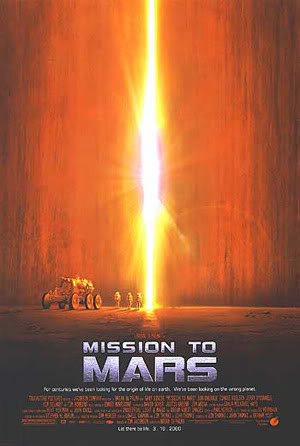
7. Mission to Mars (dir. Brian De Palma, scr. Jim Thomas, John Thomas, Graham Yost)

“Drifting through eternity will ruin your whole day.” So goes some wisdom from Brian De Palma’s marvelous spaceman thriller. Mission to Mars is practically a humanist retort to 2001: A Space Odyssey, its climactic moments dedicated to a pretty and inspiring filmstrip on biological evolution on Earth. Containing something to bewilder or sour nearly ever viewer, even the film’s final statement of wonder is marred by one badly designed transitional era CG alien effect. But all De Palma films have a little of this wonder, and no small amount of dread, as starry-eyed humans are ricocheted around a cosmic pool table along networks too daft to make sense of, dragged by forces they cannot see. Mission does, in its finale, marvel at nature, but until then it is variously spooked and awe-struck.

The climax of physical action occurs in the black void, of course, stranded between heaven and earth (well... between spaceship and Mars), safe home and unknown adventure, chilly womb and blazing death. The suspense device is of properly calibrating jet pack thrusters and conserving limited fuel supplies; the moral questions are of the same stuff: applied force, inertia, impossible choice and aiming carefully while navigating through space.

One zero G setpiece alone sees the director pushing the cinematic apparatus’ ability to organize space and time to a new plane: it is a De Palma Future. As the ship is about to enter orbit around Mars, a micrometeorite barrage perforates the hull, one space suit helmet, and one astronaut’s hand: bam, bam, bam, these are the crises in poetic simplicity, tiny rocks hurtling through infinity just to fuck up four heroes. The ensuing repair effort is a suspense scene of elaborate construction without parallel... except in the De Palma canon. Beginning with the image of atomized blood globules swirling lazily about the pristine ship, the sequence expands and flows into airless abstract 3D museum diorama. As four crewmembers undertake separate tasks in different locations and the atmosphere rapidly suctions out of the craft, their work unites the action, a seamless vignette about punctured seams. The source of the first leak is detected via the floating blood droplets, the second by a serendipitous packet of Dr. Pepper. The pieces and particles flocking in one direction to create a whole, the scene snakes through space, inside and outside, perfectly oriented in a place where up and down do not apply and time is the crucial dimension. Linked in purpose, discrete no longer, like the chromosomes sent to a blue planet from a red one, like the astronaut’s DNA model built of M&M’s, like the Dr. Pepper and the blood, like the clouds of Martian dust. Like pictures threaded in sequence, moving in time together to tell a story.


6. Dancer in the Dark (dir., scr. Lars von Trier, songs by Björk)

Old-time women’s picture hokum, nothing in Lars von Trier’s musical extravaganza holds any water or makes any sense, except that melodrama tells its own sort of truth. When the indignities and cruelties upon the innocent are piled high enough, any weeper turns into a dark comedy; tell a horror joke from the inside out, and with enough sincerity and it becomes a tragedy.

This joke is about a girl who gave and gave and a world that took and took, until she had nothing left. Von Trier has told this one before, would tell it again, and the challenge this time around must have been to test the limits of weepy excess while purging every semblance of reality: how far can either fundamental component of the film be pushed before it undoes the other? The martyr heroine is not only impoverished, abused, wrongfully persecuted and slowly going blind, but apparently suffering some intellectual disability, her every interaction and behavior exactly the kind of thing no one would do. Björk plays Selma as a walking Sacred Heart, a lived-in, humanity-stinking performance, a matted waif that one might feel compelled to slap for her own good, if she were not constantly being slapped already. The music is exuberant, aching and achey, and bitterly ironic in context. Björk’s own records thrive on a similar tension, as dance music that cannot be danced to, soaring pop as intimate and uncomfortable as crawling through the singer’s throat. As a victim/collaborator in Von Trier’s campaign, Björk adds another layer of contradiction and mystique to both the film and the art project of her public persona. For in Von Trierland, it is possible to become confused as to what is sincere or put-on, sophisticated or juvenile. Dancer in the Dark is both, of course. The kind of emotional rawness and thoughtful technique on display are simply too much work to muster up for a derisive chuckle. Dancer in the Dark is Passion play as escapist Mamoulian musical, and vice versa.


5. American Psycho (dir. Mary Harron, scr. Harron, Guinevere Turner)

Brett Easton Ellis’s gasbag novel is punctured, drained and distilled into an elegantly mean and hilarious feminist tract by director Mary Harron and her co-screenwriter Guinevere Turner. While Ellis’s method of literary satire is to stand in one place, bare-knuckled, and punch the same spot over and over and over, Harron and Turner feint and bind, slice and dice with a thin, exacting blade. The subject is manly competition and conspicuous consumption in the world of late-1980s Wall Street investment banking, the case study one Patrick Bateman and the crimes engendered by boundless privilege and ridiculous amounts of money: disconnect from humanity, ennui, failure of taste and serial murder. As a period piece takedown of extreme yuppiedom, American Psycho picks an easy target, but courtesy of Ellis there exists a graceless, hammering take on the same material, proof that this is not as easy as it looks. Whether one finds the ‘80s stage dressing deft and funny or irrelevant nearly a decade after the fact, the thesis is tied to no one time and place, a hysterical burlesque of late period capitalism careening into a barbaric dead-end, the human body made ultimate disposable luxury commodity.

The excesses of Ellis’ novel are the point, but it is more excruciating than funny or horrifying, ideas more interesting to discuss than to read. Harron and Turner’s choice to clean up the grue, besides making the book filmable, eliminate Ellis’ habit of rubbing an audience’s nose in the material. The only lamentable cuts are of Bateman’s most far-out hallucinations — being pursued by a park bench, and witnessing a Cheerio being interviewed on television — that might have strained credulity even with this most unreliable narrator. The psycho himself is alternately locked in a human skin sarcophagus, and on berserk nude chainsaw rampage. While the film is largely lodged inside Bateman’s head, crucial space is made for the voices of the women of American Psycho. Turner is tellingly cast as the only woman who laughs in the protagonist’s face. In a moment like a clear, mournful bell amidst the cacophony, Bateman’s secretary, Jean (Chloë Sevigny, earnest and breakable, good as gold), steals a peek at the boss’ diary, and finds only primitive childish doodles of mutilated women. The film still closes with Ellis’ bleak jabber (and portentous inscription: THIS IS NOT AN EXIT), Bateman’s final embrace of nihilistic abandon, brain-snapped and sweat-drenched. But the summary of Harron’s Psycho is in the eloquent, beautifully composed scene of Jean alone, confronted with the swarming, dehumanizing rage of Bateman’s notebook. Whether the crimes of the book are “real” or not, the disease behind the symptoms is the same, and lost, confused, and hurt, Jean weeps.

Bonus points for a credits sequence that prefigures Dexter's opening by 6 years.


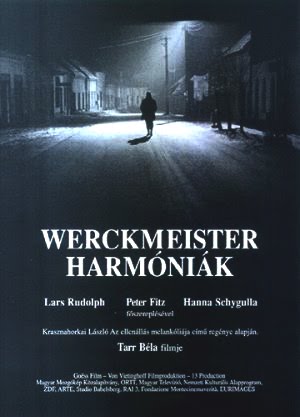
4. Werkmeister Harmonies (dir. Bela Tarr, scr. Tarr, László Krasznahorkai, from the novel The Melancholy of Resistance by Krasznahorkai)


3. In the Mood for Love (dir., scr. Wong Kar-wai)


This is a film about extraordinarily beautiful people smoking cigarettes, which make extraordinarily beautiful smoke, and looking moody, sexy and tragic while they do it.

The story of Chow Mo-wan (Tony Leung) and Su Li-zhen (Maggie Cheung) lovers-never-to-be, neighbors united because their own spouses are cheating on them with each other, is both emotionally complicated, poetically pared-down. It is speaks to many things inside those prone to heartsickness, romantic longing and indolence. Like a series of lugubrious interlocking etudes, In the Mood for Love is vague and elliptical enough, repeats variants on its own themes with such seductive rhythm as to encompass itself in forward and reverse. It is a story about how a mutual case of blue balls prolonged over the better part of a decade, combined with a propensity for melancholy, can cause the afflicted to inflate intimacy and longing into having mistimed meeting one’s one and only Soulmate. In more sympathetic light, the opposite spin: love and connection flit through our lives, prolonging defining moments with an aching sustain, and sex just has nothing to do with romance. Chow and Su torture themselves into increasingly lovely emotional and-or sexual starvation, their stated motives may be to maintain the moral rectitude and dignity that their spouses could not. Of course, this just makes their anguish more perverse, their behavior creepier and more damaged.

Should you remove the mud, and let the whispered secrets float out like scribbled plumes of cigarette smoke, there is every chance that the voice of a broken heart has nothing to say but “Oh my God, oh my God. I should have fucked her.”

In the Mood for Love is truly and deeply about how gorgeous movie stars can look while smoking cigarettes in the rain.


2. “The Heart of the World” (scr., dir. Guy Maddin)
“Heart of the World” IS:
-Six minutes and some few seconds long.
-An erotic montage-edited frenzy about the erotic frenzy of montage editing.
-A romantic evocation of the spasmic lovemaking of silent Soviet sci-fi, Fleischer brothers shorts, experimental Marxist documentary and many other sorts of popular entertainments currently in vogue with audiences the world over.
-A loving, meticulous recreation of German Expressionism and Soviet montage that looks precisely like no Expressionism or montage that ever existed.
-Absurdist redemptive melodrama about the redemption of melodrama!
-A full history of passion, love, death, resurrection, erection, economics, religion, science, sacrifice and birth conveyed in such bold, decisive strokes that it takes place entirely in hyperspace!
-KINO KINO KINO KINO!


1. Battle Royale (dir. Kinji Fukasaku, scr. Kenta Fukasaku, from the novel by Koushun Takami)

Directed by the 70-year-old Fukasku, the last great film of the millennium closes with an imperative to the young: RUN.

Japan of the undefined near future finds its economy collapsed, unemployment rates soaring and youth in rebellion. The implied fascist government instates the Battle Royale program: each year, a ninth grade class is abducted, shipped to a small island, and made to participate by slaughtering each other until one child remains standing. From this high concept, equal parts compelling and appalling, proceeds Battle Royale. The giggly, angry, black satire plot reads, on paper anyway, like a premise John Waters might have imagined, had he been born some thirty years later. Its barely-science-fiction kill-or-be-killed tale meditates on universalist themes common to Lord of the Flies, The Most Dangerous Game, and Stephen King from Roadwork to Under the Dome: the scary speed with which the body’s survival instinct kicks in when under duress, the fascinating and varied ways in which civility disintegrates and societies break down.

Battle Royale is bitterly funny to be sure; its political bite sinks deep into the luxury culture, unhealed generation gap and entertainment tastes of postwar Japan, teeth scraping bone. The premise alone is enough, an overstated, ferocious lampoon of conservative social politics, and their bad ends for the defenseless and innocent. The BR program is ostensibly created to quell the rising tide of youth discontent, but is motivated by adult failure, fear, and anger scapegoated onto the nation’s teens.

But Battle Royale does not play out as a bad taste splatterpunk comedy, a sadistic action movie or, really, in any way expected at all. The film’s main modes inside its pointed, complicated satire are rich, novelistic storytelling and quiet, sensitive poetry. The strong backbone allows Fukasku to check in with the 42 students in various combinations all over the island, and on their mysterious teacher Kitano (Takeshi Kitano, also malevolent and weary), in quick sketch intertwining vignettes. Comically blunt intertitles punctuate the deaths, but the survival game is not the heart of this story, and the rest unfolds in the oblique, haunted tone of flipping through a high school yearbook with a headfull of psilocybin.

In careful, spare strokes, the film marks out miniature portraits of its dozens of 15-year-olds. The emotionally intense reality of adolescence is so vivid that Battle Royale seems willed into existence by the resentments, heartache and irrational impulses of the ninth grade class. Still, somehow the film stands at a contemplative distance from this hormonal miasma, those love stories that are really crush stories, bullying that is really dismemberment. The abject nastiness, adorable naïveté and poignancy of teenage social interaction is observed with empathy — respect, even— and on their own terms.

In the greatest movie scene of 2000, fierce and beautiful class track star Chigusa (Chiaki Kuriyama, blood type: A) is dying. Her friend Hiroki (Sousuke Takaoka) finds her, and though freaked out, picks up the dying girl and sits with her as dusk falls. And what can she want in those final moments? What is important right then? She asks Hiroki if he is in love. And yes, he is. She asks: but not with me, right? And no, not her. Hiroki can barely stand to look. But he will stay with her. Still nervous, even with nothing to lose, Chigusa musters everything she has and... tells Hiroki that he looks cool. Hiroki gives his friend the most beautiful last moment possible, as her heart simultaneously breaks and slows and stops. He tells her: “You’re the coolest girl in the world.”

What does it mean, then, to tell a generation to “RUN”? Contemporary as its other concerns may be, Battle Royale is not an anthropological exposé on the slang, savagery and mating habits of modern Japanese youth. It is about what it is always like to be 15, what it has always been like to be 15, and what 15-years-old means to a 70-year-old man. There is nothing sweeter than catching the extremely jaded in a moment of wistful reverie.

Friday, October 30, 2009

Secret Test!: A SERIOUS MAN (2009)

NOTE: As always, please see A Serious Man before proceeding.

"As long as I learn I will make mistakes
What do I want? What do I need?
Why do I want it? What's in it for me?
It's the imagery of technology
Is what you get is what you see
Don't worry your mind
When you give it your best
One two one two this is just a test"

- Beastie Boys, "Just a Test"


A barrage of questions, then: Why is this happening? What does it mean? What are the rules? How do I behave properly? What choices are available? Which options should I take? And they culminate, really, in the one central mystery: What the fuck is going on?

Larry Gopnik (Michael Stuhlbarg, looking and acting like an ideal live-action Opus the penguin) stands on his suburban roof under slate skies and adjusts the television aerial. Signals from the aether flow into the antenna, and the man hears garbled, incomprehensible messages from the heavens. Something is coming through, and he will continue to adjust the apparatus, strain to listen and see. The mystery of existence continues, and all Larry can get in reply is blurry broadcasts of F Troop.

Negative Theology

Like a Lenny Bruce retelling of a lost Ingmar Bergman script for The Book of Job: The Movie, A Serious Man is both nightclub sick joke style riff on Jewish identity crisis in postwar suburbia and a humane and silver-filigreed parable about the reasons and methods by which we derive spiritual and philosophical nourishment through hermeneutic process; it is about the relative value of lessons relayed by allegory, of the midrash of all things, from Torah to F Troop, Surrealistic Pillow to dreams, physics to kook literature, weather patterns to collections agency calls.

Myriad troubles compounding troubles begin swarming Larry until one day, without warning, his life is falling down around him. His protesting refrain is: "I didn't do anything!/ I haven't done anything!/ What did I do?" When his wife (Sari Lennick) demands a divorce, he asks what he did, and she tells him "You haven't 'done' anything. I haven't 'done' anything." When his impending tenure is threatened by anonymous letters to the board, he can think of no reason they should have been written. When harassed by the Columbia Record Club, which he did not join, he yelps "I didn't ask for Santana Abraxas!... I haven't done anything!" The indignities and calamities come swirling up from nowhere Larry can perceive, and his only conclusion can be that God is doing this to him. Or not.

And indeed, Larry is a good man, in the best way he knows how. He is intelligent and gentle, sensitive and responsible and unassuming. What he is not is demonstrative, confrontational, brash and headstrong, those qualities that pass for heroism in contemporary protagonists. He prides himself as a rational man, a fine thing for a physics professor to be. But his rigid framing of a cause-and-effect universe makes him indignant about lack of apparent cause when his wife and her boyfriend, the sympathy-oozing, pious Sy Ableman (Fred Melamed) kick him out of his own home to live at the Jolly Roger Motel. As a teacher, Larry is accustomed to the use of stories to illustrate complex ideas. He explains as much to Korean student Clive (David Kang), who insists he understands the Schrödinger's Cat paradox; Larry counters that the "cat" is just a device for communicating a mathematical idea, and the math is the lesson. "They're like fables. To give you a picture... The math is how it really works." But as Clive tries to simultaneously bribe the professor for a passing grade and/or blackmail him for accepting the bribe (or perhaps does neither, the unmarked face of the envelope a blank screen of possibility), he seems to have grasped "dead cat" after all. Though he is familiar with the uncertainty principle and quantum superposition, Larry cannot see through the torment to apply chaos theory to his own situation (to be fair, it being the late '60s/early '70s, he'd have to be keeping ahead of the curve on his physics publications reading). The rational man is caught in a tangle; he uses the rhetorical technique, but does not do well when left to divine the lesson beneath the many signs, signals and allegories offered him. "I mean, even I don't understand the dead cat," he gasps to Clive.

The story being bent through the lens of Larry's perspective, the motivations of others are largely veiled, their intersections with Larry effectively blindsiding him. There are three exceptions, in sections of the film which swap perspective. The second most frequent point of view offered is Larry's son, Danny (Aaron Wolf), budding stoner and F Troop enthusiast who drowns out Hebrew school lessons with his transistor radio blaring Jefferson Airplane's secret message through his headphones. The Gopnik story proper begins here, inside Danny's ear canal, pulling outward into the light as "Somebody to Love" roars in the darkness, the film's leitmotif of alienation and thirst for simple salvation.

In the only other Minnesota moment entirely outside Larry's perspective, Sy Ableman drives to the golf course (even when no one is around, he drips self-satisfaction). Intercut synchronous car accidents befall both men, as Larry screams in impotent rage at the bicycling Clive and bangs up his auto, and Sy grows impatient waiting for a left-hand turn and is killed. Though (surprisingly) no one offers Larry the cold comfort that "it could've been you!," the value and meaninglessness of the sentiment that things could be worse is illustrated. Danny's life is not without problems — his aggravations include a harpy older sister, he owes his pot dealer twenty bucks, and dude, F Troop is coming in fuzzy — but he's not as bad off as his dad. And Larry does not quite recognize it, but his life is not so shambolic as his own destitute brother Arthur's (lovable gargoyle Richard Kind).

An extreme magnification of Larry, Arthur is crashing on his brother's couch, plagued by a cyst in constant need of draining, can neither hold a job nor appears to want one. That Arthur may be suffering serious psychological dysfunction becomes an increasingly likely possibility as he asks Larry's professional opinion of The Mentaculus, which he identifies as "a probability map," a Theory of Everything of his own devising. When Larry examines the little notebook, the pages roar with the white noise of madness, scribbles and equations cover every surface in mandalas of incomprehensible mathematics. Larry cannot make heads or tails of the Mentaculus. We might guess that it makes no sense, but Arthur's "system" apparently "works" as intended, and he applies it to winning at back room card games. And still, Arthur is hounded by police for gambling and solicitation and sodomy in seedy bars. Arthur understands the math and it solves none of his problems. The possibility exists that understanding the math has prompted Arthur's mental snap. While the Mentaculus appears to perfectly outline probabilities of limited stochastic systems like card games, perhaps Arthur does not think to apply its output to his personal life, or perhaps its wisdom holds no bearing when contemplating the nature of God.

Whether plagued by profoundly connected events or a designless swarm of fluke locusts, Larry cannot say. But even the shaggiest of shaggy dog stories has a structure, and the fundament of mathematical chaos is not disorder, but ungraspably complex determinist systems that can only look like pandemonium to the unaided eye. Larry may be haunted by a void of meaning, or by a surplus.

Maimonides tells us that the only statements we can make about the nature of God are statements of negation: all we may affirm is what God is not.

At the Mixer with Rambam and Rabad I: Of Advisors and Stories

Arthur does come closest to telling Larry what he may need to hear, wailing in the night at a hotel poolside freak out: "Look at everything Hashem has given you! And what do I get?! I get fucking shit!" Larry can't hear it, counters: "Arthur. What do I have? I live at the Jolly Roger."

In attempt to resolve his crisis of meaning, Larry visits three rabbis. Junior Rabbi Scott (Simon Helberg, nerve-wracked and befuddled, as if he can't believe he's a holy man) proposes that Larry has lost his perspective, and advises looking at the world with refreshed vision. Rabbi Scott is sympathetic but his empathy is stunted, and his illustration ends and begins with the temple parking lot: "... imagine yourself a visitor, somebody who isn't familiar with these autos and such. Somebody still with a capacity for wonder. Someone with a fresh... perspective. That's what it is, Larry!... Because with the right perspective you can see Hashem, you know, reaching into the world!" Larry already believes that one potential of his situation is God's presence, the other is God's non-presence, and the difference is stacking up as a narrow one. The first rabbi's advice is sound, but he does not adequately connect the dots to Larry's circumstance for the idea to get through. "Just look at that parking lot."

To put his divorce proceedings in order, Larry consults his lawyer, Don Milgram (Adam Arkin). The principles of Judaic faith and practice are philosophically framed in legalistic terms, and Larry's trips to his lawyers are conferences with moral advisors as much as those with the rabbis. Though he visits Milgram to sort out the divorce and clarify a property line issue, Jewish law — Halakhah, the path on which one walks — informs all of Larry's choices. He sees the possibility and feels the weight of every day as a series of choices, large and small, to greet seriously or ignore. Should he grant a do-over "secret test," as Clive requests? Should the family wait for Arthur to finish in the bathroom before eating dinner? Should he pay for Sy's funeral?

A gruff, monosyllabic gentile neighbor (Peter Breitmayer) begins asserting ownership of what Larry believes to be part of the Gopnik yard. Mr. Brandt asserts that the property line ends at the poplar tree. Larry doesn't, apparently, but has no counter-evidence. On neighboring, possibly overlapping territory, a blurred boundry becomes matter of interpretation, one the self-assured gentile is going to win by default. Both satirizing the degree to which these suburban Jews have and have not become integrated, and addressing Larry's concern that he is correctly interpreting the law, the matter of the Gopnik yard is never resolved: the property lawyer (Michael Lerner) up and dies before Larry's eyes without uttering a word of his strategy.

And so to the second rabbi, Nachtner (hilarious character actor superpower George Wyner), who provides two critical lessons, one in comic council with Larry and one while presiding over Sy Ableman's funeral. To Larry, Nachtner relates the half-joke half-object lesson story of The Goy's Teeth, revealed as the rabbi's one-size-fits-all anecdote for any occasion. In brief, a dentist finds the words "Help Me" engraved? grown? into a patient's lower incisors. The riddle haunts the doctor, no answers are forthcoming, and he eventually stops worrying about it and finds peace. Larry stares and gapes, aghast at what he takes to be a shaggy dog story. Though he strains to hear the essence the advice, the rabbi refuses to elaborate.

Nachtner's timing is off and Larry isn't communicating his needs. Gopnik is seeking comfort and the rabbi provides an intellectual explanation to a theological question. The answer is sound — God neither provides nor owes any explanations — but the advice is misplaced. It is not what Larry wants to hear, so he does not.

Through all Larry hears is an irrelevant, anticlimactic joke, the Goy's Teeth is, in essence, a story about unknowable mystery, its presence and purpose in our lives. In the story, Sussman the dentist guesses at a moral — should he help others? Nachtner neither confirms nor denises: couldn't hurt. There is a disconnect between this conclusion and the questions. Helping people is an action to take in this world, a way to conduct oneself which, sure, couldn't hurt. It has not much to do with the nature of God or the question Sussman and Gopnik share with Job:

If this is sign, what does it mean?,
and: Why me?

The Goy's Teeth is linked to Schrödinger's Cat and the invented folktale prologue to Larry's story. In that miniature Yiddish comedy sketch of A Serious Man, a man and wife are visited one dark and snowy eve by a Torah scholar (Fyvush Finkle) who may (or may not) be a dead man inhabited by a dybbuk. Surely not, chuckles the rational husband. Obviously so, says his deadly serious wife, and stabs the guest in the heart. But Schrödinger's dybbuk shuffles off into the night, wounded and insulted. Doomed or saved or maybe neither, the couple never learns. The snow falls on the just and unjust.

At Ableman's funeral, Rabbi Nachtner gives a stirring and warm hesped in honor of the deceased and to guide the bereaved. He explains the Jewish concept of the afterlife, L'olam Ha-Ba, the World to Come. "It is not a geographic place like Canada..." (pause for laughter), it is not about a reward of riches and physical comforts, not entirely analogous to a Christian concept of an individual dividend Heaven. Nachtner outlines at length what the afterlife is not, and offers that L'olam Ha-Ba "is in the soul of this community which nurtured Sy Ableman and to which Sy Ableman now returns."

As for the third rabbi, Marshak refuses to see Larry at all. The old man devotes his time only to religious study and briefly advising the new Bar Mitzvahs. As Larry moves up the chain of wisdom, the advice becomes more succinct and cuts to the heart of the matter, while the comfort grows slim. Marshak does allow conference with Danny Gopnik, who triumphs through his Torah reading while righteously stoned. The ancient man stares across his empty desk, quotes Jefferson Airplane and advises Danny: "Be a good boy."

Perhaps the most concise version of these esteemed commentators is Clive Park's father. As Larry protests that either Clive is bribing him or not, and he cannot be blackmailed for a bribe he isn't accepting, Mr. Park's zen reply: "Please. Accept mystery."

Job Didn't Ask for Santana Abraxas: Five-Minute Exegesis

Joel and Ethan Coen tend to favor noir and screwball comedy, genres which may be played as farce or thriller, and that take as their base the dogpiling of misery and accident onto hapless protagonists. In its way, A Serious Man is a small primer on how to read the moral philosophy of the entire Coen oeuvre. We should not mistake a portrait of an absurdist universe for nihilism. The only self-identified nihilists the Coens have placed onscreen are in The Big Lebowski, and they are dismissed as buffoons, if slightly more dangerous than the rest of a cast of buffoons.

The real point of The Goy's Teeth, Nachtner simply hands to Larry. Eventually, these nagging questions will go away, in the face of small, everyday happiness, or at least the business of living life while cosmic mystery roars in the background. The point of Rabbi Scott's advice is similarly to marvel at what portion of the universe one does understand, and to tend personal relationships and behavior in that context. Marshak to Larry: following this line of questioning ends with a life of devoted, serious Torah study, and furthermore, when you get to the top of the chain, you may find deafening silence.

In a dream — the only Coen films with no dream sequences are Fargo and Burn After Reading — Larry tells his class that the Uncertainty Principle "proves we can never really know what's going on. So it shouldn't bother you, not knowing what's going on." While it sounds good and ominous, the Uncertainty Principle does not quite say that. Sy Ableman appears and says that he does know what's going on. Though in this anxiety dream, Ableman is overstating the case, this unshaken confidence is part of why Nachtner had deemed Sy "a serious man." And they debate. Larry goggles that mathematics is proof, and the principle applies. Sy says that what happens in the afterlife, the cosmic balance of justice, is not the issue, and Larry need concern himself with present life. He says that "mathematics is the art of the possible." Otto von Bismarck said that was politics, of course: "... the attainable, the art of the next-best." Sy is talking about a place where the math cannot go.

A Simple Man opens with an epigram from Rabbi Shlomo Itzchaki, vital and most influential Tanakh and Talmud commentator: "Receive with simplicity everything that happens to you." Rashi was writing on Deuteronomy, instructing that we trust in God's plan and not strain to predict the unseeable future. Larry is not too far off in evaluating this — and The Goy's Teeth, and the Example of the Parking Lot, and Marshak's silence, and Mr. Park's koan — as "it shouldn't bother you, not knowing what's going on." It can only cause us further consternation to be ordered stop there, though, because that is a pitiless interpretation. On the other hand, one is not sure who told Larry Gopnik that Judaism involved easy answers.

So to Job.

The Book of Job shares a structure roughly in common with A Serious Man. As protagonist, a good man by most standards, a man of some prosperity, a man of solid faith, and a man to whom atrocious things happen in unceasing barrage. He kvetches and questions why, but maintains that he did not do anything to merit the treatment. At the end, a whirlwind, out of which appears a voice both frightening and soothing. In Job, God does answer. In A Serious Man, the voice is Grace Slick's.

There is a key difference between the horrors that befall Job and those experienced by Larry Gopnik. Job is bedeviled by Acts of God. Until the grand finale, Larry's problems are the result of the behaviors of other people, or his interaction with other people. The reverse implication of Deuteronomy 18:13 and Rashi's note is that while God should be received wholeheartedly, other people may be suspect. So be a good boy. You will be responsible for this on the midterm.

The climax in which God responds to Job contains one of history's most burning, beautiful and profound answers to the problem of evil and the myriad uncertainties that come part and parcel with being a living human. No hero of these books speaks to God the way Job does without being rebuked. Few of them are given such visions — and be sure, God's defense/questioning of Job is so vivid that Job sees the words from the storm.

God answers the charges against him by pummeling Job with a series of questions. "Where were you when I laid the foundation of the earth?..." That is just the beginning, as God provides a stirring account of the marvel of creation. God holds forth on the perfect system of the natural world in such poetic fashion that it sounds like even God is impressed with the intricacy of ecosystem and solar system. God speaks of a vast planet and a vastness in which it whirls, physical and abstract: "Have the gates of death been revealed to you, or have you seen the gates of deep darkness?" God plumbs the symbol-myths of human imagination: would you tangle with Behemoth, go fishing for Leviathan?

A number of points are being made and woven together in awesome rhetorical display. The universe's design is too complex for the human eye to take in at once, and what looks like hellish disorder is part of an incomprehensible system. For some of this, we may devise maths and sciences for prediction and explanation. There are those places where the math cannot reach, the place where position and momentum may be known at once, where the cat is alive and dead, we call those "God". Most vitally, the human beast lives in an amoral, unsympathetic world that is crammed with wonders, and any system of moral judgment, any divination of meaning belongs to the peculiar needs and inventions of the human mind. God's justice is not man's justice. Nature needs no justice or meaning: it is its own law and purpose.

These are majestic ideas and uncomfortable ones. Job retracts his accusations and embraces the freedom of being a creature of dust and ashes. This is not about milk and honey. Accept mystery? Good luck with that, though you don't have much choice. Here is what Larry has that Arthur does not: "You've got a family. You've got a job." As Marge Gunderson said, "There's more to life than a little bit of money, don't you know that? And here you are. And it's a beautiful day. Well, I just don't understand it." God answers Job by explaining exactly why he will get no answers: not only are the questions ill-formed, but the answer is immeasurably vast and all around him. Popular shorthand would have it that God "tests" Job, but the game is always stacked — God's playing with a Mentaculus in his back pocket and knows the outcome. Job suffers torment and vision so that we will have this story, this poem, this song about man's yearning. So you have it, I have it, Larry Gopnik has it. This is a far cry from "it shouldn't bother you, not knowing what's going on."

We need these stories, because it is hard to just remember the math parts of the lesson during the test. "...[T]hey're illustrative. They're like, fables, say, to help give you a picture. An imperfect model." One can even walk away from a story about persistent inscrutability, only to be frustrated by how life makes no sense. The vision God gives Job is powerful enough to affect the man's spiritual refinement, but it too is an imperfect model, the totality being an infinity that cannot be squashed into language. Believing he can master the math and evacuate all secrets, Larry does not hear the voice. As Dick Dutton of Columbia Record Club says, "we can't make you listen to the records, sir."

Danny listens to the records, and stepping out of Marshak's office, onto the path of the serious man, he faces down the Whirlwind. The awesome, fearful black chaos of a tornado — or does it just look like chaos to us? — rips through darkening skies, the Airplane jangles and bellows. In the moment of pain and fear, philosophical and theological argument dissolve into abstracts and human yearning takes over. You want to know why it picked you? If you're being tested? Want to know what it means? Want answers? Or... don't you want somebody to love?

In a universe lacking in inherent, built-in meaning, our task is to forge our own meaning. A Serious Man is the world as a terrible, beautiful parking lot. Just look at that parking lot!

Thursday, September 03, 2009

For Bravery: Das Unheimliche and INGLOURIOUS BASTERDS

ACHTUNG!: You are not stepping into a movie review. Readers proceeding beyond this point should have already seen Inglourious Basterds, expect no plot summary, and require no protective gear for the RAMPANT, CONSTANT SPOILERS AHEAD

* * * * *

In 1941, Jack Kirby and Joe Simon decided that the cover of Captain America #1 would be Cap coldcocking Adolf Hitler. Like so many Golden Age comics luminaries, Kirby was Jewish. Joe Simon is Jewish. They wanted to see Hitler's face smashed in. And if not, they correctly guessed that their audience wanted to see the Nazi leader cracked in the mouth.

A plot strand in the tapestry of Inglourious Basterds directly concerns the exploits of a mini-platoon of Jewish-American soldiers on a secret mission through the European Theater of Operations: to cause as much havoc as possible behind enemy lines by brutally murdering and desecrating the corpses of as many German soldiers as possible. All its stories eventually converge in a blazing, startling, shrieking climax of Nazi-immolating carnage.

This material -- the adventures of Captain America and the Inglourious Basterds alike -- in its simplest reading taps a nearly universal vein of desire to see modern history's designated greatest villains met with violent pretend retribution. Arguments to the contrary are probably futile. We never see the Basterds or Shosanna Dreyfus behave or react to the world in any particular way reflective of the Jewish experience, but their ethnicity is fuel for the plot engines and bolsters the righteousness of the murders and mutilations that serve as the only twisted justice of the Inglourious Basterds universe. Whether the world Jewish community does or should savor this with any relish is likewise up for grabs.

Whether there is ever such a thing as an uncomplicated, cathartic and healthy revenge fantasy is an eternal mystery.

Inglourious Basterds crams into a punishingly short 153 minutes nearly every family, genus and species of narrative possible in the order of World War II films. All that is noticeably missing are hand-wringing Holocaust melodrama and the large-scale battle epic -- in other words, the predominant subgenres still being made in our era. But they are there too. Both are hover over Basterds in subverted, negated spirit, conspicuous in their absence (the home front drama is accounted for in a particularly wonderful and, sadly, deleted scene, three minutes of backstory on the trademark baseball bat of one Donny Donowitz). The battalion of misfits adventure tale ("men-on-a-mission" says Tarantino: The Dirty Dozen, The Dam Busters, and yes, Inglorious Bastards), to stories of artists engaged in ideological resistance fighting (The Last Metro, To Be or Not to Be, Cabaret), every kind of WWII movie is there in turn or at once. Some stake a claim to major plot points and concrete screen time like the espionage thrillers (Foreign Correspondent, Notorious) that inform the spygames of the La Louisiane sequence...

Some WWII-themed subgenres merely flash by in an off-hand visual or verbal reference, but some infect/inform/form the very heart of the film without speaking their name. A comic horror insert shot reveals Josef Goebbels banging his translator, and the majority of "Chapter Five" drips with decadent Third Reich taste in arts and decoration, as Goebbels commandeers Dreyfus' theater for a film premiere. From the wincingly confused purpose of cheapjack sexploitation films like Love Camp 7 to their arthouse grandfather in Visconti's The Damned to (maybe most of all?) Tinto Brass' line-straddling, conundrum Salon Kitty, the least reputable strain of WWII drama holds its own peculiar power, and Tarantino wields it handily in his own war epic. The unique gift of Nazisploitation is the efficacy of a perverse moral bewilderment. The chromosomal anomaly of Nazisploitation films slowly mutates the genetic makeup of Inglorious Basterds, warping its form into a great mad, startling beast. As Inglourious Bastards' final chapter escalates, its plot convergences become inevitable as surely as they become unpredictable, as it makes definitive, unashamed break with historical record -- the movie will not hide in an imaginary unspoken pocket of history -- and it erupts with a black, irrational tone of hysteria and hallucination.

With Jonathan Rosenbaum accusing the film of being tantamount to Holocaust revisionism and other critics rendered helpless with inarticulate rage, difficult questions are posed: why do these strong reactions from detractors proceed from a viewing experience entirely alien to those who admire the film? The semi-approving assert that a kind of shallowness and movie-headed retardation of vision are the core and limit of Tarantino's purpose.

The gripe springs eternal:

"Those who like this film do so because it doesn't seem to have anything to say and renders the cinematic experience as pure play. Those who dislike it dislike it for the very same reasons, seeing the deliberate cool superficiality of Pulp Fiction as a symptom of the empty post-modernity of our age."

"Like the allusions in the film, Pulp Fiction itself is either a film you get or you don't. Some people luxuriate in its meaninglessness, some people find its meaninglessness to be the symptom if not the origin of major social ills, others find a meaningfulness in a message of redemption"

-Dana Polan, BFI Modern Classics: Pulp Fiction

With nearly sixty years of fiction devoted to how very much Nazis have it coming, why single out Tarantino's film? If it is because his stories crackle with aestheticized kick and poppy frisson, what do the same critics make of Basterds-inspiring tough guy fantasia The Dirty Dozen itself? Certainly it is just as difficult to argue the moral rectitude of The Great Escape, to say nothing of a sitting duck like Ilsa, She Wolf of the SS. Jim Emerson makes the agreeable but problematic comparison to Warner Bros. cartoons about Bugs Bunny tormenting Axis powers with Brooklynite pluck -- implication being, if it is all a cartoon, not to take it seriously... even while he takes the movie pretty seriously. It's the reading method of the Dana Polan BFI volume above: "Those who like this film do so because it doesn't seem to have anything to say and renders the cinematic experience as pure play." This hardly accounts for any viewers deeply moved in the heart or powerfully stimulated in the head by Basterds (or Pulp-- I guess, given Polan's two options, we don't exist or are mentally unsound?), but also ignores that the men of Termite Terrace were living through the historical moment. They worked out their own concerns through their art form and were tasked too with boosting homefront and battlefield morale. Little entertainments can shoulder big responsibilities.

Why pick on Tarantino? is a good question indeed, when after six features the complaints hardly waver. On one hand, Tarantino invites it, on the other hand, clasped with the first, the critical establishment has a stubborn unwillingness to budge. The paradigm is set as to What to Do with Quentin Tarantino and has hardly been revised.

Top dirty names to call Quentin Tarantino: Nostalgia Hound, Magpie, Trainspotter, Sadist... Cinephile.
This, although his view of cultural history is neither as blinkered and sentimental as Spielberg at his most nostalgic or cynical as Spielberg at his grumpiest. Tarantino's bricolage is nowhere near as pervasive, disruptive and dizzying as Joe Dante's -- indeed Dante's major theme is the hollow, brain-numbing echo chamber of disposable culture bouncing off itself, while Tarantino's is, simply, not. We all speak daily, openly and actively about popular culture and our experience with it. Many of us do so more than Tarantino characters. Why should Movie People be deprived of a cultural frame of reference? In Basterds it is particularly fun to watch the scope of direct dialogue references narrow with a 1941/45 cut-off point, even if a joke about Lilian Harvey is greeted in packed theaters with exactly one laugh. In-jokery is, of course, free to associate across time at whim, and name-dropping Emmanuelle, and the real world Hugo Stiglitz and Antonio Margheriti tints the picture gently, it indicates the company Inglourious Basterds wants to keep, names its secret gods.

And there it is again, again, that perpetual bugbear, The Violence. So why single out this filmmaker, who's made nothing so bloodthirsty as Rambo III or City of the Dead? He courts it. Asks for it. Engages when provoked, and seems to argue back on film. An apologist would, after Reservoir Dogs and Pulp Fiction, make the realistic case that the violence of those films is substantially less graphic than its liminally felt impact -- a strong case in point of the filmmaker's prowess (and the Psycho Shower Scene Argument) -- only to be greeted by the 1-2 punch replies of the relatively bloodless Jackie Brown and unmatched mayhem of Kill Bill - Vol. 1. The critic's hand is forced. Either deal with Tarantino seriously or be doomed to rehash the same complaints endlessly.

That the living tissue of his cinema is a successful graft of 10,000 movie donors should be particularly appealing to film critics, who more than any of us live with perpetual projector bulb tan and a Geneva Drive tattoo over the heart. What Tarantino does by crafting the fabric of cinema history into fully wearable new garments is not dissimilar to the life's work of Brian De Palma and Jean-Luc Godard. Tarantino is less black-hearted than De Palma, less politicized than Godard, less schematic than either. To single him out for ridicule as a filmmaker with film itself as a ruling thematic concern is bizarre. Most of Generation X's directors don't even have ruling thematic concerns.

Tarantino is not without his authorial tics. He punctuates suspense with hyperfocused extreme close-ups of food, feet, arcane detail, peers out of car trunks incessantly, frames characters in doorways and crams metatextual declaration into dialogue. But his technique possesses no faddishness. In an age where most directors flatten their visual field magazine cover thin and alternate between big head TV close-ups and impotent camera flailing, Tarantino composes for the entire frame, constructs screen geography by holding shots as long as possible and, in Basterds in particular, uses deep focus to impart as much information as possible in a shot. Take some time with the scene in which Zoller pesters Shosanna in a cafe. She just wants to smoke, sip coffee and read, but the soldier tries his damnedest to chat her up, fending off her rebukes and disruptions from ardent fans, then recognizes the opportunity to impress the girl with his celebrity. Tarantino places Shosanna by the storefront window and keeps everything mostly in focus from the woman in the foreground to the buildings across the street. Sidewalk pedestrians recognizing Zoller are fully visible as they move from exterior to interior space, and several interlocking stories are being told at once.

Inglourious Basterds luxurates in the pleasures and pains of the movies and meditates on film as a force shaping our lives, interior identities and human history. That second clause is the writer-director's great step forward in his sixth feature, though his concerns have not changed, they are articulated with emphatic force in Basterds. The breadth and depth of reference is impressive by its own right, but less canny filmmakes pull similar, less encyclopedic stunts all the time: naïve accumulation of a hundred years of film cliché may also cause the sensation of a thousand films overlapping on one screen.

A headspace is established for the film: that we are in Movieland, in Movie History where Movie People operate on Movie Rules. This is not the same as saying the film operates with weightless unreality, that situations are not serious in any way. Inglorious Basterds then does a service to all war films -- indeed, all films -- from the earnest propaganda documentary modes of Why We Fight to the studio-slick entertainments of Casablanca. All movies are movies. That Tarantino is not embarrassed to say so does not make his films shallow exceptions to any rule or inherently frivolous, but exceptionally honest, generous, grateful for the cinema, grateful to be of the cinema. The notion does not strip art of importance but return it in kind, separates art from the stifling, impossible, dishonest illusion that its function is/should be/can be to duplicate reality. And of all words in the above that should be bracketed by a good post-modernist's set of quotation marks, it is "reality." When we're at the movies, regardless of how naturalistic the performers or fantastical the scenario, every movie is equally unreal. And every movie is real in and of itself.

Rosenbaum's complaint, once he deigned to (sort of) elaborate, seems (?) to be that Basterds makes the Holocaust "less real". Putting aside that it is not a Holocaust film (nary a concentration or extermination camp is seen or mentioned), and that the purpose of the film may not be to deepen an audience's understand of historical fact -- and do note, those are large, potentially crucial blocks to "set aside" -- the opposite may be true, even if Bastards is read as puerile revenge fantasy. The film does not establish Hitler's Final Solution in any exposition, and depicts persecution of occupied Europe's Jews mainly to set up Shosanna's plight. Basterds requires foreknowledge of history, presumes an audience understands facts of the Holocaust. The rage of its characters, the machinations of the plot, the purpose that fuels the film's passions all operate on the assumption of an audience for whom the the Holocaust and a war against fascist, antisemitic enemies are very real, and that a basic set of feelings are shared on the subject.

There are stories of violent revenge, retribution and score-settling, professional and private, in all Tarantino's features as a director, and most of his screenwriting. One of the basic reasons we go to the movies is their bottomless capacity for wish fulfillment fantasy. It is a shade of escapism, or perhaps vice versa. These wishes and their cinematic granting may be base, cathartic, pathetic, unarticulated, mysterious or unhealthy. The movies provide a potentially powerful and relatively safe arena for working it out.

One of the fascinating things about The Parent Trap, for example, is its bizarrely naked fulfillment of a fantasy harbored by children of divorce, that Mom and Dad will reconcile -- that they can be forced to reconcile. When given some thought, surely no one would want their own children clinging to the desperate, futile hope, wallowing in the stunted, immature understanding of relationships, or the practicing the conniving and cruel schemes of Sharon and Susan to reunite their parents. And yet adults made the film. It is irresistibly sunny and extremely incorrect at the same time, with no hope for the faithless to say it is charmless or unfunny or the faithful to untangle it.

Genre cinema's most basic scenarios all run on this principle, a chance to experience the romantic comedy courtship ideal, to explore and adventure beyond one's backyard, to be a cowboy, a fireman, an astronaut. But it's always more complicated than that, and where there's tension, things get interesting. Horror films are particularly good at this: genre theorists are constantly telling us that we attend to identify with a murderer or monster, to sate some primal bloodlust, to vent some dark steam pushing against our interior walls. Even more basic, though, deeper, stranger and unsayable, we are afraid and exhilarated because we identify with the victims. We get to watch ourselves killed, over and over, to die a thousand make-believe deaths that we may understand our own.

A principle pleasure of Tarantino's films is the shape of their stories ( and say, then, if we speak of "content" or its "form"? The form of a movie is its content). His wooly-souled tales are electrifyng because truly anything can happen and we're aware that the storyteller holds no fear of Going There. Anywhere -- to the pawnshop basement, into Mia Wallace's heart, or to loop back into its own first scene. Pulp Fiction's scheme is that each sequence will end up 1000 miles fom where it began. Reservoir Dogs and (the original screenplay for) True Romance rupture the tail end of each sequence with sudden violence and/or surprise revelation, carefully parcelling out information by jumbling chronology. Jackie Brown is a series of games in which characters outsmart one another, cards held against chest so the audience cannot know who will win each match or if it will end in a flagrant foul. Kill Bill, Death Proof and Inglourious Basterds are structured as strings of conflict with nearly self-evident resolution, giving off an unbearable heat of suspense because we know they will end but cannot tell when.

Basterds is specifically a series of interrogation scenes. It is practically a field guide to variations on human conversation as interrogation: police questioning (Landa and LePedite), meet-cute flirting (Zoller and Dreyfus), job interview (Goebbels and Dreyfus --> Dreyfus and Landa), briefing (Churchill, Fenech and Hicox), debriefing (Hitler and Butz).

In the structural tour-de-force second Chapter, "Inglourious Basterds", Tarantino loads all his storytelling guns. In nested scenes of characters telling stories to one another, the chronology gradually burrows at least four layers deep, then claws back through to the other side. Hitler meets with Pvt. Butz --> who recounts his platoon's encounter with the Basterds --> which pauses for the backstory of Hugo Stiglitz --> which begins with a newspaper photo of the thirteen Gestapo he killed --> which leads to mini-vignettes highlighting the killings and Stiglitz's Basterd recruitment - at which point we are four levels down. The film is artfully, breathlessly driven to distraction by the infinite possibilities of story itself. The chronology then collapses back into position, all efforts focusing for impact as Butz raises his cap to reveal his swastika scarification. Then, a signature flourish: how'd Tarantino get so good at this? Same way as Aldo Raine. "Practice!"

All of Tarantino's films have been about the way identity is little but accumulation of stories about ourselves: the stories we tell about (and to) ourselves, the stories we tell about each other, the stories the world tells about us, the stories that are us. Reservoir Dogs is about scumbags and weasels playing at being men of honor and lions. Natural Born Killers and True Romance play out as mirrored halves (and were, in long ago drafts, likely retrograde counterpoints). In True Romance Clarence and Alabama bluff their way into legend, pretend to be Bonnie and Clyde until it comes true, while in Natural Born Killers Mickey and Mallory abandon all civilization for primal violent impulse, and marvel as the media inflates their atrocities into the American myth of individual freedom and integrity; the same thing happens to both couples, but inside-out. You can't help but end up a story. Jackie Brown is endless circles of everyone duping one other, which, naturally, involves nigh constant subterfuge and reading of other players' strategies. In Kill Bill everyone truly is the badass world-shaking giant they appear to be, but also rifle through indices of identity until they find the person they need to be. Vol. 1 establishes their legends, Vol. 2 deconstructs them, the vital layer being that the story The Bride tells herself of a mission of revenge melts away to reveal the story of Beatrix Kiddo's rebirth and redemption. Death Proof and Inglourious Basterds alike reconfigure and take hard looks at the purpose and meaning of exploitation film iconography. And in Pulp Fiction everyone is telling stories all the time, projecting and revealing themselves, bulding the world with talk, rumor, joke and anecdote, their constant chatter a meticulous network of meaning.

Espionage and fugitive drama being Inglourious Basterds' orders of the day, everyone is lying, acting, or hiding something, every character both themselves and a story about themselves. It is a film very much about mythmaking and performance. In the schematic marvel of the La Louisiane sequence, multiple layers of playacting converge and quarrel as a frivolous bar game variant on What's My Line? endangers the deadly serious acting of undercover agents impersonating German officers attempting to rendezvous with a double agent -- herself an actress and the scene's fulcrum of teetering make-believe.

Even Aldo Raine and his Basterds, who cannot abide that Nazis may escape anonymous into history and make it their mission to brand the living enemy and desecrate the dead, in their primary function as a guerilla terror unit are spreading a story. The Basterds constitute a bogeyman legend to ripple through the psyche of the German ranks. Until conscripted into Operation Kino, their usefulness as a story is understood to be larger than the mayhem they could cause by hand. Meanwhile, "Jew Hunter" Hans Landa's tactics include two powerful weapons which do most of the work for him: the reputation which precedes him, and the air of confidence that implies he already knows your secrets. These are sharpened and on display even when in non-detective mode, as when discussing theatre security issues with a petrified Shosanna.

Landa and Raine both open their major introductory dialogues by asking the interviewee what they know about the dangerous reputations of the interrogators. This paralleling gives a good indication of what Tarantino is up to at the heart of his vengeance stories.

There are only two setpieces in Inglourious Basterds focused on the violent destruction of Nazis, and both are complicated, designed to be more felt on a phenomenal level than understood intellectually. Because here it is: What Inglourious Basterds does spectacularly well is imbue its adrenalized violence with a feeling that is utterly weird. It is uncanny. Something feels panicked and wrong and it is difficult to pinpoint what or why. Tarantino's last two films periodically shifted into similar discordant tones, and such sustained irrational dread is only matched onscreen by Dario Argento's heyday run of films from 1975-1985 and David Lynch whenever he feels like working.

In the first of these setpieces, the Basterds question then beat to death one Sgt. Rachtman. It is giddy and sweat-beaded as a suspense sequence, for the same reasons as the needle-to-the-heart climax of "Vincent Vega and Marsellus Wallace's Wife": a dire situation played as slapstick sick joke, a surrogate audience laughing themselves queasy with anticipation, a poised weapon completely apropos as metaphor for the physical sensation of the scene itself. The scene is inherently conflicting, but in the key exchange, Sgt. Donowitz demands of Rachtman: "How'd you get that medal on your chest? Killing Jews?" And the answer: "Bravery." And when Rachtman's head caves in, we know he had this one virtue at least, and that he died wearing a Nazi uniform. Brett: "I'm sorry things got so fucked between us and Mr. Wallace." Mr. Pink: "I'm acting like a professional!" Sgt. Werner Rachtman: "Bravery." Bang. Bang. Bang.

Chapter Five - "Revenge of the Giant Face" grows increasingly unsettling as it shifts into the Salon Kitty-styled décor of Shosanna's violated movie palace, but the sensation that something is off begins earlier, as David Bowie's "Cat People (Putting Out Fire)" throbs and laments over a Suiting Up montage in which the weapons are film reels and the warpaint and uniform are the gowns and makeup required for a movie premier. The bold musical selection is proving to be a sore spot with some viewers, but even those who admire the audacity of the loud intrusion of a 1982 goth-glam track into the audio space of a period film might consider that a) by this point either Basterds has one in its grip or does not, and b) the Bowie track is not any more or less anachronistic than the repurposed Morricone cues that score the rest of the film. Or more "fair" or "correct" than the Billy Preston music, or any of the music, for that matter -- little to none of the score is authentic in period, instrumentation or style.

An omniscient, or at least very informed narrator provides expositional assistance once in awhile. In a neat trick straight out of Suspiria, that narrator is never identified, and eventually disappears altogether (Argento's version is even scarier: his narrator only speaks once and provides no particularly useful information). Innocuous (and cool, because it's Samuel L. Jackson's voice) while on the soundtrack, but ultimately ominous, because at any point in the film we may remember that extra-dimensional layer, that voice from inside-outside the Story, and realize we have been completely abandoned.

Shosanna and the Basterds blow it up, the pretend reflections of Reich leaders and Nation's Pride, the pretend film within this film, some stories just too evil to be allowed to walk the earth, and this is not an anti-revenge story. Most of the baddies aren't in uniform, but evening wear. They aren't currently ranting and spouting arguments for eugenics and totalitarian politics but screaming in fear and scrambling for their lives. If we desired a horrible, spectacular demise for these villains, this is certainly a horrible, spectacular demise. The climax graphically echos an extermination camp gas chamber but the crucial referent is the finale of Carrie.

The moment Carrie goes PK-A-bomb is a dozen climaxes at once, and De Palma's film multiple orgasms all the way to the credits. In disorienting, crashing waves the outsider's revenge story culminates, a tidal force of cleansing female power washes through, and everything goes completely berserk. Carrie White is transformed, an inhuman avenging angel, out of (self) control and channeling a righteous flame. She is a supernatural wrath straight out of Revelation. And we want to see this, want the dipshits who tormented Carrie to burn, but it is also the film's apex of horror. Carrie's prom sequence is satisfying, scary, brutal, several other adjectives and exhilarating all at once, and those are not incompatible feelings. They don't cancel each other out, and this is a secret to the film's spooky power. No one should walk out of the film feeling guilty or complacent.

A swastika Zoller whittles into his sniper's perch in Nation's Pride rhymes with the Basterds' nickname carved into a rifle butt, and of course, Raine's handiwork across the foreheads of surviving Nazis. These echoes draw disconcerting parallels, connect ideas to be compared, but do not necessarily imply coequals. Continually complicating matters are glimpses of common human experience peeping through holes in Nazi uniforms: the one-word story of Rachtman's Iron Cross, an off-duty soldier celebrating his child's birth, Landa's disarming dorkiness beneath his hard, smooth legend. In the person of Pvt. Zoller, this stinging theme is distilled. He thinks he and Shosanna are in a romantic comedy, plays his role with much charm and confidence. At the Nation's Pride screening then, what is it that makes him flinch, avert his eyes, abandon his seat? Embarrassment at his performance? Pain at the memory of taking hundreds of lives (his explanation)? Pain that it took the power of cinema to make him feel the weight of those deaths; that his favorite art form had turned on him? Or the crushing realization that he is not in the movie he thought he was in? In Zoller's defining moment, he disrupts Shosanna in the projection booth, tries to play romantic lead one last time, is pushed too far, and threatens to assault her. He feels entitled, as occupying force. Human, certainly, and a G.W. Pabst fan to boot, but the equation is unbalanced: he's a human being that has irrevocably chosen to throw in with the Nazi Party. There are, in the end, those things Nazis believed, things they did, which cannot be made up for by doses of charm, frailty and circumstance. Things get complicated, Inglourious Basterds admits, but some of the identities we flicker through stick with us and muck up all the others. And Zoller's a Nazi.

Rachtman and Landa are both indignant that the Basterds do not play by War Rules, that they hold their enemy in contempt. They're right, as far as it goes, and as far their indignation is not coupled with oblivious arrogance. Rachtman is unrepentant to the last, thinks he is going down with dignity and a soldier's honor. Things get complicated, but ultimately, Sgt. Rachtman goes down as a Nazi with his head caved in by a baseball bat.

Landa is so amoral as to edge into anti-moral. During a boast that he does not hate Jews, and is possessed of the amazing ability to "think like a Jew," it may never cross his mind that if he could truly think like a Jew, he would not hunt them down for the Party. It is just part of a story: he's the Jew Hunter. He's a master detective. He's an SS Standartenführer, a multilinguist, a saboteur, a turncoat and a war hero... and oops. One of the stories Landa has chosen to occupy drowns out the others. And as Landa is the last Nazi standing, Lt. Raine has one final piece to sign before the gallery hanging at Nuremberg. In a film about faking it until it's real, about verbal sleight-of-hand, and the ability of a great storyteller to be anyone he or she wants to be, what Aldo Raine has done is decide Hans Landa's story for him.

As Operation Kino bursts into bloom, Inglourious Basterds makes its most startling connection. The association is self-critical and self-congratulatory, it's funny and scary, it's honest and false, it's everything Tarantino's critics hate in his work and everything they see missing, it is the surface and it is the core. Adolf Hitler is at the movies, a violence-saturated piece of propaganda about the romantic legend of a tough guy bringing down an abstracted enemy for the audience's satisfaction. Hitler laughs and rollicks and he gets really into it.

Before anyone could reasonably begin processing what this means, that Tarantino has willingly drawn connection between his imagined audience and a theater full of Nazis, and thereby implicated himself, Sgt. Donowitz steps in, grim triumph, revulsion and deep psychosis spilling out of his eyes, and demolishes Hitler's skull with a machine gun. Pulped. Things are complicated, ethical ideologies are diced, stirred, simmered and in the critical moment, a choice is made. A fantasy of vengeance is not the same as a wish for justice, as moral instruction, as poetic justice, as a prescription for behavior. It may be weird, it may not be the voice of our better angels, but it is a real human impulse. Choose your stories wisely.

The final German Night in Paris is a similar brand of unsettling as Carrie's last stand: the phantasmagoric theater of destruction is presided over by Shosanna's manically laughing giant face. She is made of smoke and light, wreathed in flame, a cinematic godhead. She shapes history. She demolishes history. She is producer, screenwriter, actor, director, editor, distributor, exhibitor, projectionist and projection.

And Shosanna is a film critic. She programs her theater with her heart, sneers at Riefenstahl's politics, counter-programs with Le Courbeau, and cannot abide smears on G.W. Pabst's art even in the face of what she has been through. Because she's from France, and perhaps it is a France of the cinephile imagination, but in her country, they respect directors. In France, things are different. They got the metric system. They wouldn't know what the fuck a Quarter Pounder is.